

Revenue leakage is money a business should earn but fails to realize because its pricing, sales, payment, or operational processes break down. For an ecommerce owner, investigating it means looking beyond unpaid invoices to the decisions made between attracting a buyer and keeping the proceeds.
Your marketing team sees orders. The warehouse sees parcels. Finance sees deposits. Each view can look reasonable while the complete order tells a less comfortable story.
This guide examines twelve areas where that happens, including reporting across multiple stores, inventory, and customer retention. It also separates missing revenue from avoidable costs and potential lost sales, so you can investigate the whole business without counting every expense as a leak.
What counts as revenue leakage in ecommerce?
Revenue leakage occurs when a process prevents a business from realizing revenue it was entitled to earn. Undercharging, unbilled transactions, and unresolved collections are direct examples. Related problems in advertising, packaging, inventory, and returns can erode profit or future sales, but need different evidence and measures.
The distinction matters when you decide what to fix. A missed payment needs a collection check; an expensive parcel needs an operational comparison; a lost customer needs an explanation and a test.
Use three categories in your investigation:
| Category | What belongs here | How to establish the impact |
|---|---|---|
| Revenue shortfall | An agreed charge was omitted or not collected | Match approved terms and fulfilled obligations to billing and final payment records |
| Avoidable margin loss | An unnecessary cost or concession reduced the money retained | Compare actual cost with a feasible approved alternative at the same service level |
| Lost sales opportunity | A stock or customer experience problem may have prevented purchases | Use customer evidence and controlled tests; do not treat projected sales as cash owed |
Definitions in business writing vary. Stripe’s revenue leakage explanation includes pricing, billing, and contract gaps. This guide keeps the wider operational investigation, while naming which kind of loss the evidence supports.
Where should you look for revenue leakage?
Start where a decision passes between teams or systems: a promotion becomes an order, an order becomes a shipment, or a refund reaches one report but not another. The twelve areas below connect those handoffs to records, responsible teams, and checks you can repeat.
1. Price leakage: pricing and promotion gaps
A supplier raises its price. Your merchandising team raises the selling price to protect margin. Marketing then includes that item in a promotion based on the old economics.
McKinsey describes this exact conflict in its pricing and promotions analysis. The weakness is the handoff between two decisions, even when each person follows their own target.
Look beyond the discount shown on the product page. An order can also carry a welcome offer, free delivery, a partner commission, or a later service credit.
Check: Put the current product cost, actual selling price, all discounts, and relevant order costs together. Compare the result with the promotion’s approved goal and margin floor.
Owner and control: Pricing and marketing should approve the combined offer using current costs. Separate an intentional acquisition subsidy from an unintended concession; a discount that worked as planned is not automatically leakage.
2. Marketing leakage: spend without enough additional profit
A campaign can receive credit for an order without causing it. That distinction matters when you repeatedly pay to reach existing buyers who would have purchased anyway.
In a 2014 eBay field experiment, researchers found paid-search effects were smaller than conventional estimates suggested, with important differences between customer groups. That result belongs to its setting; it does not establish that brand advertising is ineffective for every store.
There is a second problem: an attributed purchase can later be returned. Google Ads supports retracting or restating conversions after cancellations and returns. Check whether your integration already sends those adjustments before adding another process.
Check: Compare retained sales and contribution by campaign and product mix. Where traffic and measurement allow, use a properly designed holdout test to estimate additional demand, rather than treating attributed revenue as proof.
Owner and control: Marketing and finance should agree on the costs, return window, and decision rule before increasing spend. High return on ad spend (ROAS) can coexist with weak contribution after product and fulfillment costs.
3. Affiliate leakage: commissions and discounts without clear added value
A partner can earn credit near the end of a purchase journey even when the buyer arrived through another channel. If a coupon interaction triggers both a discount and commission, assess the combined cost against the partner’s actual contribution.
That pattern is a reason to investigate, not proof of fraud. impact.com’s promo-code documentation explains how tracking codes and credit policies affect attribution, and how code-specific exceptions can change payable commission.
Check: Match the order to partner interactions, the code used, commission, customer purchase history, and later cancellations or refunds. Separate payment outside agreed terms from a legitimate commission whose incremental value needs testing.
Owner and control: Partnerships and finance should review code distribution, credit rules, and refund treatment against the partner agreement. Do not withhold an earned commission simply because the last interaction occurred at checkout; attribution alone cannot prove whether the partner caused the sale.
4. Checkout leakage: buying intent blocked before payment
A shopper can select an available product and still fail to buy because the checkout breaks, delivery is unavailable, or the final cost arrives as a surprise. This is a potential sales opportunity lost before a collectible obligation exists.
Baymard’s checkout research distinguishes ordinary browsing from friction such as unexpected costs and complicated checkout steps. Treating all abandoned carts as recoverable revenue would ignore that distinction.
Check: Segment checkout completion by device, browser, payment method, and delivery region. Reproduce suspected errors, check shipping eligibility and cost disclosure, and follow payment attempts through to later successful purchases.
Owner and control: Ecommerce and engineering should own technical failures, with operations responsible for accurate delivery options. Test fixes against completed orders and contribution; a lower abandonment rate alone does not establish how much additional revenue the change caused.
5. Fulfillment leakage: packaging and shipping costs
A packaging decision changes more than the price of a box. FedEx can bill using the greater of actual and dimensional weight, which reflects the space a parcel occupies.
Shopify also documents later shipping-label adjustments when declared measurements or packaging do not match the shipment. The original label quote may therefore understate the final cost.
Inventory placement adds another layer. One basket may become two shipments because no location holds everything. Shopify’s routing rules can reduce splits but cannot eliminate them in every situation.
Check: Join each order to its parcels, sealed dimensions, final carrier charges, packaging, pick/pack charges, and replacements. Group exceptions by product, package type, location, and destination to find recurring causes.
Owner and control: Operations should test the complete alternative. A smaller box that increases damage, or consolidation that requires an expensive stock transfer, may leave the business worse off.
6. Returns leakage: preventable returns and incomplete closeout
A refund completes one part of a return. Someone still needs to inspect the item, decide whether it can be sold, and record the resulting costs or write-off.
ShipBob’s returns workflow separates inspection, grading, disposition, and financial closeout. It also identifies product information, fulfillment accuracy, and packaging quality as controllable return factors.
Check: Connect the reason for the return to the original product, warehouse, package, and delivery. Then trace return shipping, replacement shipments, handling, and the item’s final condition.
Owner and control: Support and operations should investigate recurring reasons together. Repeated wrong-item returns call for a picking fix; repeated sizing complaints may need better product information.
Keep legitimate returns separate from suspected abuse. If an item returns to sellable stock, do not also count its full product cost as a permanent loss without accounting for the recovered inventory.
7. Collection leakage: fulfilled orders without collected payment
An approved payment is not always a collected payment. In a manual-capture workflow, an authorization can expire before the merchant captures it; Shopify explains this distinction in its authorization guidance.
Subscription businesses have another blind spot: the renewal may never enter the failed-payment queue because billing did not start. WooCommerce documents how scheduled-action failures can prevent renewal orders from being created.
Check: Compare fulfilled orders with final captures, and expected renewals with generated renewal orders. Follow retries through to the final outcome so one failed attempt does not become a separate loss after payment succeeds.
Owner and control: Operations, billing, and finance need an exception owner before capture or renewal deadlines pass. Confirm approved payment terms, grace periods, cancellations, and source status before asking a customer to pay again.
8. Recovery leakage: unresolved credits and reimbursements
You refund a buyer for a lost parcel or write off warehouse stock. The customer issue is closed, but an eligible reimbursement may still be unresolved.
Amazon’s US FBA reimbursement policy covers qualifying lost or damaged inventory, subject to eligibility and valuation rules. That does not mean every incident is covered or reimbursed at the retail price.
Check: Match each incident to its supporting evidence, applicable policy, claim status, replacement, credit, and any later reversal. Verify that payment has not already arrived before raising another claim.
Owner and control: Assign a person to the financial closeout, not just the customer response. Record the applicable deadline from the actual carrier, marketplace, or warehouse agreement; there is no universal claims window.
9. Reporting leakage: disconnected stores and payment sources
Here, reporting leakage means gaps in visibility that let losses continue. A dashboard mismatch does not itself prove money disappeared, but it can hide the product, store, or process that needs attention.
Start with these five checks:
- Multiple stores: Review each store as well as the combined business. Growth in one can conceal falling sales or rising refunds in another.
- Orders and payment sources: Keep store order IDs, processor payment IDs, and refund references together. A direct payment may sit outside the store export; the same purchase may also appear in both exports.
- Multiple currencies and dates: Use a stated currency conversion method, time zone, and cutoff. Otherwise, comparisons can change simply because the reports use different rules.
- Customer and product identities: Check verified relationships across stores. Fragmented histories can distort repeat-purchase analysis and split one product’s performance across several names.
- Order states and adjustments: Distinguish placed, cancelled, fulfilled, captured, refunded, and settled activity. These totals answer different questions.
Owner and control: Finance or analytics should define the shared metrics and consolidation rules. Match records using verified identifiers rather than deleting rows because amounts or names look similar.
Consolidate to see the business; retain store and source detail to investigate it. For payment-specific checks, trace activity across gateways rather than assuming one account represents every collection.
10. Inventory leakage: inaccurate stock and delayed recovery
System stock and physical stock can disagree. A store can accept orders it cannot fulfill, or delay replenishment because the system says units are still available.
A grocery inventory study, revised in 2026, examined approximately 24,000 SKUs across 11 stores and investigated stock-count effects. Its findings make inventory accuracy a useful research direction, not a promised sales uplift for another business.
Check: Compare physical counts, available-to-sell stock, cancelled orders, replenishment, and returned items waiting for inspection. Review slow-moving stock separately for storage, markdown, and write-off exposure.
Owner and control: Inventory and merchandising should prioritize counts where errors are supported by evidence. Do not value every unavailable unit as a lost sale; buyers may substitute, wait, or never have intended to purchase.
11. Retention leakage: weakening repeat purchases
New orders can mask a weakening repeat-purchase pattern. A customer may stop buying after an unresolved complaint, repeated damage, or a delivery experience that did not match the promise.
First establish that repeat purchasing changed. Shopify’s customer reporting includes cohort retention measures, which group buyers by acquisition period and follow later purchases.
Check: Compare similar customer groups at the same age since their first purchase. Account for product replenishment cycles, acquisition channel, seasonality, and orders across your other stores before classifying a buyer as lost.
Owner and control: Customer marketing and support should investigate the complaints and buying patterns together. Test a relevant service or follow-up change; a decline in repeat purchasing alone does not establish its cause.
Retention is a future-revenue opportunity, not an unpaid balance. A win-back discount that generates an order still needs to earn enough contribution to justify its cost.
12. Ownership gaps: exceptions without an accountable owner
Many of these issues cross a boundary: marketing approves the offer, operations absorbs an extra shipment, support issues the credit, and finance discovers the combined effect later.
Nobody needs to be careless for the handoff to fail. A target such as more orders or faster ticket closure can leave the financial outcome outside each person’s responsibility.
Check: Follow one exception from discovery to closeout. Look for missing evidence, repeated transfers, and cases marked resolved without a credit, process correction, or confirmed payment.
Owner and control: Assign one accountable person, supporting teams, a next check date, and the evidence required to close the case. Keep the original issue and its later adjustments under one reference so several teams do not count the same loss.
What does a two-store investigation look like?
A useful investigation combines a consistent order population with its discounts, returns, and costs, while preserving each store’s detail. The fictional example below shows why healthy sales and advertising figures can coexist with limited contribution. It identifies questions to investigate, rather than labeling every expense as leakage.
All figures below are invented teaching data, not a customer result. Two stores have 100 original orders: 60 from Store A and 40 from Store B. The table includes refunds known at the review cutoff and excludes taxes, fixed overhead, and opening balances.
| Measure | Store A | Store B |
|---|---|---|
| Original orders | 60 | 40 |
| Product sales before discounts | $4800 | $3200 |
| Approved discounts | $300 | $500 |
| Refunds | $100 | $500 |
| Net product sales | $4400 | $2200 |
| Product cost consumed or written off | $1700 | $900 |
| Final outbound carrier cost | $450 | $450 |
| Packaging | $90 | $90 |
| Pick and pack | $120 | $100 |
| Payment fees | $132 | $66 |
| Advertising spend | $1000 | $800 |
| Contribution before fixed costs | $908 | -$206 |
Net product sales total $6,600, leaving $702 contribution after the listed costs. In this simplified example, sellable returned inventory has already been credited against product cost; there are no additional return-handling costs or customer shipping receipts. A real audit must include them where applicable.
Store B’s $2,200 net sales hide a $206 negative contribution. That result directs attention; it does not tell you which costs were unnecessary or whether a planned acquisition investment will pay back later.
Three investigations follow:
- Operations traces Store B’s parcels. Suppose its records substantiate $80 of charges caused by incorrect package dimensions and $60 of avoidable split-shipment cost, on separate shipments. Those findings support $140 of excess cost, not a claim that all $450 shipping spend was wasted.
- Marketing checks retained sales. If ad reports still show $7,200 after discounts but before the $600 refunds, reported revenue ROAS would be 4.0 on $1,800 spend. The comparable return-adjusted ratio is about 3.67, assuming all those orders were attributed to that advertising; neither ratio proves incremental profit.
- Support and merchandising examine Store B’s returns. The $500 refund total is not automatically avoidable. Return reasons, product information, fulfillment evidence, and stock condition must establish what could change.
These are different views of the same orders. Do not add the $600 refunds, $206 negative contribution, and $140 excess cost into one loss total. Contribution already includes the refunds and carrier costs.
How do you decide which problem to investigate first?
Prioritize supported, recurring exceptions with meaningful financial impact and a clear route to action. Keep confirmed revenue shortfalls, avoidable costs, and estimated opportunities in separate totals. Urgent collection or claims deadlines can take priority over a larger issue that needs longer testing.
Use these five questions to select the next case:
- Is the evidence complete? A verified payment or invoice discrepancy is more actionable than an unexplained dashboard difference.
- Is action time-sensitive? Check capture expiry and the actual claims policy before a review date passes.
- Does the issue recur? A packaging or promotion rule can affect many future orders, even when each exception is small.
- Can the alternative deliver the same promise? Compare cost changes against delivery, damage, service, and customer outcomes.
- Can you measure the result once? Avoid overlapping amounts and give return or retention outcomes equal time to develop.
Maintain one register with the store/order reference, category, amount or estimate, supporting records, owner, next check, and closure evidence. Review it together on a schedule that fits your deadlines; a weekly meeting is not a substitute for a payment check needed today.
Close a cash recovery only after a confirmed receipt. Verify cost prevention on later comparable orders, and keep experimental sales improvement separate from recovered cash.
How can connected reporting support the investigation?
Connected reporting helps identify patterns across stores, orders, customers, products, and payment accounts. It supports investigation by bringing related activity into view, but needs source evidence to establish a missing obligation, explain warehouse costs, or prove a marketing intervention caused additional sales.
Putler documents consolidation, currency conversion, customer/product reporting, and duplicate resolution. Its usage documentation also describes transaction review and customer segmentation.
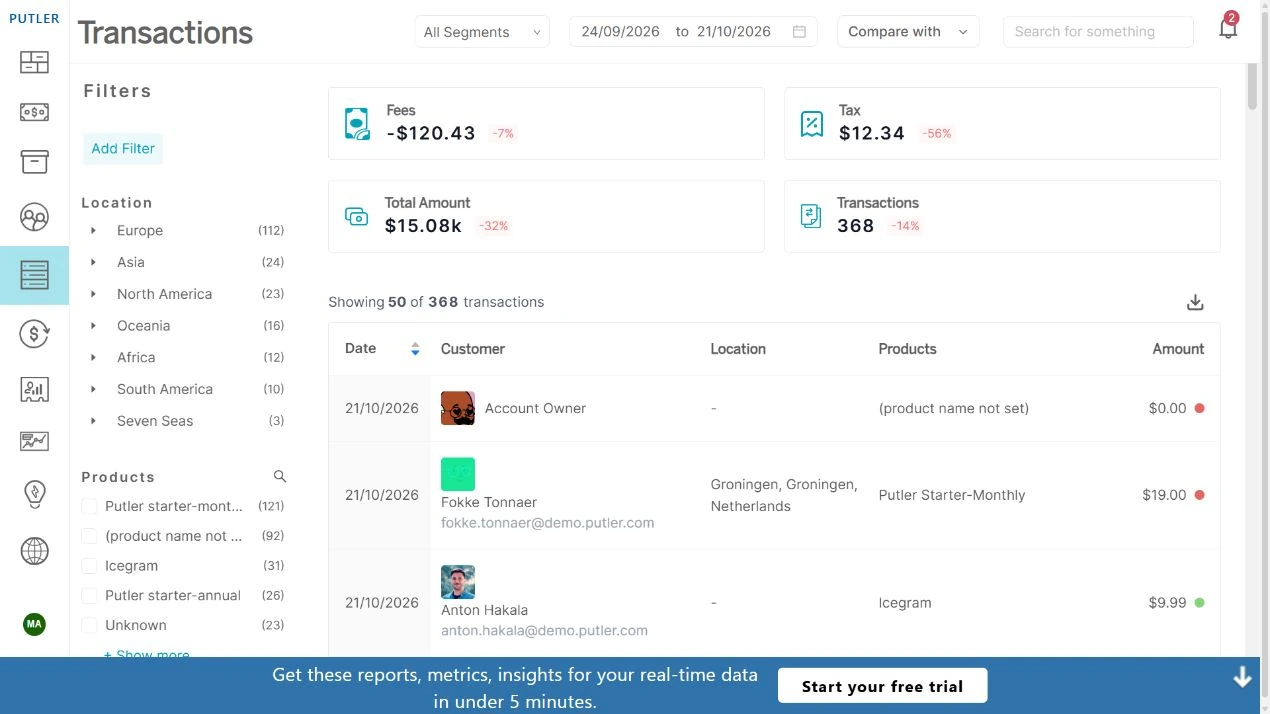
Public demo data, separate from the fictional two-store example. Source: Putler live demo.
Use those views to select the store, product, customer group, or transaction needing attention. Keep ad spend, supplier costs, carrier invoices, stock counts, and claim records alongside the investigation; this screenshot does not demonstrate a complete profit calculation or automatic leakage detection.
FAQ
What is revenue leakage?
Revenue leakage is revenue a business fails to realize because a process breaks down, such as undercharging or not collecting an agreed payment. A wider ecommerce investigation can also examine operational waste and lost sales opportunities, but those should be measured separately from money already owed.
What causes revenue leakage in ecommerce?
Causes include inconsistent pricing, unbilled transactions, missed payment capture, and unresolved collections. Related profit losses can arise from poorly coordinated promotions, unnecessary fulfillment costs, and preventable returns. Fragmented reports and unclear ownership can keep those problems hidden across multiple stores and teams.
How do you calculate revenue leakage?
For a revenue shortfall, compare legitimate obligations with final billing and collection evidence. For avoidable costs, compare actual expenditure with a substantiated alternative. Estimate missed sales through appropriate tests. Do not subtract bank deposits from sales and assume the entire difference is leakage, or sum overlapping findings.
How can multiple stores hide revenue leakage?
Combined totals can conceal a store with high refunds or weak contribution, while separate reports can fragment customer and product histories. Store and gateway exports can also include the same payment. Use consistent dates, currency rules, verified record matching, and store-level detail before drawing conclusions.