
Amazon fees run roughly 15% referral plus an FBA fulfillment fee if you use it. eBay fees run roughly 13.25% to 13.6% all-in, with no separate fulfillment layer. That’s the real starting point for amazon vs ebay, not company history or user counts.
This article breaks down what each platform actually takes from a sale, what changed in 2026 that most comparisons haven’t caught up to, and which platform fits which seller. No “it depends” dodge at the end.
Amazon vs eBay: the real cost of selling on each
Every comparison starts with fees because fees are the one number that changes every payout, not just the platform’s pitch. Here’s the side-by-side before the detail underneath it.
| Fee element | Amazon | eBay |
|---|---|---|
| Base rate | 8-45% referral (15% most common) | 13.25-13.6% final value fee |
| Fulfillment | Separate per-unit FBA fee, or self-fulfill and lose Prime | No separate layer; seller pays actual shipping cost |
| Per-order fee | None beyond referral | $0.30 or $0.40 flat |
| Payment processing | Included in referral fee | Included in final value fee (Managed Payments) |
| Fee calculated on | Item price + shipping | Item price + shipping + sales tax |
| Payout timing | 7 days after delivery (DD+7, from Mar 12, 2026) | 1-2 business days after shipment |
What Amazon actually takes
Amazon’s referral fee runs from 8% to 45% depending on category, though most categories land at 15%. That range hides a mechanic worth knowing before pricing a product, not after.
Several categories use price tiers rather than one flat rate. Clothing charges 5% up to $15, 10% from $15-$20, and 17% above $20, so a $19.99 shirt and a $20.01 shirt pay noticeably different effective rates.
Jewelry runs 20% up to $250 and drops to 5% above that. Electronics, computers, and cell phones sit low around 8%, while Amazon Device Accessories sits at the top at 45%.
There’s also a $0.30 per-item minimum on most categories. A $1.50 product at 15% would technically owe $0.225, but Amazon charges the $0.30 floor instead, an effective rate well above 15% at low prices.
A seller using Fulfillment by Amazon also pays a separate per-unit fulfillment fee, based on size and weight. Amazon raised that fee by an average of $0.08 per unit starting January 15, 2026.
Standard-size items priced above $50 saw the largest increase, around $0.31 per unit. Referral rates themselves stayed frozen through 2026; the fulfillment side is where the cost moved.
Selling without FBA skips the fulfillment fee entirely, but the product loses Prime eligibility, which measurably lowers conversion for many categories.
Amazon’s referral fee already includes payment processing, so there’s no separate card fee stacked on top. Amazon also offers several seller plans with different fee structures by volume, worth checking before assuming the individual rate applies.
What eBay actually takes
eBay’s final value fee runs roughly 13.25% to 13.6% of the total sale for most categories, plus a flat $0.30 or $0.40 per-order fee. The exact rate has shifted within that range over the past year.
Category variation exists here too, though narrower than Amazon’s: musical instruments sit around 5.85% and heavy equipment can run as low as 3%.
Since eBay moved every seller onto Managed Payments, the final value fee also includes payment processing. Older comparisons that add a separate PayPal fee on top are describing a system that no longer exists.
Both Amazon and eBay now quote an all-in rate with processing baked in. The headline percentages are the real percentages, not a floor with more to add.
There’s no separate fulfillment fee layer on eBay, since the seller handles shipping either way. eBay’s own guaranteed delivery program is one way to make that shipping experience competitive without giving up fulfillment control.
The shipping and tax trap
What catches sellers off guard on both platforms: fees apply to the total amount of the sale, not just the item price.
eBay calculates its final value fee on item price plus shipping plus sales tax collected. Amazon’s referral fee applies to item price plus any shipping charged.
A seller who prices fees off the item alone will consistently underestimate what actually lands in the payout.
A worked example
Sell a $50 item with $6 shipping on each platform, in a standard category (15% Amazon referral, 13.6% eBay final value fee).
On Amazon, fees come to roughly $11.00, leaving about $39.00 before the cost of goods. On eBay, the $56.00 total sale gets about $8.02 in fees, leaving roughly $47.98 before the shipping label cost.
The numbers aren’t directly comparable line for line, since Amazon’s FBA fee bundles in fulfillment that eBay sellers pay for separately. But it’s close enough to show why category matters more than the platform in the abstract.
Category changes the math more than the platform does. That same $50 item in Amazon’s electronics category (8% referral) pays about $4.00 instead of $7.50, a swing bigger than the entire gap between the two platforms’ headline rates.
A $50 clothing item crossing the $20 price tier on Amazon jumps from 5% to 17% referral, more than tripling the fee. Checking the actual category rate matters more than the platform comparison for apparel, electronics, or jewelry.
Payout timing: a real difference now
Starting March 12, 2026, Amazon rolled out a policy called DD+7 for all remaining seller accounts: funds are held for 7 calendar days after confirmed delivery, not after the order ships.
For FBA sellers this is largely absorbed into Amazon’s existing fulfillment speed. For FBM sellers using standard shipping, the total time from sale to bank deposit can stretch to 17 to 21 days or more.
eBay, under managed payments, initiates payouts 1 to 2 business days after the seller confirms shipment, with the bank posting the deposit within another 1 to 3 days.
For a seller who relies on sales revenue to fund the next round of inventory, this gap is a real operating difference, not just a fee difference.
Returns: who actually pays
As of February 8, 2026, Amazon requires prepaid return labels on all seller-fulfilled orders, including high-value items that previously had an exemption.
Returns processing fees, which apply once a product’s return rate crosses a category threshold, have also expanded in 2026. Apparel and footwear sellers can pay an extra $1.50 to $5.00 per returned unit on top of the label cost.
eBay splits return cost by reason instead. The seller covers return shipping if the item didn’t match the listing or arrived damaged.
If the buyer simply changed their mind, the buyer pays for return shipping, unless the seller has opted into free returns. Questions about using PayPal on Amazon come up here too, since Amazon doesn’t support it natively for buyer payments.
What’s the actual difference between eBay and Amazon?
Beyond amazon fees and ebay fees, a handful of structural differences shape how each platform actually works day to day.
| Dimension | Amazon | eBay |
|---|---|---|
| Role | Retailer, controls most of the sale | Facilitator, connects buyer and seller |
| Pricing format | Almost entirely fixed price | Fixed price and auction |
| Payment | Amazon checkout, cards, Amazon Pay | Cards, PayPal, Apple Pay, Google Pay |
| Fulfillment control | FBA (Amazon controls), FBM (seller controls), or EasyShip (2026, middle option) | Seller controls, always |
| Automation | Deep, built into Seller Central | Lighter, third-party tools common |
Retailer vs facilitator, and who controls the sale
Amazon operates largely as a retailer: it sources or receives inventory, often warehouses it, and controls most of the customer-facing sale even when a third-party seller owns the product.
eBay operates as a facilitator instead. Sellers list, price, and generally ship their own items, with eBay’s role staying closer to connecting buyer and seller.
“Amazon controls the process” undersells how much choice actually sits with the seller, though. FBA hands Amazon control of storage, packing, and shipping in exchange for the Prime badge, but the seller loses input on carrier choice and branded packaging.
FBM keeps the seller in charge of packing and shipping, at the cost of losing Prime eligibility unless the seller separately qualifies for Seller Fulfilled Prime, which requires strict delivery thresholds.
Amazon is also rolling out EasyShip in 2026, a middle option giving FBM sellers access to Amazon’s carrier network and Prime-like speed without moving inventory into Amazon’s warehouses.
eBay doesn’t have an equivalent fulfilled-for-you tier. The seller picks the carrier, sets the price, and answers the customer directly every time.
Fixed price vs auction, and automation
Amazon runs almost entirely on fixed pricing. eBay supports both fixed-price (“Buy It Now”) and auction-style listings, which still matters for collectibles and price discovery.
Amazon’s automation is deepest around fulfillment. FBA sellers don’t choose or pay for shipping per order, since Amazon selects the carrier and folds the cost into a flat fulfillment fee.
Automated repricing tools and standardized tracking come built into Seller Central. eBay’s automation is lighter by comparison, with sellers connecting their own shipping tools, Shippo and similar services are common.
That means more manual setup, but also more choice over which carrier and service level to use for a given item.
Amazon vs eBay by the numbers
Amazon reaches over 310 million active customers worldwide and holds an estimated 37 to 38 percent of the US e-commerce market. The exact figure varies by source and methodology.
eBay reported 136 million active buyers as of Q2 2026, up 2% year over year, per the company’s own investor filing. It holds roughly 3.5% of the US retail e-commerce market, the fourth-largest online retailer behind Amazon, Walmart, and Apple.
eBay’s Q2 2026 GMV came in at $22.4 billion, up 15% year over year, on a full fiscal 2025 total of $79.6 billion. That’s meaningful acceleration, not a platform in decline.
The scale gap is real but not the whole story. Amazon’s third-party marketplace alone processes roughly $300 billion in annual GMV, close to four times eBay’s full-year total.
That gap matters most for sellers chasing volume in mainstream categories. It matters far less for a seller in a niche where eBay’s smaller, more targeted buyer base converts better, a real pattern for collectibles and vintage goods.
One honest gap: eBay hasn’t disclosed an active seller count since Q1 2021, when it reported 20 million sellers globally. Every current figure repeats that same five-year-old number.
Amazon, by contrast, reports roughly 9.7 million registered sellers worldwide, though only about 2 million are actively selling at any given time. For a broader read on where Amazon’s numbers and eBay’s numbers come from, both platforms’ investor disclosures are the most reliable source.
Among the top ecommerce marketplaces, Amazon and eBay remain the two most relevant for a seller running an ecommerce business who wants broad reach. Both eBay and Amazon’s seller hub publish current fee schedules directly.
Amazon vs eBay: which platform should you actually sell on?
Here’s a real answer, split by what actually drives the decision for different sellers, not a generic “it depends.”
Match your business to a platform
- New or branded products, want Prime eligibility: Amazon, despite the higher fees. FBA’s fulfillment speed and the Prime badge measurably increase conversion for new and branded goods, worth more than the fee gap for most sellers here. This also applies to sellers running print-on-demand or similar made-to-order product lines, where consistent branding matters.
- Reselling, vintage, or hard-to-find inventory: eBay. The all-in fee is lower, auction format fits items where the right price isn’t obvious upfront, and there’s no category approval process standing between finding an item and listing it.
Getting started matters as much as the math
eBay lets a seller list almost anything immediately. Amazon gates specific categories where counterfeiting or safety risk runs high: toys and games, shoes and handbags, beauty and personal care, and supplements.
Recognizable brands like Nike or Coach are enrolled in Amazon’s Brand Registry. Supplements additionally require GMP certification and FDA facility registration as of a Q1 2026 tightening. Collectibles, fine art, and trading cards are gated too.
Getting approved (“ungated”) means submitting an invoice from an authorized distributor showing at least 10 units purchased, dated within the last 90 to 180 days.
The supplier’s name, address, and contact details have to match the seller’s own account exactly. Approval typically takes 1 to 7 business days once a valid invoice is submitted.
First attempts fail more often than sellers expect. First-try approval rates run around 30-40% by some estimates, mostly on documentation formatting rather than legitimacy.
Most categories on Amazon are actually open with no approval needed. Gating concentrates in the categories above rather than spreading evenly across the catalog.
A reseller with mixed, unpredictable inventory will hit that wall far more often than a seller focused on one product line. eBay has no equivalent process for any category.
How much account risk you can tolerate
Neither platform is risk-free, and they fail in different, specific ways.
| Metric | Amazon threshold | eBay equivalent |
|---|---|---|
| Order defect rate | Must stay under 1% (60-day window); safe sellers run 0.3-0.5% | No published single metric |
| Late shipment rate | Must stay under 4% | Tracked, but folded into overall account standing |
| Suspension trigger | Mechanical, tied to published thresholds | Accumulation of flags, less transparent |
| Appeal process | Documented Plan of Action process | Sellers report fewer clear appeal paths |
Amazon’s thresholds sound forgiving until order volume is small. One A-to-z claim against ten total orders is a 10% defect rate; the same claim against a thousand orders is 0.1%.
A new or low-volume Amazon seller has far less room for a single bad order than an established one. eBay doesn’t publish an equivalent metric-driven threshold.
Suspensions there get described by sellers as tied to an accumulation of account-level flags rather than one specific number, with less clarity on what triggered the decision.
The practical takeaway isn’t “one platform is safer.” Amazon’s risk is more predictable and measurable, easier to build guardrails around but also easier to trip mechanically during a bad week.
A seller with thin margins or a single supplier is more exposed on either platform than one with room to absorb a rough stretch.
Test before you commit volume
Sellers running identical inventory on both platforms report meaningfully different results by category, sometimes ten times the sales on one platform for the same item.
The fee math favors eBay per unit in most direct comparisons, but that doesn’t mean eBay outsells Amazon for a given product. List a small batch on both before committing real volume.
Pros and cons of selling on eBay and Amazon
The pros of selling on eBay
- Auction-style listings for price discovery on unique items, where a fixed price would either underprice or sit unsold
- Lower all-in fees for most categories, roughly 13.25-13.6% vs Amazon’s 15% referral plus a separate fulfillment fee
- No category gating, list almost anything immediately with no ungating invoices or approval wait
- Large customer base for unique and hard-to-find items, where eBay’s smaller audience converts better than Amazon’s broader one
- Faster payout timing (1-2 business days) versus Amazon’s new 7-day post-delivery hold
The cons of selling on eBay
- Lower sales potential for new, mainstream products where Amazon’s Prime badge and larger audience win on volume
- Seller handles fulfillment and customer service directly, with no FBA-equivalent fulfilled-for-you tier
- Suspension appeals reported as harder to resolve, with less visibility into which specific metric triggered the decision
- Promoted Listings’ January 2026 attribution change means an ad fee can now apply to a sale the ad never actually influenced
The pros of selling on Amazon
- Huge, high-intent customer base, over 310 million active customers worldwide
- Prime eligibility measurably lifts conversion for eligible listings
- FBA handles fulfillment and much of customer service, including carrier selection at no extra per-shipment cost
- More predictable, published account-health thresholds, which at least gives a visible target to manage against
The cons of selling on Amazon
- High competition in mainstream categories, harder to stand out without ad spend
- Category gating blocks entry to toys, shoes and handbags, beauty, supplements, and collectibles without distributor documentation
- Suspension can trigger automatically from performance metrics, and low-volume sellers get hit statistically harder by the same single defect
- DD+7 payout delay and expanded prepaid-return-label costs, both added in 2026
Branding and seller-friendliness
These two questions come down to the same trade-off: how much control a seller wants versus how much Amazon’s reach is worth giving up for.
Amazon offers more built-in tools for brand building: sponsored ads, storefronts, and enhanced brand content. Sponsored Products averages roughly $0.80 to $1.30 per click, rising past $2.00 in competitive categories.
Most brands spend somewhere between $150 and $3,000 a month. That buys real visibility, but the sheer volume of competing sellers narrows the gap rather than closing it.
eBay offers a more level playing field for smaller sellers by default, no pay-to-play ranking system required to be seen.
eBay’s own ad tool, Promoted Listings, changed meaningfully in January 2026. Previously, a seller only paid the fee if the exact buyer who clicked went on to purchase.
Under the new attribution model, any sale within 30 days of any click triggers the fee, whether or not that buyer ever saw the ad.
UK and German sellers saw “ad sales” jump from roughly 35% to over 80%; US sellers are seeing the same shift now.
On fees generally, eBay tends to be more transparent and, in most categories, cheaper, covered in detail earlier in this article.
Amazon’s fee structure is more predictable once a seller understands the tiers, which some find easier to plan around even if the total is higher.
Listing and inventory management leans the other way. Amazon’s interface takes longer to learn but includes more built-in tools for fulfillment at scale.
eBay’s interface is simpler to start with, but scaling past a few hundred listings usually means bringing in a third-party tool.
Growing Amazon and eBay sales with Putler
A seller running both platforms ends up with two separate dashboards and two sets of reports that don’t talk to each other.
Putler combines data from Amazon, eBay, and other sources into one view. Real revenue after fees, product performance across both platforms, customer behavior, none of it split across two tabs.
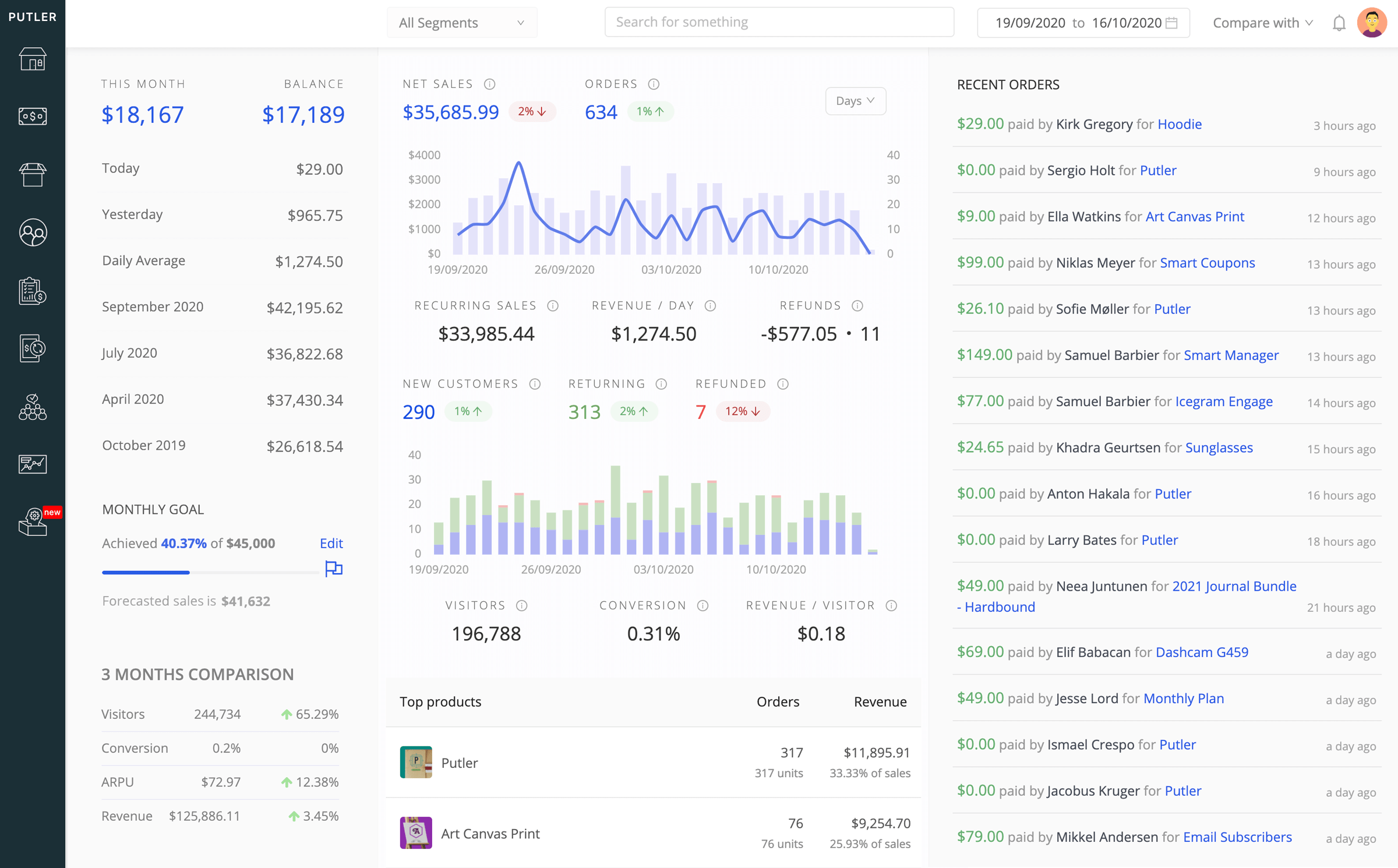
What that combined view actually shows:
- Real-time order tracking across both platforms in one feed, instead of switching tabs to catch a problem early.
- Order and revenue reports that already account for fees, so the number shown is closer to what actually lands, not the gross sale price.
- Product performance across both platforms side by side, which product sells better where, and by how much.
- Customer data, including purchase history and spending patterns, pulled into one profile even when the same customer buys on both.
- Sales forecasting based on combined historical data, not just one platform’s slice of it.
For a seller deciding whether to expand from one platform to both, or already running both without a combined view of what’s actually working, that’s the practical gap Putler closes.
eBay vs Amazon: frequently asked questions
Can I connect eBay to Amazon?
Not directly. Third-party tools like Sellbrite or ChannelAdvisor sync inventory and listings across both, and a reporting tool like Putler combines the sales data from both into one dashboard, but the platforms themselves don’t connect.
How many sellers are on eBay vs Amazon?
Amazon has roughly 9.7 million registered sellers globally, though only about 2 million are actively selling.
eBay’s last disclosed seller count was 20 million, reported in Q1 2021, and the company hasn’t updated that figure since. Treat any current “eBay has X million sellers” claim as an estimate.
How many people shop on eBay vs Amazon?
Amazon reaches over 310 million active customers worldwide. eBay reported 136 million active buyers as of Q2 2026, per the company’s own investor filing.
Are buyers loyal to eBay or Amazon, or do they shop both?
Most sellers who list identical items on both platforms report meaningfully different results depending on category, evidence that buyers on each platform behave differently rather than simply preferring one site over the other.
Can you make more money selling on eBay or Amazon?
It depends on category and fulfillment method more than platform. eBay’s lower all-in fee helps on thinner margins.
Amazon’s Prime eligibility and larger audience can outweigh the higher fee for products that convert well there. The fee comparison earlier in this article is the place to start the math for a specific product.
Is Amazon more trustworthy than eBay?
Both platforms have buyer protection programs and both have had trust issues at points, counterfeit listings on both, and their own seller-suspension controversies.
Neither is categorically safer for buyers or sellers; the details depend on the category and the specific seller.