

In simple terms, ARPPU tells you how much revenue a business generates from each of its paying customers on average. It’s a key input for pricing decisions, marketing spend, and product strategy, because it shows whether the people who actually pay are becoming more valuable over time or less.
This article covers the ARPPU formula, how to calculate it step by step, the difference between ARPPU and related metrics like ARPU and ARPA, what counts as a good ARPPU, how it connects to customer lifetime value, and five ways to increase it.
What is ARPPU (Average Revenue Per Paying User)?
Average Revenue Per Paying User (ARPPU) is the average amount of money generated from a paying customer.
ARPPU formula
Example –
If monthly recurring revenue is $10,000 from 100 paying customers, ARPPU is $100.
ARPPU vs ARPA: are they the same thing?
ARPA (Average Revenue Per Account) is often mentioned alongside ARPPU, but the two aren’t always interchangeable.
ARPPU counts individual paying users. ARPA counts paying accounts, and in B2B software, one account can hold many users under a single subscription.
For a consumer app or an ecommerce store, where each paying customer is typically one account, ARPPU and ARPA usually land on the same number. For B2B SaaS selling seat-based plans, they diverge: a $500/month account with 20 user seats has an ARPA of $500, but an ARPPU closer to $25 per individual user.
Track ARPA when account-level economics, like deal size and expansion revenue, matter most. Track ARPPU when the question is what an individual paying user is worth.
How to calculate ARPPU (step by step)
Since ARPPU is calculated from monthly recurring revenue and active paying customers, two numbers are needed:
- Net MRR
- Include revenue from existing paying customers
- Include revenue from upgrades
- Include revenue from new subscriptions, both full price and discounted
- Normalize annual or quarterly plans to a monthly figure
- Subtract revenue lost to downgrades and cancellations
- Active paying customers
- Include only customers with an active, paid account
- Exclude free trials, paid trials, canceled subscriptions, and inactive accounts
Including trial or canceled users waters down the average and distorts the real picture of how the business is performing.
- Divide net MRR by active paying customers to get ARPPU.
Want to skip the manual MRR calculation? Here’s how.
Worked example
Here’s how the calculation plays out over one month:
- 35 existing customers renew their $100/month plan
- 3 customers pay $1,200 for annual plans
- 2 customers pay $180 every quarter
- 5 customers upgrade from $100 to $150
- 5 customers downgrade from $100 to $80
- 10 new customers subscribe to the $100 plan using a 20% off coupon
- 5 customers cancel their $100 plan
Annual and quarterly revenue gets normalized to a monthly figure before it’s added to MRR. Canceled customers contribute $0 and are excluded from both MRR and the customer count. Here’s how each group contributes:
| Customer group | Customers | Monthly revenue |
|---|---|---|
| Existing customers renewing at $100 | 35 | $3,500 |
| Annual plan, normalized ($1,200 / 12 × 3) | 3 | $300 |
| Quarterly plan, normalized ($180 / 3 × 2) | 2 | $120 |
| Upgraded customers, now at $150 | 5 | $750 |
| Downgraded customers, now at $80 | 5 | $400 |
| New customers, $100 plan at 20% off | 10 | $800 |
| Canceled customers | 5 | Excluded |
| Total | 60 | $5,870 |
3 common mistakes in ARPPU calculation
Treating ARPPU and ARPU as the same metric
ARPPU is often confused with a similar metric: Average Revenue Per User (ARPU). The two sound alike, but they measure different things.
ARPPU is monthly recurring revenue divided by the total number of active paying customers. ARPU is monthly recurring revenue divided by all users, paying and free combined.
Assume a business has 100 users, 30 of them paying, with $3,000 in monthly recurring revenue. ARPU is $3,000 / 100 = $30. One user, on average, brings in $30 a month.
ARPPU, on the other hand, is $3,000 / 30 = $100. One paying user brings in $100 a month.
That’s a considerable gap between the two numbers, so when reporting either metric, state clearly which one is being used.
Using total revenue instead of monthly recurring revenue
Instead of monthly recurring revenue, some calculations use total revenue earned. For subscription businesses, monthly recurring revenue shows the true picture, since total revenue can include one-off charges that don’t reflect the ongoing rate. In both cases, the total user count will always be greater than the paying user count, but the revenue figure needs to match the recurring, not total, number.
Confusing ARPPU with average check
Another common mistake is treating Average Check as the same thing as ARPPU. That’s incorrect, and it can quietly misguide business decisions.
Average check is an average transaction value, and the number of transactions isn’t the same as the number of paying users. A user who pays repeatedly in a month counts once in ARPPU, but each of their transactions counts separately in average check.
Here’s an example. Assume 50 users pay $50 each, and 10 of them pay again at $10 each. ARPPU is (50 × $50 + 10 × $10) / 50 = $52. Average check, dividing by the 60 transactions instead of the 50 users, is (50 × $50 + 10 × $10) / 60 = $43.
What’s a good ARPPU?
There’s no single “good” ARPPU. It varies enormously by business model, pricing, and market, so the most useful comparison is against a business’s own trend over time and its direct competitors, not a flat industry number.
That said, rough category ranges give a starting point. Mobile games often land in the $5 to $50 range. Subscription apps typically run $10 to $30. SaaS products commonly start around $20 and climb into the hundreds of dollars a month, with enterprise plans going well beyond that.
If ARPPU sits well below the range typical for the category, that’s usually a pricing or packaging signal worth investigating before chasing more customers.
ARPPU and customer lifetime value
ARPPU and Customer Lifetime Value (LTV) are closely connected metrics. ARPPU shows what a paying customer is worth in one period. LTV shows what that same customer is worth across their entire relationship with the business.
A common shorthand is LTV = ARPPU × average customer lifespan in months, or ARPPU divided by monthly churn rate when lifespan isn’t tracked directly. Either way, an ARPPU increase compounds directly into LTV. The same $10 monthly ARPPU lift is worth far more to a business with a 24-month average customer lifespan than one with a 3-month lifespan, which is why ARPPU improvements and retention work tend to reinforce each other.
How to find ARPPU accurately across every platform
Finding an accurate ARPPU number gets harder the moment a business runs more than one payment gateway, shopping cart, or subscription system. Revenue lives in different places, currencies don’t automatically convert, and a spreadsheet someone updates by hand falls out of date within a week.
Putler pulls revenue and paying-customer data from every connected source, payment gateways, shopping carts, and subscription platforms, into one place and calculates ARPPU automatically, alongside related subscription metrics like LTV, MRR, and churn rate.
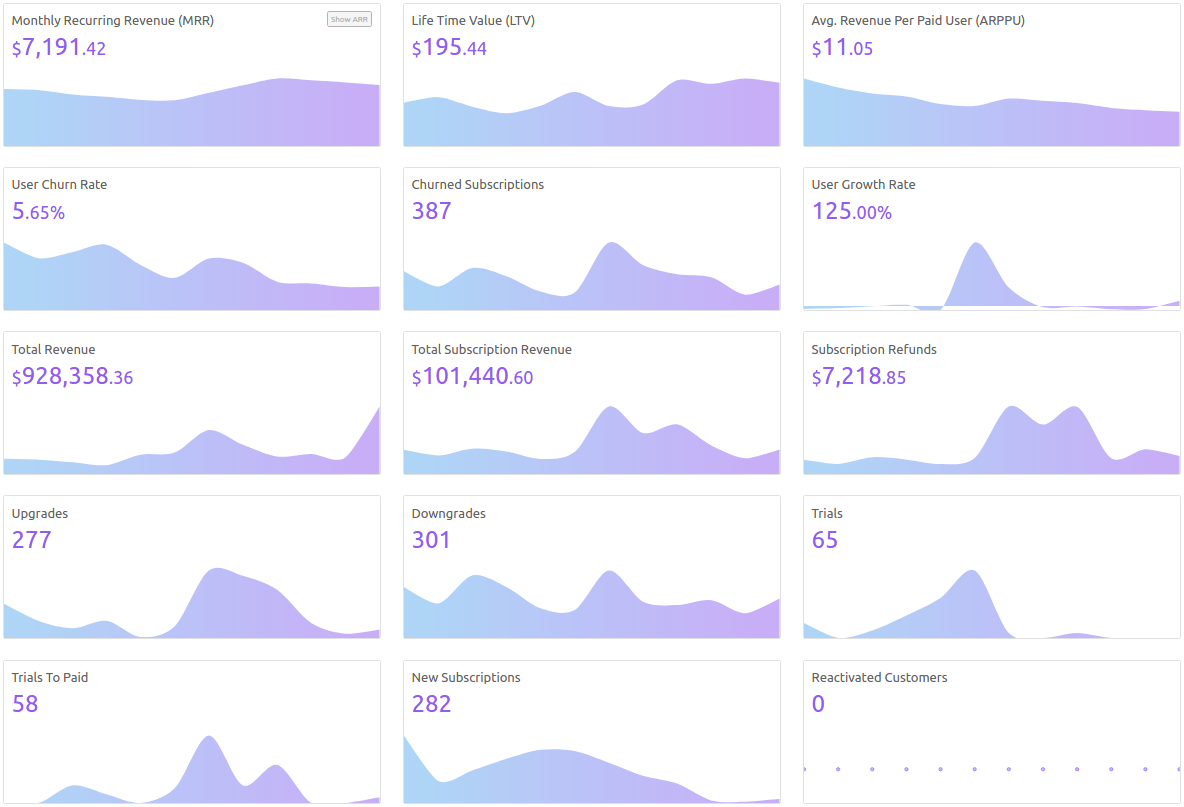
If customers pay in more than one currency, this matters more than it looks. Revenue collected in euros, pounds, and dollars has to be converted to a single base currency before ARPPU means anything, and doing that conversion by hand every month is exactly the kind of task that quietly introduces errors. Putler converts every transaction to a chosen base currency automatically, so ARPPU stays accurate whether customers are paying in one currency or a dozen.
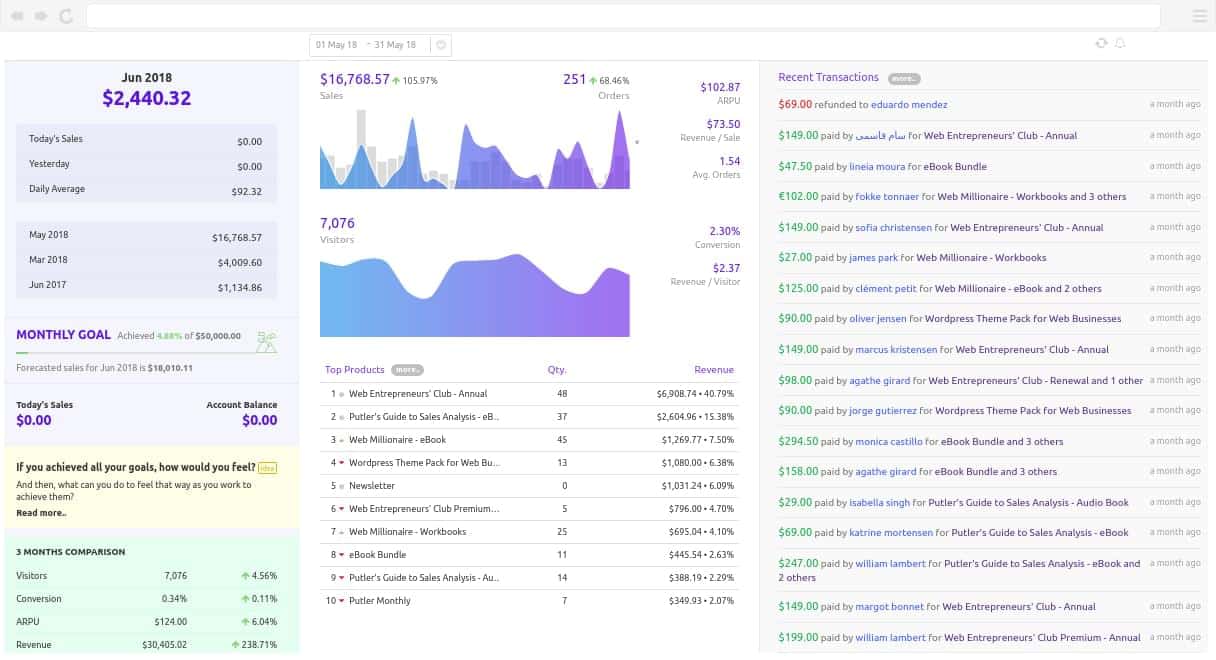
Beyond the headline number, Putler segments ARPPU by product type, location, subscription level, and customer behavior, and filters by date range for a more detailed view of revenue and ARPPU trends. Customer profiles generated automatically show purchase history and behavior alongside the number, so a low or high ARPPU comes with the context to explain it.
ARPPU is one input among several. Paired with churn rate, customer lifetime value, and customer acquisition cost, it gives a fuller picture of how the business is actually performing.
The $550 ARPPU example: what Game of War got right
The number seems like a dream, right? But it’s a reality.
It wasn’t a tech giant or an investment firm that hit this. It was a gaming company, Machine Zone, with their game “Game of War,” in 2015.
That figure was an annual average, not monthly, so it isn’t directly comparable to the monthly ARPPU used elsewhere in this article, but the scale is still remarkable for a mobile game. See the original article here.
Plenty of games use similar monetization tactics, and part of Machine Zone’s success is that other studios haven’t matched its results.
Two factors that affect your ARPPU
Low price bracket
Pricing plans at $10, $15, or $20 a month keeps ARPPU low by definition.
A low ARPPU means support, infrastructure, and scaling costs hit harder and faster relative to revenue, which makes staying in business more difficult.
Customers migrating to lower or higher value plans
Packing too many valuable features into lower-priced plans gives customers little reason to upgrade. Without customers on higher plans, ARPPU takes a hit.
Why is ARPPU important?
ARPPU reflects loyalty across paying users, since the customers who stick around are the ones paying every month. A higher ARPPU has the potential to generate more revenue from existing customers.
A high ARPPU relative to the value provided, or relative to overall company revenue, is a sign of a product with a strong value ratio.
Indicates business financial health
A low ARPPU of $50 means a business needs a large volume of customers to build something sustainable. This reveals what kind of pricing and value positioning the business actually needs.
A higher ARPPU points to growth. A lower ARPPU points to a product that doesn’t fit its market well.
Shows whether enough value is being extracted from target personas
Targeting too many small, low-revenue customers can quietly deflate ARPPU. Outside of consumer spaces with hundreds of thousands or millions of potential customers, chasing sub-$100/month customers usually isn’t worth the effort. Quantifying buyer personas properly and targeting the right ones matters for growth.
Validates that sales and marketing are closing the right deals
An ARPPU that climbs consistently over time is a sign that sales and marketing value propositions and targeting keep improving, and that the business is becoming more efficient at closing the right kind of deal.
How to increase ARPPU
Here are five ways to optimize ARPPU for a SaaS business:
Increase the price, wisely and with justification
The most common method to increase ARPPU. It shouldn’t create friction with existing customers, or more users will churn than upgrade.
Any price increase needs a strong justification behind it. Where feasible, small, incremental price increases tend to draw fewer complaints than one large jump.
Offer up-sell and cross-sell
Identify key touch points to up-sell (invite customers to upgrade) or cross-sell (offer additional relevant services).
A limited free trial also gives users a reason to sign up for the paid plan before it expires.
The goal is to analyze past user behavior, find the turning points where users are most likely to benefit from an upgrade, and make the pitch there.
Pitch other valuable products
Once a customer relationship is established, other products or relevant affiliate products can be pitched to the same user base.
Focus on the highest-value customers
With enough market understanding and consistent value delivery, it’s worth focusing on the top 1 to 2% of clients for special membership offers or high-priced services like premium support or customer success management.
Deprioritize low-growth-potential customers
Narrow down the customer segments least likely to progress to higher-paying tiers. Direct more resources toward cross-selling and up-selling high-growth-potential customers instead, which improves ARPPU overall.
The bottom line
ARPPU is a small formula with a large amount riding on it: pricing decisions, marketing spend, and how a business reads its own growth. Getting the calculation right, and comparing it against the right benchmarks and adjacent metrics like LTV and ARPA, turns it from a single number into a genuine strategic signal.
FAQ
What is the difference between ARPU and ARPPU?
ARPU measures average revenue per user, including both paying and free users. ARPPU focuses solely on paying users, providing a more specific metric for revenue from this segment.
How are ARPU and ARPPU calculated?
ARPU is calculated by dividing total revenue by the total number of users. ARPPU is calculated by dividing total revenue by the total number of paying users.
What is the difference between ARPPU and ARPA?
ARPPU measures revenue per individual paying user. ARPA measures revenue per paying account, which matters most in B2B software where one account can include many users. For consumer products where each customer is one account, the two numbers are usually the same.
What is a good ARPPU?
There’s no universal answer, since it depends heavily on business model and market. As a rough guide, mobile games often run $5 to $50, subscription apps $10 to $30, and SaaS products $20 and up. Comparing ARPPU against a business’s own trend and direct competitors matters more than any fixed number.
How does ARPPU relate to customer lifetime value?
ARPPU measures revenue per paying customer in one period, while LTV projects that value across the customer’s entire relationship with the business. A common estimate is LTV = ARPPU multiplied by average customer lifespan, so an ARPPU increase compounds directly into higher LTV.
How can I find my ARPPU if I use multiple payment gateways?
Manually reconciling revenue across gateways, carts, and currencies is time-consuming and error-prone. A tool like Putler consolidates data from every connected source into one base currency and calculates ARPPU automatically.
Hi Akshat,
Really an awesome article on ARPPU.
I’m sure its kind of the first metric, topic, on which you have written very well. My compliment again.
Many sites cover RFM, but ARPPU is new to us…
Thanks for the appreciation.
Glad you found it useful.
Also, read our other metric articles on MRR, Churn rate, User growth rate.
Generally ARPPU is the response of exactly paying users to the value that your project carries. This metric shows how much a loyal paying user is willing to pay. It can also be interpreted as a reaction of users to the prices set in the project. If you raise prices, your ARPPU is likely to rise after them. However, this does not mean that you will earn more, as the share of paying users may drop sharply.
Yes. Raising prices may cause churn to increase and we have exactly mentioned that in one of the five strategies to grow ARPPU in this article.
Hence, we suggest doing a micro-price increase and presenting a strong justification for price rise. This won’t let your users churn.
Hi, i think i found a mistake in “ARPPU calculations” section: Thats the calculation is got: 3,500$ + 300$ + 120$ + 250$ -100$ + 800$ -500$ => total 4,370$/65 customers = 67.23$ ARPPU.