

Behavioral segmentation groups customers by actions such as purchases, product usage, and engagement with a business. It helps marketers choose a relevant response based on what a group has done.
Sending the same promotion to a first-time buyer and a regular customer can waste a useful opportunity. But labeling someone a loyal fan just because they ordered twice can lead to another mistake: assuming the data explains their motives.
Start with the action you can observe. Then decide what response makes sense and what else you need to know.
What is behavioral segmentation?
Behavioral segmentation is a form of customer segmentation based on actions and patterns, including buying frequency, product use, and responses to marketing. A segment might contain repeat buyers, occasional app users, or customers who purchased during a particular season. Its definition depends on the data available.
Within customer segmentation, behavioral data answers a different question from demographic or geographic data. A customer’s city describes location; buying a winter coat in October describes an action. Combining those details may help you plan a relevant campaign, but the location alone is not purchase behavior.
Psychographic information concerns attitudes, values, and lifestyles. Buying an organic product may suggest an interest worth investigating, but it does not establish the buyer’s values. Ask for feedback before turning a purchase into a claim about motivation.
Segmentation also differs from personalization. You define a group first; the message, offer, or experience you choose for that group is the response.
Why is behavioral segmentation useful in marketing?
Behavioral segmentation helps marketers match an action to a relevant next step, such as welcoming a new buyer or contacting a customer whose usual purchases have slowed. It can also help prioritize limited campaign resources. The benefit depends on the segment definition, offer, timing, and measured response.
Consider customers who bought a printer. An offer for compatible ink has a clearer basis than a generic promotion for unrelated electronics. Check whether they already bought the ink before sending it.
For retention, a long gap between orders can be a reason to investigate. A customer who bought a durable appliance may have no need to return soon, while someone buying a replenishable product might be overdue. The same inactivity rule should not automatically apply to both.
A useful segment changes a decision. If you would send everyone the same message anyway, the grouping may add work without improving the campaign.
What are the main types of behavioral segmentation?
Common behavioral segmentation types include purchase behavior, usage and engagement, occasion and timing, loyalty, customer journey stage, and benefits sought. These categories can overlap. A seasonal buyer may also be a repeat customer, so campaigns need clear priorities when someone qualifies for several groups.
Identify purchase patterns
Purchase behavior includes what customers bought, how often they ordered, and how much they spent. You can separate first-time and repeat buyers or identify customers who purchased a particular product.
Use those records to choose relevant follow-ups. A buyer of a specific shoe model could receive care instructions or compatible accessory suggestions. A purchase alone does not reveal whether they researched for weeks or bought on impulse; that requires other evidence.
Measure usage and engagement
Usage describes how people use a product or service. Engagement describes interactions such as clicking an email, visiting a page, or watching content.
A software business might distinguish customers who used a key feature from those who never tried it. A store could identify subscribers who clicked a product guide. Both need the relevant event data: an order export cannot show app activity or email clicks.
Look for occasion and timing patterns
Timing-based segments group customers around a buying pattern or event, such as holiday purchases or repeat replenishment. A previous gift purchase can support a seasonal follow-up, but it does not prove the customer will buy the same gift again.
Your sales calendar can help identify periods worth investigating. A sales heatmap shows aggregate timing patterns; individual buying schedules need customer-level purchase records.
Recognize loyalty signals
Loyalty-based segmentation can use repeat buying, participation in a rewards program, or other evidence of an ongoing relationship. Purchase frequency is a useful signal, but it does not measure affection or exclusivity.
RFM analysis groups customers using recency, frequency, and monetary value. It can help identify purchase patterns worth acting on without requiring a separate loyalty survey. Keep those measurements distinct from statements about how a customer feels.
Match the customer journey stage
Journey-stage segments reflect actions associated with stages such as exploration, purchase, and post-purchase use. A completed first order is a clear purchase event; a page visit is a weaker signal of readiness.
Use the signal to choose a proportionate response. A new buyer may need setup help, while a visitor comparing products may need specifications. One click rarely tells the whole journey.
Investigate benefits sought
Benefits-sought segmentation groups customers by the outcome they want, such as convenience, durability, or comfort. Purchase and engagement patterns can suggest a benefit, but feedback helps check that interpretation.
In its behavioral segmentation guide, HBS Online illustrates this with software customers who value security versus collaboration, identified through interviews. That distinction supports different messaging because the underlying needs were investigated, rather than inferred from a sale alone.
What data does a behavioral segment need?
A behavioral segment needs an observable action, a reliable customer or user identifier, and a defined period. Some segments also need product details, transaction status, or feedback. Keep missing data separate from inactivity: an action that was never tracked cannot safely be treated as an action that never happened.
| Signal | Useful source | Limit to remember |
|---|---|---|
| Repeat purchases | Customer-linked order records | Earlier orders may be outside the imported history |
| Product interest | Purchase records or tracked product events | A purchase and a page view show different levels of commitment |
| Product usage | App or service events | Payment records do not establish feature use |
| Email engagement | Email platform events | Having an email address does not show campaign engagement |
| Benefits sought | Feedback plus observed patterns | The same product may serve different needs |
When you sell through several stores or gateways, inspect how records connect before counting purchases. One order appearing in two source exports should not become two buying occasions. Likewise, two different customers should not be combined simply because their names match.
Check the observation window too. “First order in the imported data” is safer than “first-ever customer” when earlier history is unavailable.
How does a behavioral segment work in practice?
A practical segment combines a clear rule with records that show why each customer qualifies. The following hypothetical example uses a merchant-defined repeat-purchase audience. It is an illustration of segment logic, not a real customer case, an RFM scoring model, or a statement about a product’s default calculation.
Define the rule and its boundaries
Imagine a store reviewing activity at the end of 30 September 2026. It wants to send a product-care guide to recent repeat buyers.
For this example, the rule is: at least two qualifying orders during September, with the most recent on or after 21 September. The merchant chooses to exclude fully refunded orders from the qualifying count. All records below belong to September, and the refund status is known at the cutoff.
| Customer | Observed orders | Qualifies and why |
|---|---|---|
| A | 5 September and 25 September | Yes: two orders and a recent purchase |
| B | 2 September and 12 September | No: latest purchase is before 21 September |
| C | 26 September only | No: only one order in this window |
| D | 8 September fully refunded and 28 September | No: only one qualifying order after the example exclusion |
| E | 21 September and 29 September | Yes: both conditions are met |
A and E qualify. The rule does not classify B as a lost customer or C as a lifetime first-time buyer. It only says they do not match this audience, using the supplied records and dates.
Check the response before sending
The care guide should fit the purchased products. If it covers leather care, exclude buyers whose products do not need it, even if they meet the purchase-frequency rule.
Before sending, refresh the audience, check current marketing permissions, and honor unsubscribes or other suppression rules in the sending platform. Also review recent service issues: another promotion may be a poor response to an unresolved complaint.
These example exclusions are campaign choices. They are not a claim that every customer analytics tool applies the same rules automatically.
Test what the example cannot tell you
Order records do not show whether A and E love the brand, need another product, or want an email today. Their behavior supports a specific audience definition; it leaves other questions unanswered.
If the store imported only September, C may have earlier purchases elsewhere. A longer history could change the interpretation, even though the September rule and result remain correct.
For more ready-to-use store audiences, see the guide to ecommerce customer segments.
How can behavioral segments guide marketing actions?
Behavioral segments can guide email, physical mail, social campaigns, push notifications, and website experiences. Each response needs a suitable delivery system and the relevant permissions. An analytics audience is the starting input; it does not by itself send a message, personalize a page, or create an advertising audience.
Choose relevant email and physical mail
Welcome emails can help first-time buyers use what they purchased. Replenishment reminders can follow an observed buying cycle, while win-back messages can address a meaningful gap in repeat activity.

Email and direct mail are separate channels. Physical mail might include a product-care card or a printed catalog, and needs a usable postal address. Email requires an appropriate sending setup; behavioral targeting can inform the message once the required data and delivery tools are available.
Avoid sending an automatic discount to everyone who becomes inactive. Check product lifespan, stock availability, and service history before deciding that price is the obstacle.
Suggest complementary products
Purchase records can identify buyers who may benefit from a related item. A printer buyer may need compatible ink, but compatibility and prior purchases matter more than a broad “bought electronics” label.
Use frequently bought together analysis to investigate combinations, then check whether the suggestion fits the recipient. A popular pairing is a clue, not proof that every buyer needs both products.
Use social, push, and website signals carefully
Social advertising can use relevant audience information where the platform and permissions support it. App push notifications need app events and a notification system. Website personalization needs a system that can recognize the relevant behavior and serve the chosen experience.
Keep these capabilities separate when choosing customer segmentation tools. A purchase-analytics tool, an event-tracking tool, and a campaign platform may each handle a different part of the workflow.
A useful first-party example comes from Netflix’s recommendation-system explanation: viewing history and ratings help inform recommendations. That supports an example of using observed interactions; it does not establish that a store with order records has the same signals.
How do you measure and refresh a segment?
Measure a segment against the action the campaign was designed to influence, using a defined audience and period. Refresh membership before activation so the group reflects current behavior. Timing depends on the signal: a completed purchase can make an abandonment reminder irrelevant much faster than it changes a long-term loyalty assessment.
For the hypothetical care-guide audience, decide whether success means reading the guide, reducing avoidable support questions, or making a later purchase. Those are different outcomes, and one should not stand in for another.
Record the eligible audience size and the number who received the message. When measuring purchases, state the follow-up period and whether the reported value includes or excludes refunds. Keep the definition consistent across comparisons.
Where practical, compare similar eligible customers who received different treatments, including a group without the campaign. A rise in orders after sending is useful to investigate, but seasonality or other promotions may also explain it.
A segment name is not a campaign result. Check both whether membership is correct and whether the chosen response helps.
Where can purchase analytics help?
Purchase analytics can support segments based on products bought, order counts, spending, and recency. It is useful when the decision concerns observed buying behavior. Questions about browsing, app use, or motivations need other evidence, and campaign execution needs the appropriate sending or personalization system.
In Putler, documented customer filters include products purchased, order count, revenue contribution, customer type, and customer-since date. Filtered customer lists can be exported as CSV; documentation also describes exporting contacts to Mailchimp audiences.
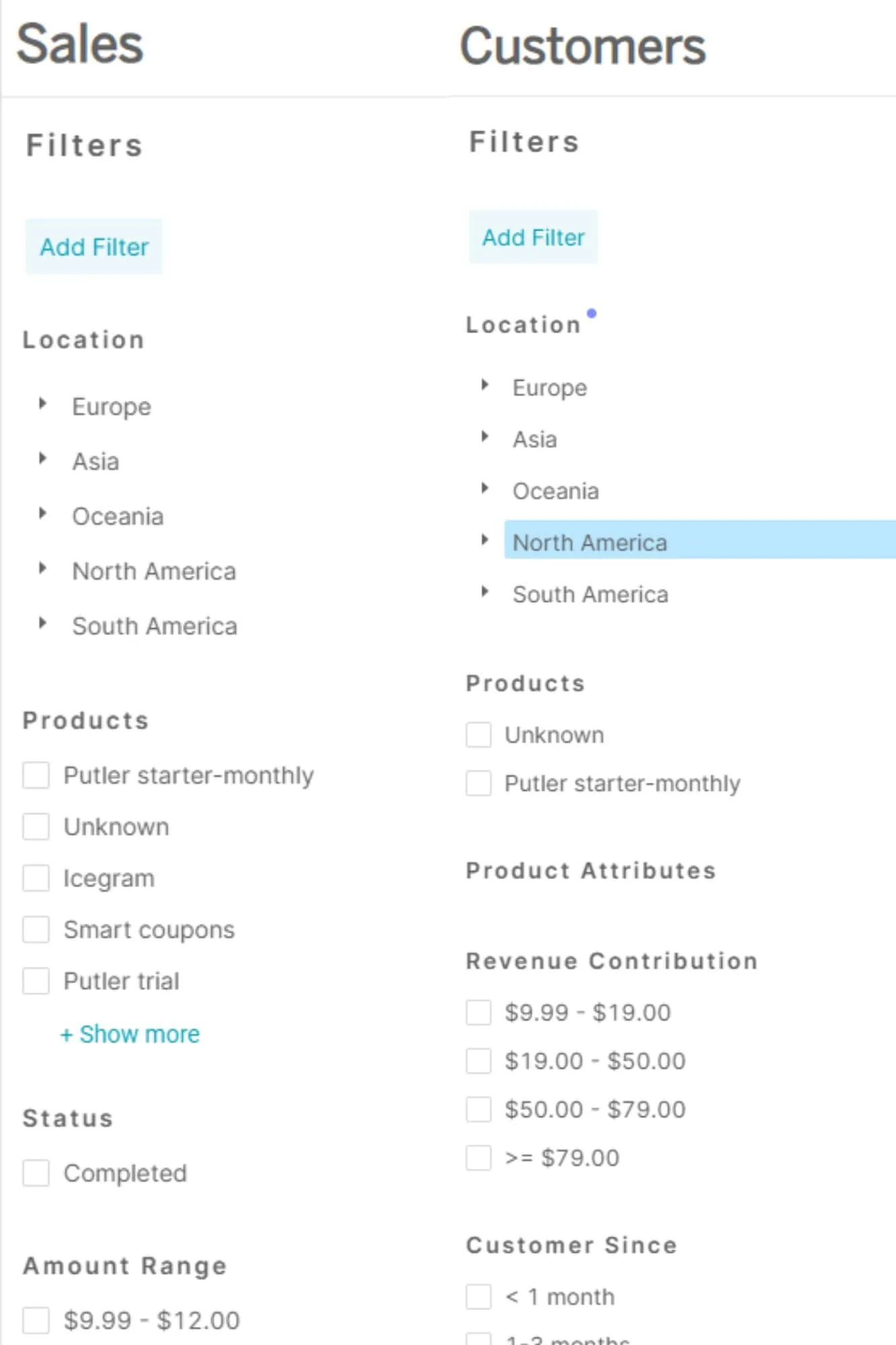
Start with the business question, then inspect the resulting list. For exact interface steps, use the customer segmentation documentation rather than assuming a generic example rule maps to one particular filter.
Read the RFM chart and filtered list correctly
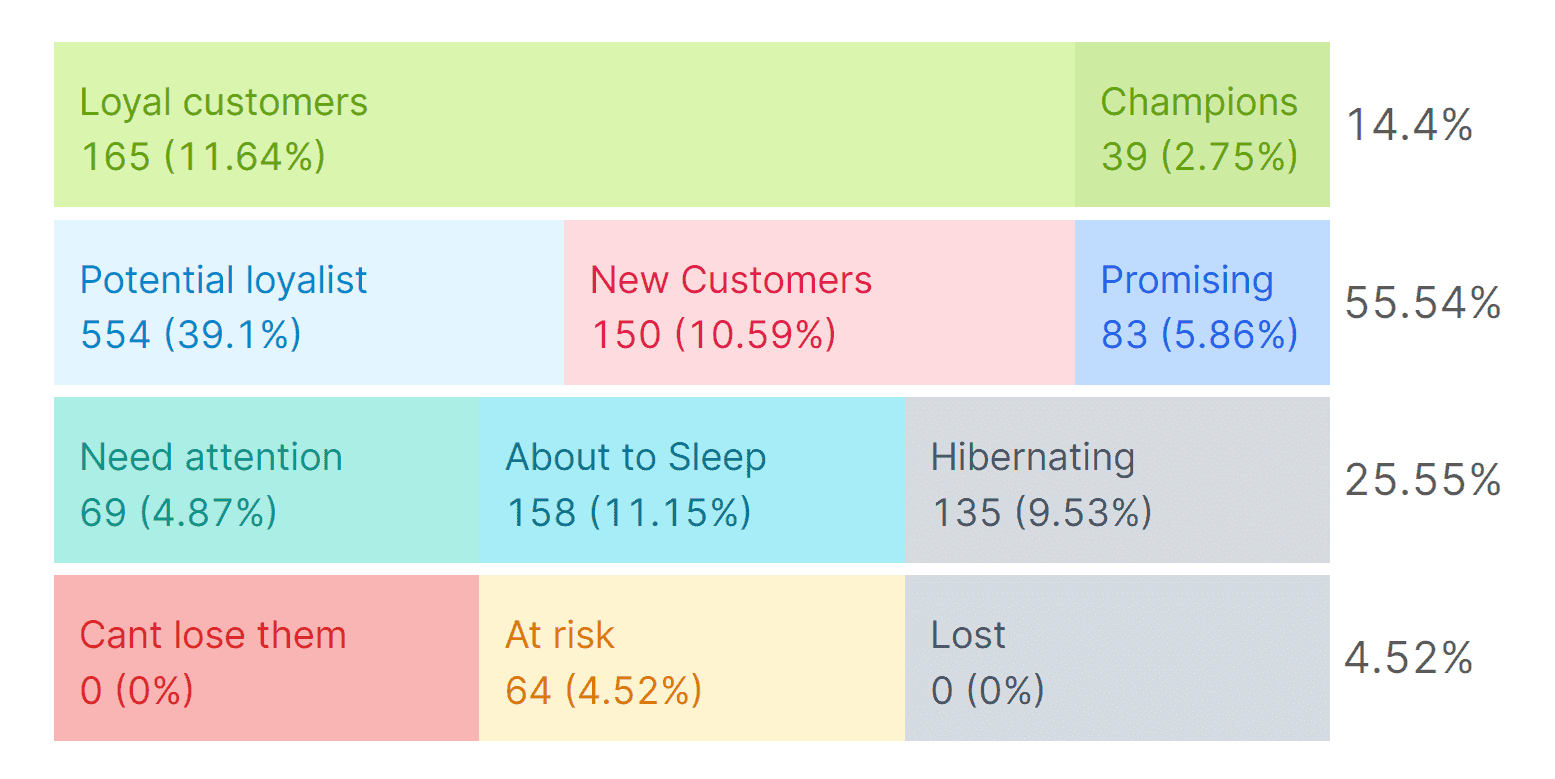
The RFM documentation distinguishes the chart from the filtered list: the chart uses the history imported into the account, while selecting a dashboard period filters the customers displayed for a chosen segment. Changing the period does not make that chart a new RFM score calculated only from that period.
Check how much history is available before interpreting a group. For activation, CSV export and Mailchimp export are documented routes; exporting an audience does not establish that campaign engagement flows back into the analytics view.
Where should you start with behavioral segmentation?
Choose one decision, one observable behavior, and one response. Write down the time window and exclusions, then inspect a few matching and nonmatching customers before sending anything. Start with records you can explain; add more signals when they improve the decision rather than merely making the rule more complex.
For a purchase-based audience, that could mean helping recent buyers use a product or checking a repeat-purchase gap. Keep the rule visible so someone else can review it before the next campaign.
FAQ
What data is used for behavioral segmentation?
Behavioral segmentation can use purchase history, product usage, browsing events, campaign engagement, and customer feedback. The required data depends on the segment. A repeat-buyer group needs customer-linked order records, while a feature-usage group needs app events. Missing tracking should not be treated as evidence that a customer did nothing.
How does behavioral segmentation differ from demographic segmentation?
Behavioral segmentation groups people by actions, such as repeat purchases or product use. Demographic segmentation groups people by characteristics such as age or income. The two can be combined, but demographic characteristics do not prove a person’s behavior. Choose the information that directly supports the decision and avoid substituting an assumption for an observed action.
What is an example of behavioral segmentation?
A store can group customers who placed at least two qualifying orders during a defined month and made their latest purchase within a stated recent period. The store can then choose a relevant follow-up for that group. Order status, refunds, missing history, and campaign permissions need explicit treatment before the audience is used.
How often should behavioral segments be refreshed?
Refresh frequency should match the action and its use. Recheck a purchase-triggered audience before sending so customers who no longer qualify can be excluded. Longer-term buying-pattern groups may need a different schedule. Check the analytics tool’s update timing and the sending system’s audience timing rather than assuming every segment updates immediately.