


MRR, or monthly recurring revenue, is the monthly value of a business’s recurring subscription charges. Calculate MRR by converting each eligible subscription to a monthly amount, then adding those amounts together.
A $1,500 annual subscription contributes $125 of MRR, even if the customer pays everything upfront. Counting that invoice as $1,500 of monthly recurring revenue makes a good sales month look like a much bigger recurring business.
The worked example below shows how to calculate closing MRR two ways, explain the difference from cash collected, and find the movement worth investigating. All example figures are illustrative, not customer results.
What is MRR?
Monthly recurring revenue is the monthly equivalent of recurring revenue from eligible subscriptions at a given point in time. MRR is a measure of the current subscription base, rather than cash in the bank or a promise that every customer will renew.
For a simple example, 100 customers each paying $50 per month contribute $5,000 MRR. With several prices or billing intervals, calculate each plan’s monthly value before adding them together.
How do different billing periods affect MRR?
Divide the recurring charge by the number of months it covers. Use the actual agreed price after the recurring discounts included in your reporting policy, rather than an undiscounted price nobody pays.
| Billing agreement | Monthly conversion | MRR per subscription |
|---|---|---|
| $100 each month | $100 ÷ 1 | $100 |
| $300 every quarter | $300 ÷ 3 | $100 |
| $1500 each year | $1500 ÷ 12 | $125 |
| $1200 annual plan discounted to $960 | $960 ÷ 12 | $80 |
A quarter covers three months. Dividing a quarterly charge by four understates its monthly value. The Cobloom calculation guide gives further context on normalizing subscription contracts.
How is MRR different from cash, bookings, and ARR?
MRR measures a monthly subscription run rate; cash receipts measure payments collected; bookings measure agreed deal value under a company’s definition. Annual recurring revenue, or ARR, expresses the recurring run rate annually. None of these figures automatically equals profit or revenue recognized in the accounts.
Suppose a customer signs for a $12,000 annual subscription plus a $1,000 one-time setup service. The full $13,000 is invoiced and paid upfront in this example.
| Measure | Amount or treatment | What it tells you |
|---|---|---|
| MRR | $1000 | Monthly equivalent of the recurring subscription |
| ARR | $12000 | Annualized recurring run rate |
| Cash collected | $13000 | Payment received before costs or refunds |
| Bookings including setup | $13000 | Agreed deal value if setup is included in the definition |
| Recognized revenue | Depends on service delivery and accounting treatment | Revenue earned under the applicable accounting rules |
Bookings don’t tell you when money reached the bank. An unpaid signed deal can increase bookings without increasing cash receipts. Likewise, the setup payment contributes cash but doesn’t become recurring revenue.
For comparable subscription definitions, ARR = MRR × 12. This is an annualized snapshot, not a guarantee of next year’s collections. The MRR versus ARR guide covers when to use each measure.
How do you calculate MRR from a subscription list?
Calculate closing MRR by adding the monthly recurring value of subscriptions eligible at the closing timestamp. Use one reporting date, timezone, currency basis, and eligibility policy. The same customer may have several subscriptions, so sum the subscription charges before interpreting customer counts.
Step 1: choose the snapshot and eligibility rules
Use the last complete month-end for your first check. Record the timestamp and whether overdue, paused, or scheduled-to-cancel subscriptions remain eligible. Otherwise, two exports can disagree simply because they use different cutoffs.
The example below has one subscription per customer, no overdue payments, no pauses, and no currency changes. Cancellations have taken effect by month-end. Free trials contribute no paid recurring charges.
Step 2: normalize the recurring amounts
Start with 100 customers paying $100 per month, giving $10,000 opening MRR. During the month, 15 upgrade to $150, five other customers downgrade to $75, and five other customers leave. The remaining 75 keep their $100 plans.
New customers also join: 12 on $100 monthly plans, three on $1,500 annual plans, and 20 on $100 plans with an ongoing 15% discount. Those discounted plans contribute $85 each while that discount applies.
Step 3: add the closing subscription values
Group each subscription into one row so nothing appears twice. The 15 free trials below are separate from the paying customer count.
| Closing group | Subscriptions | Monthly value each | Closing MRR |
|---|---|---|---|
| Existing upgraded plans | 15 | $150 | $2250 |
| Existing downgraded plans | 5 | $75 | $375 |
| Existing canceled plans | 5 | $0 | $0 |
| Existing unchanged plans | 75 | $100 | $7500 |
| New monthly plans | 12 | $100 | $1200 |
| New annual plans | 3 | $125 | $375 |
| New ongoing-discount plans | 20 | $85 | $1700 |
| Free trials | 15 | $0 | $0 |
| Total paying subscriptions | 130 | Not a single common price | $13400 |
The closing MRR is $13,400. The paying count is 100 − 5 + 12 + 3 + 20 = 130. Neither the five canceled subscriptions nor the 15 free trials belongs in that paying count.
You can also express MRR as paying customers multiplied by average MRR per customer. Compute that average from the same normalized subscriptions; using a headline plan price breaks the shortcut when plans differ. The ARPPU guide explains the related per-paying-user measure.
What are the different types of MRR?
MRR movements explain how the opening balance becomes the closing balance. New and expansion MRR add recurring value, while contraction and churn remove it. Reactivation restores value from former paying customers. Net new MRR is the combined change, rather than the closing total.
For this worksheet, use separate, non-overlapping buckets:
-
New MRR: Monthly value from first-time paying customers. The example adds $1,200 from monthly plans, $375 from annual plans, and $1,700 from discounted plans: $3,275.
-
Expansion MRR: Additional monthly value from existing paying customers. Fifteen upgrades from $100 to $150 add $750, rather than the full $2,250 now paid by those accounts.
-
Contraction MRR: Monthly value lost from customers who keep a paid subscription. Five downgrades from $100 to $75 remove $125.
-
Churned MRR: Monthly value lost when paying customers leave. Five effective cancellations at $100 remove $500.
-
Reactivation MRR: Monthly value restored by former paying customers returning. The base example has $0; track returns separately from new customers and expansion.
How do you reconcile opening and closing MRR?
Net new MRR = new MRR + expansion MRR + reactivation MRR − contraction MRR − churned MRR.
Closing MRR = opening MRR + net new MRR.
| Movement | MRR impact |
|---|---|
| Opening MRR | $10000 |
| New MRR | +$3275 |
| Expansion MRR | +$750 |
| Reactivation MRR | $0 |
| Contraction MRR | −$125 |
| Churned MRR | −$500 |
| Net new MRR | +$3400 |
| Closing MRR | $13400 |
The movement calculation and the closing subscription list both produce $13,400. Net new MRR is $3,400. Calling both figures “net MRR” hides the distinction, so label the balance and the change explicitly.
Where does reactivation MRR fit?
As an extension, suppose four former customers also return on $100 monthly plans. Add their $400 once. Closing MRR becomes $13,800, net new MRR becomes $3,800, and the paying count becomes 134.
Check a tool’s definitions before adding that row. Chargebee’s MRR documentation groups reactivation within expansion. Adding reactivation again to a total that already includes it would overstate growth.
Why do MRR reports disagree?
MRR reports can differ because of subscription eligibility, discount rules, effective dates, currency conversion, and movement grouping. A mismatch doesn’t establish which report is wrong. Compare the same subscriptions under the same rules before treating the difference as a calculation error.
Check discounts and subscription status
For this example, ongoing discounts reduce the recurring price. The 20 customers paying $85 contribute $1,700, not $2,000. A temporary invoice credit may need different treatment from a lasting plan-price reduction.
Stripe’s Billing analytics documentation describes configurable discount and subscriber-activation rules. Its standard MRR includes active and past-due subscriptions, while canceled or unpaid subscriptions stop contributing. A failed charge alone doesn’t always remove a subscription from MRR.
Use this checklist when reconciling a report:
| Item | Check before comparing MRR |
|---|---|
| Cancellation notice | Use the effective end date under the selected reporting policy |
| Free trial | Exclude trial-only items and keep any separate eligible paid items distinct |
| Mid-month upgrade | Separate a prorated invoice adjustment from the new monthly recurring amount |
| Refund | Check whether the reporting tool changes MRR or shows the refund separately |
| Taxes and processing fees | Keep the recurring-charge definition separate from tax collections and net bank payouts |
| Variable usage | State whether committed recurring charges or measured usage are included |
| Currency | Use a consistent reporting currency and identify exchange-rate effects separately |
Check the report settings and timestamps
ChartMogul’s MRR report documentation describes source-specific refund treatment and a transaction-fee setting. Don’t assume its displayed total follows the same conventions as another dashboard.
Stripe also documents UTC dates in prebuilt exports versus the account timezone in charts. A renewal near midnight can land in different reporting periods. Match the window before trying to correct an individual subscription.
How do you measure and improve MRR growth?
MRR growth rate measures the percentage change between comparable opening and closing balances. The example grows from $10,000 to $13,400, a 34% increase. That is an illustration, not a benchmark for your business or evidence that every growth action will work.
MRR growth rate = ((closing MRR − opening MRR) ÷ opening MRR) × 100.
If opening MRR is zero, report the amount added rather than dividing by zero. When reporting policies change, explain the change before comparing the growth percentages.
Which movement should you act on first?
Look at the loss or opportunity behind the figure. A discount-driven reduction, a failed renewal, and a deliberate cancellation call for different responses.
| What you find | First action | What to measure next |
|---|---|---|
| High new MRR alongside cancellations | Review the lost customers before increasing acquisition spend | Retained MRR and customer churn |
| Downgrades concentrated in one plan | Ask about usage and plan fit before offering blanket discounts | Contraction MRR and retained contribution |
| Failed renewals followed by ended subscriptions | Check payment recovery in the billing provider | Paid renewals and restored recurring value |
| Expansion concentrated in a few large accounts | Check customer concentration and whether other accounts get value | Expansion and losses across the remaining base |
What is a good MRR growth rate?
A useful target depends on starting revenue, price point, customer segment, and business stage. Adding $1,000 to a $10,000 base gives 10% growth; adding the same amount to $100,000 gives 1%. Compare similar businesses and complete periods before adopting an external target.
Keep costs and cash alongside MRR when budgeting. Reducing acquisition cost can free spending capacity, but it doesn’t directly increase recurring subscription charges. Use the customer retention guide and churn rate calculation to investigate the recurring value you lose.
How does MRR affect customer lifetime value?
An approximate revenue lifetime value divides average monthly recurring revenue per customer by monthly customer churn as a decimal. At $100 and 5% churn, the estimate is $2,000. This assumes stable revenue and churn, with no discounting, and fails at zero churn.
It isn’t net profit. Applying a gross margin gives a contribution estimate before overhead; the customer lifetime value guide explains the wider calculation. Use actual customer behavior when a simple average hides large differences between plans.
Which reporting tool should you use for MRR?
Choose an MRR tool by the subscription sources it supports, the definitions it exposes, and how easily you can trace an unexpected change. Start with existing billing reports when they answer the question. A second dashboard is useful when it reduces a reporting gap you can identify.
Start with the reporting you already have
For a Stripe-based business, Billing Analytics offers subscription reporting and customer MRR-change exports. Test whether those reports cover the recurring revenue you need before buying another tool.
For dedicated subscription analysis, inspect tools such as ChartMogul against your actual billing sources and policies. Avoid choosing from an old integration chart: support and metric definitions change, and no tool should be assumed to handle every billing setup.
Check supported sources before combining reports
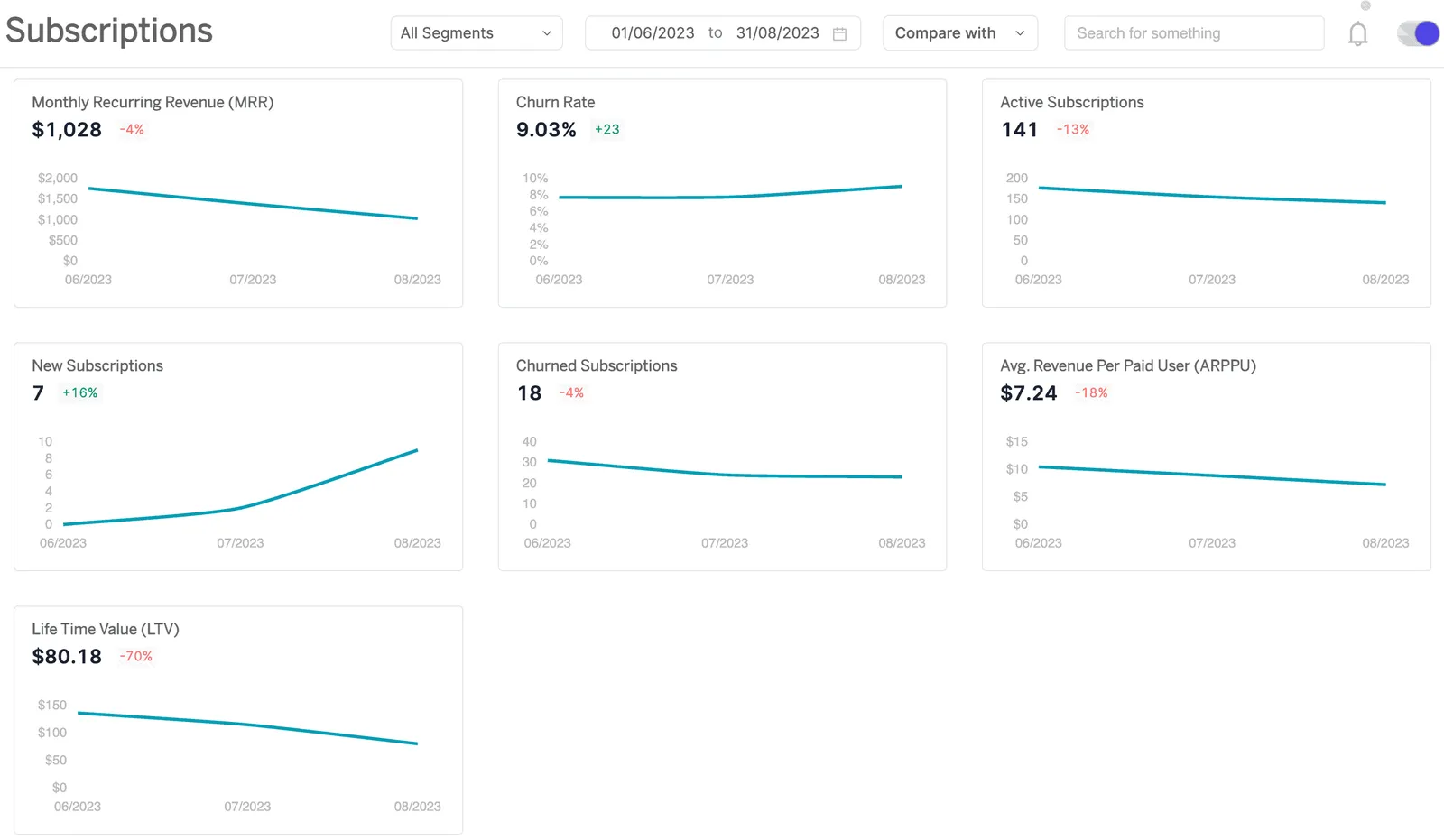
Putler’s Subscriptions documentation lists Stripe, WooCommerce, EDD, Braintree, Authorize.Net, and Inbound for subscription reporting. The dashboard brings MRR, churn, and subscription counts together. General platform integration support doesn’t mean that every source supplies subscription metrics.
What should you check during a reporting trial?
Choose one complete month and calculate its opening and closing MRR independently. Match eligible sources, dates, currencies, and reporting policies, then check one annual subscription, one discounted plan, and one effective cancellation against the underlying records.
The documentation treats refunds separately from MRR. Confirm the handling of any other edge case in your own account before relying on a match. A reporting dashboard doesn’t itself run payment retries or replace revenue recognition in your accounts.
The subscription metrics guide covers the measures surrounding MRR. For this trial, the useful result is a recurring-revenue number you can explain and a loss worth acting on.
What could a clearer MRR report change for your business?
In the example, counting all three annual invoices at full value overstates MRR by $4,125. Ignoring the ongoing discounts adds another $300. A flawed worksheet would show $17,825 instead of $13,400.
Correcting that $4,425 overstatement improves the reporting baseline. It doesn’t earn $4,425 or prove that a product increased profit.
Suppose the resulting investigation also leads to an action that retains three $100 monthly subscribers for their next paid month. That’s $300 MRR retained and, at an assumed 70% gross margin, $210 contribution before software, recovery work, and overhead.
This is a conditional first-month illustration, not a customer result or guaranteed Putler return. Judge the trial by whether it makes your reporting easier to explain and supports an action whose value exceeds its cost.
Reconcile one month before setting the next target
Save a closing subscription list and a separate movement bridge for the same period. In the worked example, both methods must reach $13,400 before you use the 34% growth figure in a plan.
If they disagree, trace the largest difference first: an annual charge, a discount, a cancellation date, or an overlapping movement category. Once the balance agrees, choose one customer or plan issue to investigate.
FAQs
How do you calculate MRR?
Convert each eligible subscription’s recurring charge to a monthly amount, then add those values. Divide an annual charge by 12 and a quarterly charge by three. Use consistent discount and subscription-status rules. With 100 customers each paying $50 per month, MRR is $5,000; mixed plans need separate normalization.
What is net new MRR?
Net new MRR is the change in recurring revenue during a period. With separate movement buckets, add new, expansion, and reactivation MRR, then subtract contraction and churn. Add that result to opening MRR to get the closing balance. Check whether a tool already groups reactivation or contraction into another category.
What is the difference between MRR and ARR?
MRR expresses the recurring subscription base monthly; ARR expresses it annually. With the same scope and definitions, ARR equals MRR multiplied by 12. Neither figure automatically equals cash collected or recognized revenue. A $1,500 annual subscription contributes $125 MRR and $1,500 ARR while eligible under the selected policy.
Do custom enterprise contracts count toward MRR?
The recurring part of an eligible enterprise contract can contribute to MRR after normalization to a monthly amount. Separate setup, consulting, hardware, and other one-time fees. A signed future contract doesn’t automatically belong in the current active MRR snapshot; use a separate committed view if your reporting policy calls for one.
Does reducing churn increase MRR?
Preventing an effective cancellation preserves the subscription’s recurring value for the period it remains active. It doesn’t guarantee future renewal or profit. Compare retained MRR with recovery costs, discounts, and gross margin, and keep customer churn separate from revenue lost through downgrades. Other movements can still make total MRR rise or fall.