

A customer segmentation ecommerce strategy helps you choose a relevant action for each customer group. Decide what changes: the message, the recommendation, the offer, or whether someone should receive a campaign at all.
A first-time buyer may need help using a product. Your most loyal customer may prefer early access. Someone who bought yesterday probably doesn’t need a win-back email.
Start with those decisions, then build the groups.
TL;DR
- Choose segments that connect to a business problem you can measure.
- Set eligibility and exclusions before sending a campaign.
- Treat spending, order size, and buying frequency as different signals.
Quick answer
The 10 ecommerce customer segments in this guide are:
- First-time customers
- Repeat customers
- High-value customers
- At-risk customers
- Inactive customers
- High-AOV customers
- Frequent buyers
- Product-specific customers
- Discount-driven customers
- Customers by location
What is customer segmentation in ecommerce?
Customer segmentation in ecommerce is the process of dividing customers into groups with shared attributes or purchase behavior. A segment becomes useful when its definition supports a specific decision, such as helping new buyers place a second order or selecting past buyers for a replenishment reminder.
Demographic and location data describe who customers are. Behavioral and transactional data describe activity and purchases. Lifecycle groups describe the relationship with your store, while value-based groups describe economic contribution.
These approaches overlap. A repeat customer can also be a high-value buyer in a particular region.
Use customer segmentation basics for broader methods. Here, the focus is choosing a group you can act on.
10 customer segmentation ecommerce examples worth creating
Each segment below includes a rule, exclusions, an action, and a metric. Adapt the rules to your store; thresholds and scenarios are illustrative.
Define a qualifying order first. Decide how you handle canceled orders, test purchases, refunds, and exchanges, then apply that definition consistently. Mixing paid orders with canceled checkouts makes both customer groups and results harder to trust.
1. First-time customers
First-time customers have placed exactly one qualifying order.
Rule: Use lifetime order count, then add a recent-purchase window for onboarding. A 30-day window is an example, not a recommended limit for every product.
Exclude or prioritize: Remove someone from the first-time flow after order two. A first order this month doesn’t make someone new if they bought last year.
Action: Send product education, setup tips, or a relevant complementary recommendation. Help the buyer use what they bought before asking for another purchase.
Measure: Divide customers placing a second qualifying order by eligible first-time customers in the starting cohort. Give everyone the same follow-up window.
A welcome coupon can’t fix a confusing product experience.
2. Repeat customers
Repeat customers have placed at least two qualifying orders.
Rule: Count purchases across the customer history you can reliably connect. State any missing stores or sales channels.
Exclude or prioritize: A repeat buyer may also be at risk or waiting for replenishment. Give the more specific campaign priority rather than sending every message they qualify for.
Action: Recommend useful cross-sells, bundles, or loyalty benefits. Prior purchases provide context for the next offer.
Measure: Track orders per customer in a defined period. Compare equivalent windows rather than a year’s activity against one month’s.
Someone buying coffee regularly needs a different follow-up from someone who bought a machine and one accessory.
3. High-value customers
High-value customers contribute more revenue or profit than your chosen threshold.
Rule: Define value explicitly: historical spend, recent spend, or contribution after costs (revenue after discounts, minus product and shipping costs). Past revenue is not a prediction of future lifetime value.
Exclude or prioritize: Account for refunds and discount use. A large buyer can still contribute little after product, shipping, and promotional costs.
Action: Offer relevant early access, recognition, or support. Avoid attaching a blanket discount to every VIP message.
Measure: Divide customers who order again by the starting high-value cohort over a fixed window, and track revenue per customer. Add contribution when you have reliable costs; if you don’t, say profit is unknown.
The customer spending the most isn’t automatically the customer earning you the most.
4. At-risk customers
At-risk customers have an established purchase pattern and a longer-than-expected gap since their last order.
Rule: Compare recency with the normal repurchase cycle for the customer or category. Coffee refills and furniture shouldn’t share one inactivity threshold.
Exclude or prioritize: Refresh before sending. Remove recent purchasers, contacts who cannot receive the campaign, and buyers whose unresolved service problems require support.
Action: Try a reminder, relevant product update, or replenishment suggestion. Test an incentive when there’s a reason to expect it will help.
Measure: Divide reactivated customers by the eligible at-risk cohort over a fixed window.
5. Inactive customers
Inactive customers have gone beyond your store’s longer lapse boundary.
Rule: Define an inactive band separately from at-risk. One quiet period doesn’t prove a customer has permanently left.
Exclude or prioritize: Avoid pushing disengaged contacts through the same promotions repeatedly. Respect unsubscribe status and channel eligibility.
Action: Try limited re-engagement or a preference update. A durable-goods buyer may need maintenance advice or accessories instead of another main product.
Measure: Divide customers placing a qualifying order by the eligible inactive cohort over a fixed window. Track unsubscribes and complaints from the same cohort. Recovering orders while damaging the contact list is a poor trade.
An inactive buyer isn’t always an unhappy buyer.
6. High-AOV customers
High-AOV customers place larger orders than the comparison group.
Rule: Calculate average order value as qualifying revenue divided by qualifying orders, with a consistent refund policy. Flag single-order buyers separately because one large purchase offers little evidence of a repeated pattern.
Exclude or prioritize: Don’t equate AOV with total value. One $500 order and ten $100 orders tell different stories; these figures are illustrative.
Action: Test relevant bundles or premium recommendations. Product fit matters more than the size of the last basket.
Measure: Track AOV alongside conversion and contribution when costs exist. Bigger baskets may not compensate for fewer purchases.
7. Frequent buyers
Frequent buyers place orders often within a defined observation period.
Rule: Count orders over comparable windows. A long-standing customer has had more time to buy than someone who joined last week.
Exclude or prioritize: Check whether orders reflect demand, split shipments, or exchanges. Administrative activity shouldn’t turn someone into a frequent buyer.
Action: Offer replenishment reminders, suitable subscriptions, or loyalty benefits. Match the cadence to product use instead of adding promotional sends.
Measure: Track repeat orders per eligible customer over the same window. Check whether frequency changes without eroding contribution.
8. Product-specific customers
Product-specific customers have purchased a particular item or category.
Rule: Use qualifying purchases and consistent category data across stores.
Exclude or prioritize: Remove already-owned products when duplication makes no sense. Check compatibility before recommending an accessory.
Action: In a hypothetical coffee store, a machine buyer could receive suitable filters, cleaning products, or beans. Recommend supplies that fit the machine rather than the entire catalog.
Measure: Divide customers buying the recommended category by eligible targeted customers over the campaign window. Freeze the starting audience for reporting.
A purchase tells you what someone owns, not everything they want.
9. Discount-driven customers
Discount-driven customers show a repeated pattern of buying with discounts.
Rule: Calculate the share of qualifying orders using a discount over a stated period. One sale purchase is too little evidence to label someone discount-dependent.
Exclude or prioritize: Separate targeted coupons from storewide sales. If every order was discounted, your offer policy may explain the pattern better than customer preference.
Action: Test bundles, convenience, or product value alongside selective discounts. Avoid teaching full-price buyers to wait for coupons.
Measure: Compare the share of discounted orders in the eligible cohort before and after the test, over equal windows. Track contribution after discounts where costs exist. Report revenue separately when you cannot calculate margin.
Redemption shows usage, not proof that the discount caused the purchase.
10. Customers by location
Location-based groups share a documented shipping region or another relevant geographic field.
Rule: Choose the location field that fits the decision. Shipping destination, billing country, and currency can differ.
Exclude or prioritize: Confirm availability and delivery conditions before promoting a regional offer. Geography alone doesn’t establish preference.
Action: Adjust seasonal messages, launches, or shipping information. A December winter campaign needs different treatment for Canada and Australia.
Measure: Divide customers placing a qualifying order by the eligible regional audience over the campaign window. Compare periods with similar availability so stock changes don’t masquerade as campaign performance.
How do you choose and activate a starter segment?
Choose a starter segment by naming one business problem, checking available data, and defining a rule that leads to an action. Add exclusions and campaign priority before activation. Record the starting audience and measurement window so changes in eligibility don’t distort the result.
Start with one decision
For a second-purchase problem, begin with first-time customers. For replenishment, use product-specific repeat buyers with a suitable buying cycle.
Write down the fields you need and their sources. Disconnected customer records or missing order history can change who qualifies.
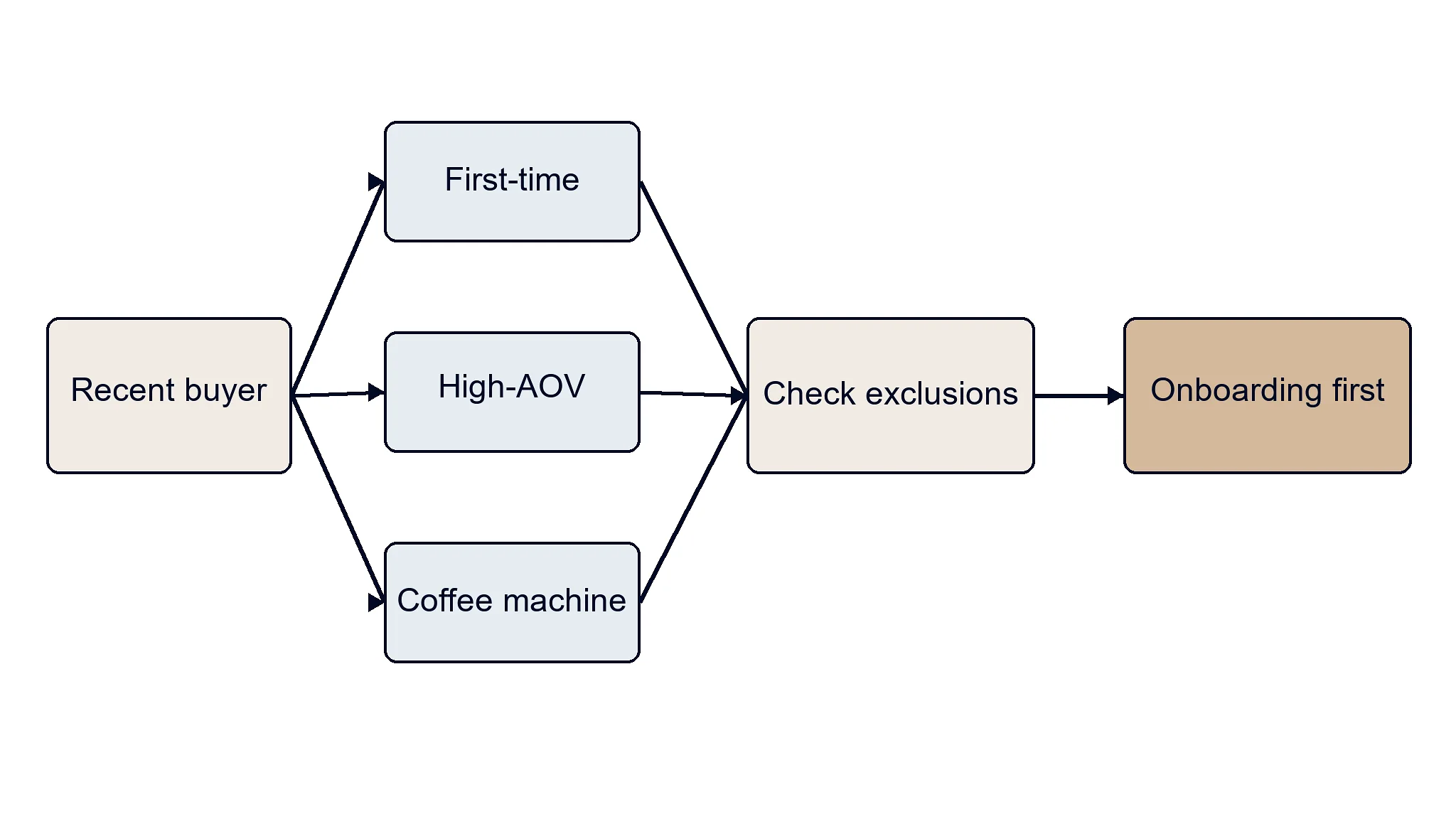
Resolve overlapping groups
Consider a hypothetical customer who recently bought an expensive coffee machine. That person could qualify as first-time, high-AOV, and product-specific.
Prioritize onboarding. Suppress a premium-machine promotion and recommend compatible supplies when appropriate.
Groups can overlap; campaigns still need a clear order.
Refresh before sending
Check new purchases, changed contact eligibility, and unresolved support issues before activating the audience. A saved definition and an exported list are different things: the export can become outdated.
Keep the audience actually used for the campaign. Otherwise, customers entering and leaving the segment will change the denominator while you’re measuring.
Where does RFM segmentation help?
RFM segmentation combines recency, frequency, and monetary value to describe purchase behavior from several angles. It can identify recent repeat buyers and valuable customers whose purchases have slowed. The analysis depends on the order history and period selected, so its group labels need context.
Recency describes how recently someone bought. Frequency describes how often they buy. Monetary value describes spending.
High historical spend with no recent purchase calls for different attention from a newer customer buying regularly. RFM helps make that distinction visible.
Use the full RFM analysis guide for methodology. Tie thresholds to your data and purpose instead of treating one published score recipe as universal.
How do you turn customer segments into campaigns?
Customer segments become campaigns when a tool defines the group and a sending service delivers the message. Before export, check which data defines the group, how current that data is, and whether each recipient can receive the channel. That handoff decides whether the campaign reaches the right people.
Putler‘s published features include saved custom segments, RFM segmentation, and customer filtering and export. Its RFM documentation also lists CSV and Mailchimp export options and says the RFM view updates when new data is pulled in.
These features support analysis and audience preparation. They don’t establish that every rule here is a built-in filter.
An older Putler email-targeting announcement, last updated in January 2025, also describes sending emails through a connected service. Check current availability in your account before relying on that option; the announcement alone does not confirm the feature’s present limits.
Compare customer segmentation tools by the data and activation job you need.
How do you measure a segment campaign?
Measure against the eligible starting audience over a fixed period, using the outcome attached to the campaign goal. Use the same rules for who qualifies, which orders count, and how long you watch. Where practical, compare with a similar group receiving the usual treatment so natural repeat purchases aren’t mistaken for campaign impact.
| Goal | Result to count | Denominator |
|---|---|---|
| Encourage order two | Customers placing a second order | Eligible first-time cohort |
| Reactivate buyers | Customers placing a qualifying order | Eligible starting lapse cohort |
| Cross-sell a category | Customers buying the recommended category | Eligible targeted customers |
| Raise order value | Qualifying revenue | Qualifying orders |
State the window beside the rate. A 30-day result and a 90-day result aren’t directly comparable.
When possible, assign similar eligible customers to campaign and comparison groups before sending. Compare outcomes across both groups because some buyers would return without the campaign.
Small audiences make results uncertain. Report counts alongside rates, and avoid calling one favorable campaign a reliable pattern.
Write your first segment brief
Start your customer segmentation ecommerce work with one group you can define with reliable data and one action your team can deliver.
Write eligibility, exclusions, campaign priority, and the success metric in the same brief. Assign an owner and review date so the group doesn’t become a forgotten saved filter.
If you cannot name what changes for those customers, choose a different segment.
Frequently asked questions
Which customer segments should an ecommerce store build first?
Start with the group connected to the most pressing business problem. First-time buyers suit a second-purchase goal; product-specific buyers suit cross-sells; at-risk repeat customers suit reactivation. Choose a group supported by reliable data and an action your team can deliver, then expand when another decision requires it.
What data do I need to start segmenting my ecommerce customers?
Purchase-based segments need a reliable customer identifier, qualifying orders, dates, order values, and relevant product data. Add shipping location or discount fields when the decision calls for them. Browsing and email engagement need their own sources; order history alone doesn’t reveal those behaviors or explain purchase motives.
How often should I update my customer segments?
Refresh before activation and whenever new data could change eligibility. Check purchases, contact eligibility, and exclusions before sending. A dynamic rule may update in an analytics tool while an earlier export stays unchanged, so verify how your particular tool and destination handle changes before reusing an audience.
What is the difference between customer segmentation and personalization?
Segmentation defines a group using shared criteria. Personalization changes the experience or message for that group or person. A segment of recent coffee-machine buyers identifies an audience; recommending compatible cleaning supplies is the action. Creating the group alone does not improve the experience or demonstrate a campaign result.
What’s RFM segmentation, and is it worth using?
RFM groups customers by purchase recency, frequency, and spending. Use it when combined signals support a retention decision better than one metric alone. Check order definitions, data coverage, and the analysis period first. RFM doesn’t automatically explain profitability, browsing intent, or why a customer stopped purchasing.