

Subscription businesses track dozens of metrics. But one number sits above the rest: ARR, or annual recurring revenue.
It tells you exactly how much predictable income your business can count on over the next 12 months. That clarity shapes everything from hiring decisions to investor conversations.
In this guide, we cover what ARR is, how to calculate it, and how to track it without doing the math yourself.
What is annual recurring revenue?
ARR stands for annual recurring revenue. Simply put, it is the total subscription revenue your business brings in over a year.
So if a customer pays you $100 every month, their contribution to your ARR is $1,200. That is it.
It is also just your MRR multiplied by 12. No complicated formula, no guesswork. Just a clear number that tells you how much recurring income your business generates annually.
One thing to keep in mind: ARR only counts recurring revenue. One-time fees and setup charges do not belong here.
Benefits of ARR for a subscription-based business
Now that you have a rough idea of what ARR is, let’s figure out the reasons behind its huge significance and importance.
From the definition, it’s clear that the ARR points out the yearly recurring revenue. Knowing this metric allows a business to:
Identify the actual standing
ARR records the company’s performance in a particular area. It lets people figure out how much recurring revenue is a sure thing.
This understanding is useful to figure out the actual market hold of a business.
Knowing ARR allows decision-makers to make data-driven decisions, create a viable operational plan, and do remedial actions to improve the company’s efficiency.
Do realistic revenue forecasting
With ARR tracking, one can easily figure out the cost of different subscriptions and predict the sales. We all know that real-times revenue forecasting lets a business take immediate actions and handle things confidently.
Increase the investment
A higher value of ARR plays a key role to woo the investors. Showing a promising, if it’s there, one can easily bring in more investment and expand that business periphery.
Take timely actions
Suppose a company has low ARR value for the upcoming year then timely actions to improve the revenue such as cross-selling and up-selling can be taken be before it’s too late.
Importance of ARR for SaaS and the Subscription Economy

The foundation of the subscription economy is based on long-term relationships. It’s not a one-time affair. The relationship between the buyer and service provider, in a subscription economy, is likely to change with time.
With continual ARR tracking, one can easily figure out what’s in favor and what’s not.
New customers, added renewal percentage, upgrades, and downgrades are some of the areas in which one can gain clarity with ARR tracking. These factors are hard to measure with traditional accounting procedures like GAAP. So, if your business is a subscription-based economy, consider ARR.
What your ARR means to investors
When you walk into a funding conversation, your ARR is one of the first numbers investors look at. ARR and ARR growth rates have historically been critical to securing funding from investors for SaaS and subscription businesses.
Investors use ARR multiples to value SaaS companies. Heading into 2023, revenue multiples for SaaS companies averaged at 5.6x sales. So a business doing $10M in ARR could be valued at $56M or more depending on growth rate.
ARR Momentum
Your ARR does not stay flat. It moves up and down based on five things:
- New customers: Every time someone starts a new subscription, your ARR goes up.
- Churn: When customers cancel, that recurring revenue disappears from your ARR.
- Downgrades: A customer dropping to a cheaper plan means less recurring revenue coming in.
- Renewals: Customers who stick around and renew are the backbone of a healthy ARR.
- Upgrades and add-ons: When existing customers expand their plan or add features, your ARR grows without acquiring anyone new.
How to calculate annual recurring revenue?
ARR calculation depends on the tone of factors/metrics such as existing pricing strategy and business model used for subscription. Here is the formula to calculate ARR.
The ARR Formula and Calculation
Calculating ARR is easy.
You will first need to figure out the MRR.
Once you have the MRR value, multiply it by 12 to get the ARR.
ARR = MRR X 12
NOTE: We use this calculation within Putler as well.
ARR example
For instance, if your customer has availed 3-year contract for a monthly plan and pays $60,000 in total for the entire contract, the ARR calculation is:
ARR= $60,000 x (12/36) = $20,000.
How to calculate ARR growth rate
Knowing your ARR is one thing. Knowing how fast it is growing is another.
ARR growth rate tells you the percentage change in your ARR from one year to the next. Here is the formula:
ARR Growth Rate = (Current ARR – Previous ARR) / Previous ARR x 100
So if your ARR was $100,000 last year and is $130,000 this year, your ARR growth rate is 30%.
But what counts as a good growth rate? It depends on where you are. Bootstrapped SaaS companies report a median annual growth rate of 23%, while venture backed companies see a median of 25%. Smaller companies with ARR under $1 million often see growth rates exceeding 50%.
Types of ARR you should track
Not all ARR moves the same way. Breaking it down into types gives you a clearer picture of what is actually driving your growth.
- New ARR: Revenue added from brand new customers who just signed up.
- Expansion ARR: Revenue gained from existing customers who upgraded or added to their plan.
- Churned ARR: Revenue lost from customers who cancelled or did not renew.
- Net New ARR: The final number. New ARR + Expansion ARR – Churned ARR. This tells you if your business is actually growing.
Practical uses of ARR (Annual Recurring Revenue)
There is no second opinion that ARR is a successful determining factor for the subscription-based organization. Here are some of the uses of these key metrics:
Learn about the future growth of the company
When used in the right manner, ARR can predict the growth, stability, and market worth a company can experience in the future.
This future growth projection is a great way to find out whether or not the current business strategy or decisions are doing any good to the company.
Weigh down the success of the business model
One company can have multiple kinds of subscription models for their businesses and it’s not necessary each one performs in the same manner. With ARR calculation, it’s easy for organizations to figure out which model is winning customers’ heart and which need a re-work.
Foretold the revenue details
This one is no secret. ARR is commonly used for revenue forecasting and acts as a common baseline for more complex calculations that can be used for predicting the future revenue of the company.
Know the trends in ASP
ASP or Average Selling Price is a key factor to keep in mind for future revenue prediction and find out how much should be the service charges. With ARR, one can figure out which are the trending ASP traits.
MRR vs ARR- Factors to Keep In Mind
Switching from MRR to ARR tracking is not always straightforward. Here is what to keep in mind.
ARR is calculated on a yearly basis, which means more things can change between calculations. New contracts, cancellations, upgrades — all of it needs to be accounted for accurately.
If your business has shorter term contracts, switching to ARR as your primary metric can also make month to month changes harder to track quickly.
And if your team is used to reporting in MRR, there is a cultural shift involved too. Reporting processes, communication, and measurement all need to align around the new metric.
Key Difference Between ARR and MRR
It’s not wrong to say that ARR and MRR are the pillars of a subscription-based economy as both these two metrics are useful to track the recurring revenue value. Though these represent the same thing, they are not identical.
ARR, as quoted above is the value of annual recurring revenue while MRR represents the value of monthly recurring revenue.
ARR gives the macro picture of the company’s recurring revenue. On the other hand, MRR represents it on a micro-scale.
Mostly ARR is adopted in the B2B subscription business where the minimum term of service is for one year. MRR is used in B2C subscription businesses wherein the minimum term of service is monthly charged.
Using ARR has an added advantage over MRR as it gets along well with GAAP revenue. MRR and GAAP revenue are two worlds apart. But, ARR is more or less equal to the GAAP revenue. So, if you know ARR, you can predict GAAP revenue as well.
When ARR is not the right metric
ARR works best for businesses with fixed, recurring subscription contracts. But it does not fit every model.
If your business uses usage based pricing, where customers pay based on how much they consume, ARR becomes unreliable. Revenue fluctuates month to month based on usage, which makes annual projections harder to trust.
In those cases, metrics like MRR or Net Revenue Retention give you a more accurate picture of business health.
Simplest tool to calculate ARR – Putler
It is evident that just like MRR, ARR is also an important SaaS metric that need to be tracked by business.
While you can always use the formula mentioned above and calculate ARR manually, some help is always welcome. There are tons of tools which can help you measure ARR but Putler is one of the simplest tools out there.
What is Putler?
In a nutshell;
- Putler is a multichannel analytics and insights tool that provides in-depth reports and insights on sales, products, customers, orders and website visitors.
- Along with reports, Putler also provides marketing features like infinite segmentation, filtering, forecasting, goal tracking sales heat etc.
- Putler can also help you perform routine tasks like processing refunds, managing subscriptions, monitoring multiple stores/businesses from a single place.
All this is impressive but how does Putler help calculate ARR?
Once you connect your store (s) to Putler, it will automatically pull in all the data, process it and provide you SaaS and other reports in dedicated dashboards. Take a look at Putler’s Subscription Dashboard.’
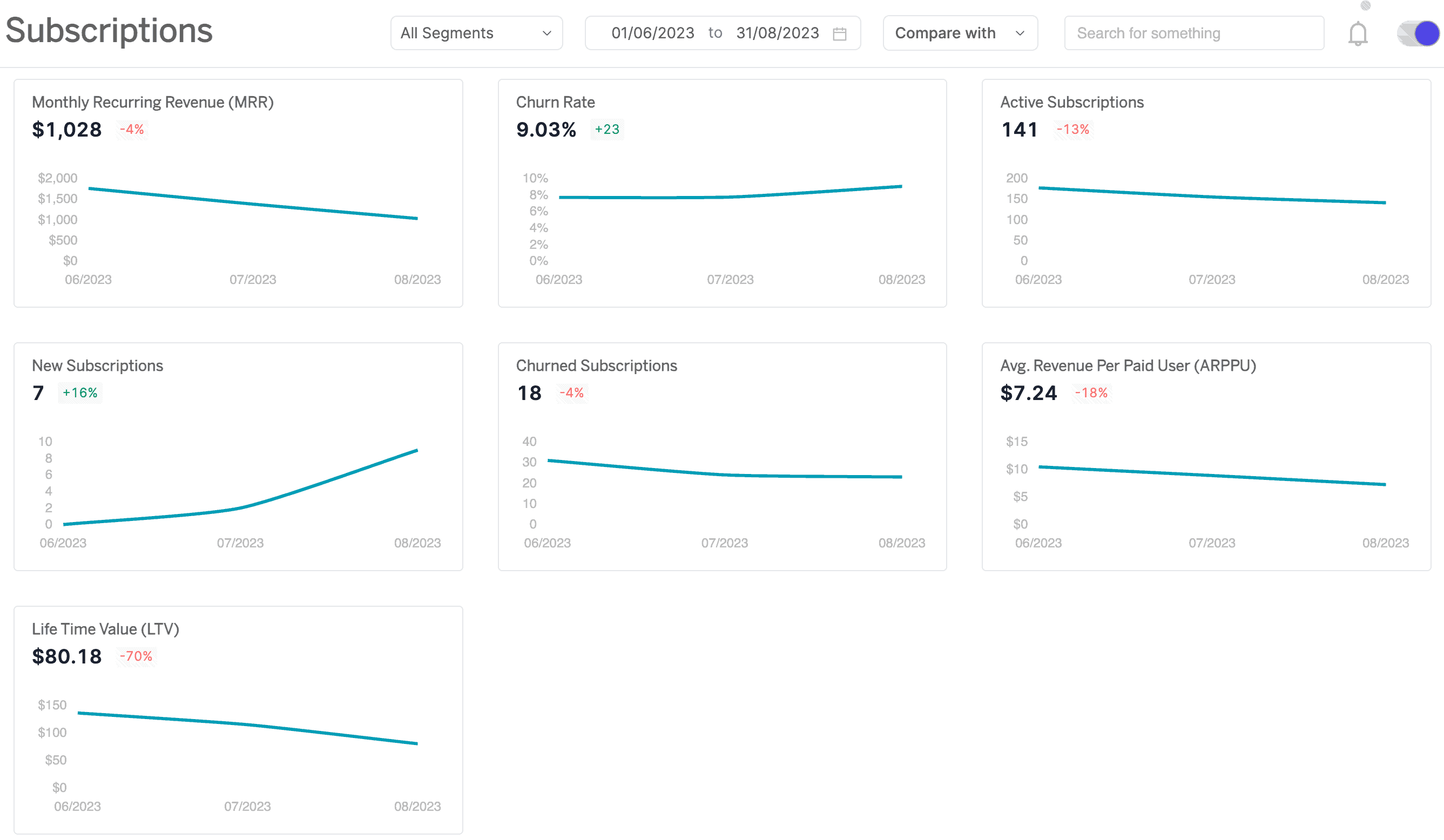
All the SaaS metrics are automatically calculated and displayed on the Subscription dashboard. You don’t have to work out anything manually or worry about the accuracy.
Easy right?
Give Putler a try and get your ARR and other key metrics updated automatically.
The Final Say
Any business, which is based on a subscription model, is going to get highly benefited from real-time tracking of ARR metrics as this gives a bigger and clear picture of the company’s future.
Additionally, it gives companies a chance to get things right and increase the growth momentum.
So, if a subscription-based payment model is what most of your customers follow, don’t overlook ARR metrics. Track it regularly and accurately and get to see the best path forward that one sets for the business growth.
Annual recurring revenue (ARR) FAQs
Here are answers to some of the most common questions about ARR.
Is ARR important for SaaS?
Yes. For SaaS businesses, ARR is one of the most important metrics to track. It helps you forecast revenue, plan for growth, and show investors that your business has a stable, predictable income stream.
What is ARR vs revenue?
ARR only counts recurring subscription revenue. Annual revenue, on the other hand, includes everything your business earns including one-time payments, consulting fees, and any other non-recurring income.
How do you optimize ARR?
There are three main ways. Acquire more customers to add new ARR. Upsell or expand existing accounts to grow expansion ARR. And reduce churn to protect the ARR you already have. Doing all three together is what drives compounding growth.
What is not included in ARR calculation?
One-time fees, setup charges, and non-recurring add-ons are not included. ARR only counts revenue you can reliably expect to repeat every year.
What is Annual Run Rate and how is it different from ARR?
Annual Run Rate projects what your revenue will look like over a full year based on recent performance. ARR is specific to subscription revenue only. So ARR can feed into your run rate calculation, but the two are not the same thing.