

Business analytics is only as useful as the information behind it.
An eCommerce dashboard might show that revenue increased last month, a particular product is becoming a bestseller, or repeat purchases are falling. These insights can influence decisions about inventory, advertising budgets, pricing, customer retention, and even hiring.
But there is an important assumption behind every chart and KPI: the underlying data is correct.
That is not always the case.
Business analytics accuracy depends on more than collecting enough data. It also depends on how reliably software captures, processes, transfers, transforms, and reports that information. A seemingly minor software issue can quietly change the numbers that decision-makers see.
This makes software quality and data quality closely connected. Reliable analytics requires both.
Accurate analytics starts before the dashboard
When people encounter an incorrect report, they often assume there is a problem with the analytics tool itself. In reality, the error may have occurred much earlier.
Consider a typical eCommerce transaction.
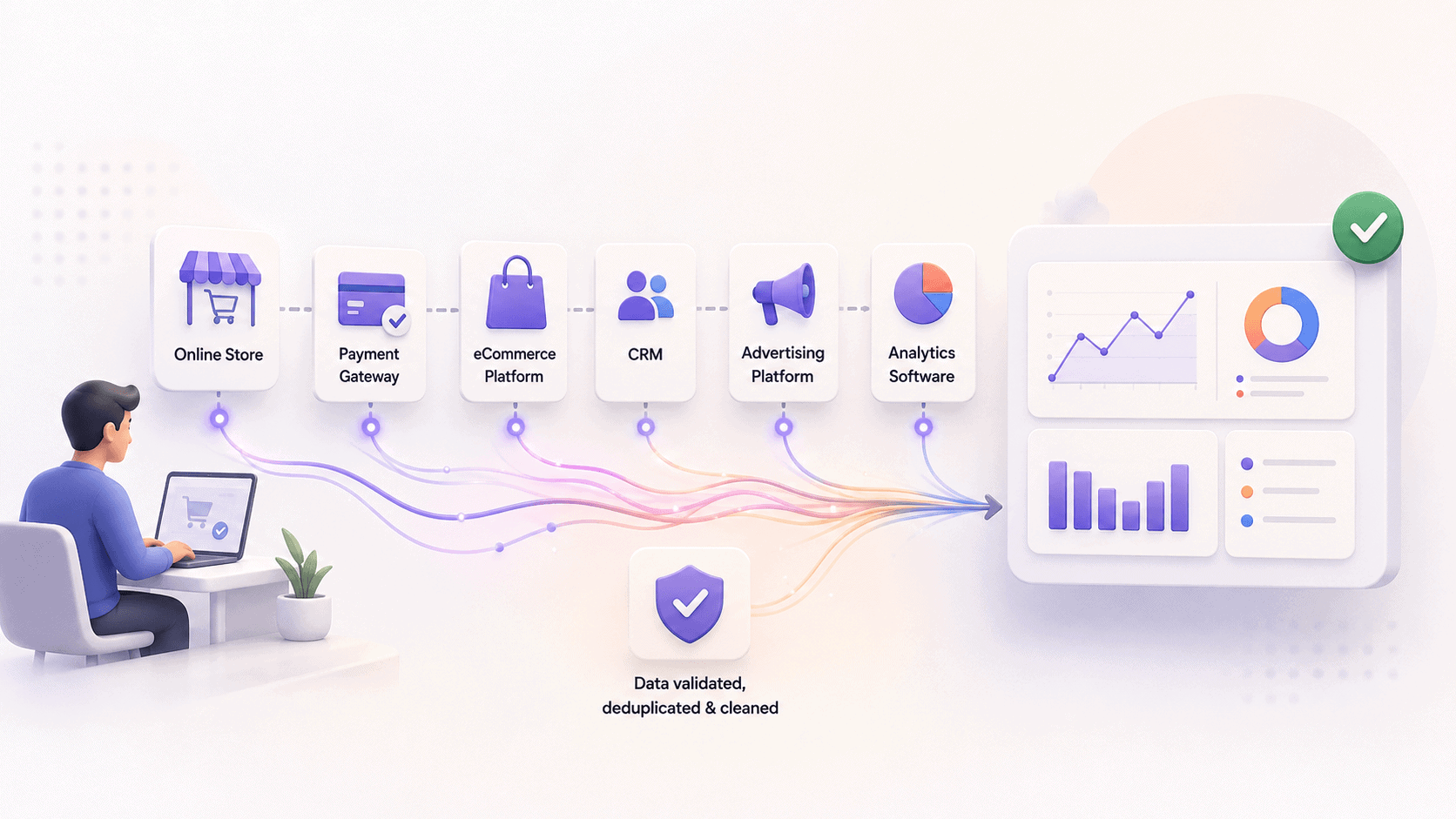
A customer visits an online store, adds a product to the cart, applies a discount, completes payment, and later perhaps requests a partial refund. That single journey may involve an eCommerce platform, payment gateway, analytics software, CRM, advertising platform, and other connected systems.
Each system collects or modifies part of the information.
For the final report to be accurate, the entire chain has to work correctly.
A few small breakdowns show how quickly the numbers drift:
- If a checkout event fires twice, revenue can be overstated.
- If refunds fail to synchronize, net sales may look healthier than they really are.
- If customer IDs are inconsistent across systems, one shopper might appear to be several different customers.
Putler, for example, helps address data inconsistencies by combining information from multiple eCommerce and payment platforms, deduplicating transactions, and cleaning the resulting data to create a more reliable view for reporting.
The dashboard is therefore the end of the story, not the beginning.
What data quality in analytics actually means
Good data is more than data without obvious errors.
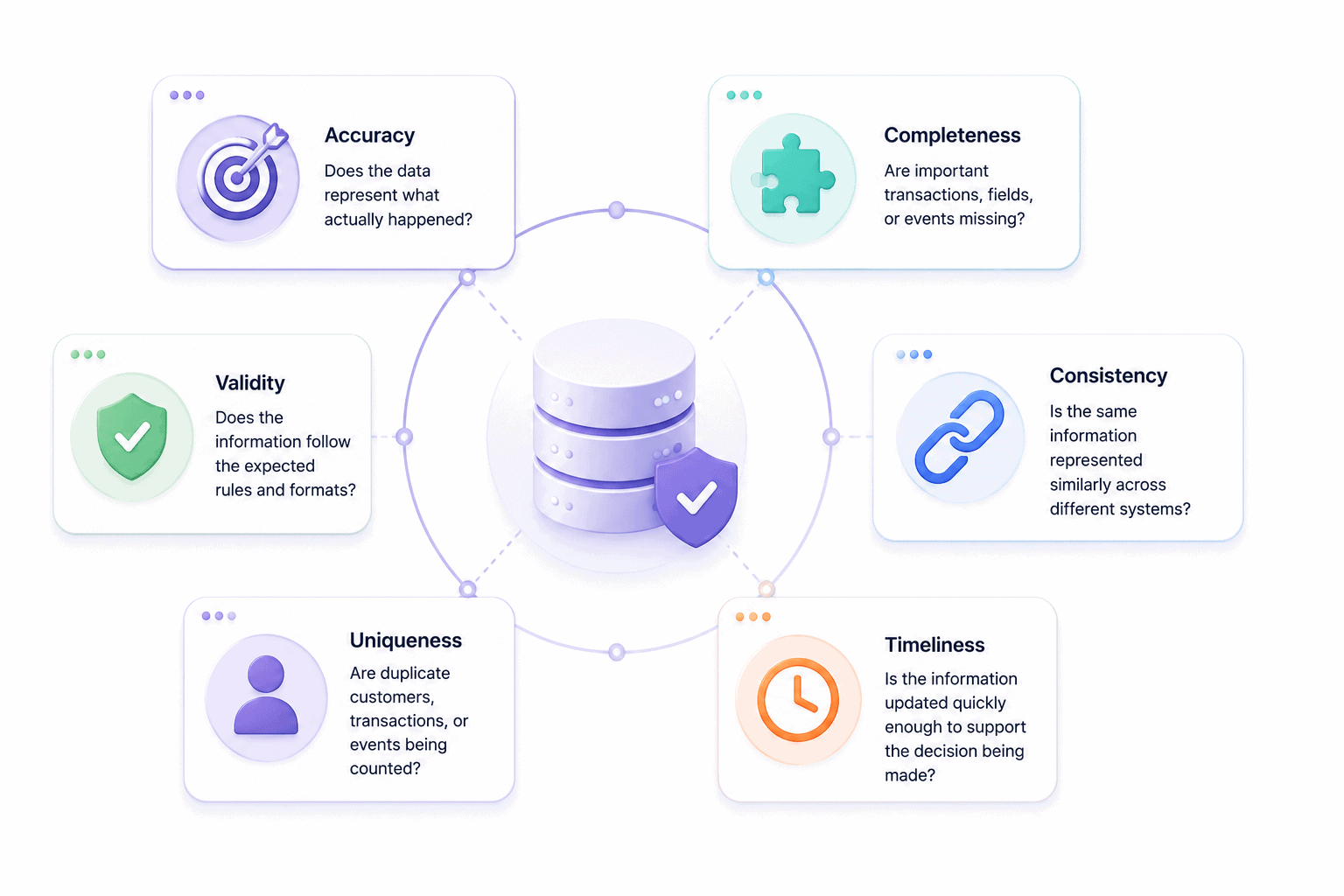
Several characteristics determine whether information can be trusted for analytics:
- Accuracy: Does the data represent what actually happened?
- Completeness: Are important transactions, fields, or events missing?
- Consistency: Is the same information represented similarly across different systems?
- Timeliness: Is the information updated quickly enough to support the decision being made?
- Uniqueness: Are duplicate customers, transactions, or events being counted?
- Validity: Does the information follow the expected rules and formats?
A dataset can perform well in one area while failing in another.
For example, every recorded transaction could contain perfectly accurate values, but if 15% of transactions are missing, the resulting revenue report is still unreliable.
This is why businesses should think about business analytics accuracy as a process rather than a simple question of whether a number looks reasonable.
How software problems become analytics problems
Software bugs do not always result in visible crashes or error messages.
Some of the most damaging issues are much quieter.
Imagine that an update changes how an eCommerce application sends transaction information to another system. Customers can still browse the store. Payments still work. Orders continue arriving.
From the customer’s perspective, nothing appears wrong.
But perhaps one field is no longer being transmitted correctly.
Over several weeks, that small issue can affect hundreds or thousands of records. By the time someone notices an unusual trend in a report, teams may already have made decisions based on incomplete information.
The same problem can occur with tracking implementations, APIs, integrations, database changes, checkout flows, subscription logic, or refund processing.
That is why teams increasingly treat testing as part of maintaining trustworthy business information rather than simply finding visible application bugs. A well-designed testing process checks important workflows and integrations before errors have an opportunity to reach downstream reporting.
For teams building these processes, a guide to effective software testing strategies can provide a useful framework for deciding what to test, where automation makes sense, and how testing fits into the broader development lifecycle.
The connection to analytics is straightforward: fewer unnoticed software failures mean fewer opportunities for inaccurate data to enter reporting systems.
Why eCommerce data accuracy is especially complicated
Data reliability becomes harder as a business grows.
A small store might initially rely on one eCommerce platform and a payment provider. Over time, it may add additional storefronts, marketplaces, subscription tools, advertising channels, CRM software, and multiple payment gateways.
Now the same business event can appear in several places.
Suppose an order is created in Shopify and processed through PayPal. Both systems record the transaction, but they may not describe it in exactly the same way. One platform might later receive a refund update before the other. Timestamps may use different time zones, product names may differ, or customer information may not match perfectly.
If these records are simply combined without reconciliation, reporting can become misleading.
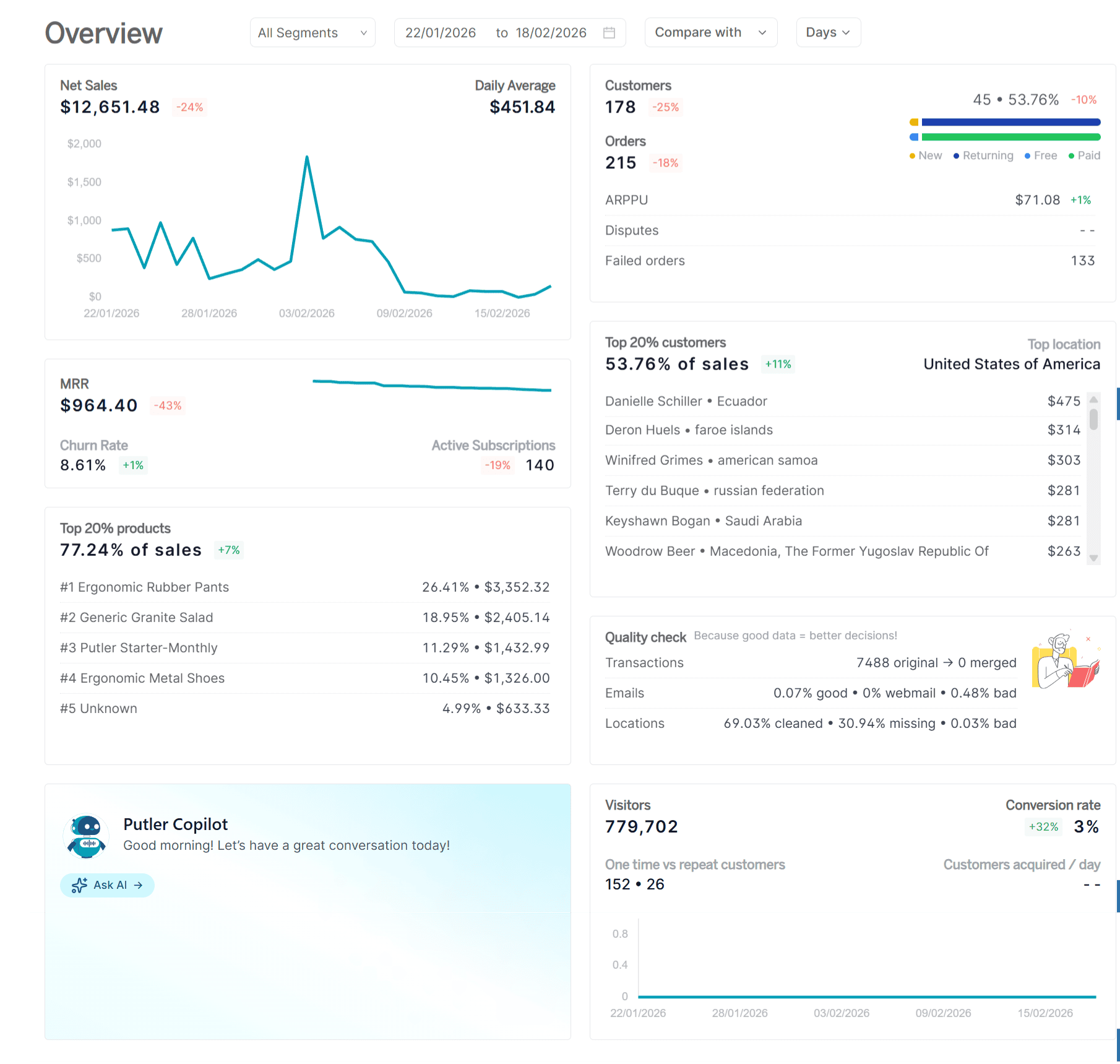
This is why data consolidation is more than putting information from several platforms into one dashboard. The information must also be cleaned, matched, deduplicated, and standardized.
The information must also be cleaned, matched, deduplicated, and standardized, particularly when businesses are consolidating sales data from multiple stores, payment gateways, and other eCommerce sources.
Otherwise, businesses can end up with a beautifully designed dashboard that presents inaccurate numbers very convincingly.
Poor data quality leads to poor business decisions
The biggest problem with inaccurate analytics is not the incorrect number itself. It is what happens next.
Imagine a report incorrectly suggests that a product category is experiencing rapid growth. The business may increase inventory, allocate more advertising budget to those products, or reduce investment elsewhere.
If the apparent growth was caused by duplicate transactions, the company has made several real decisions based on a technical error. Tools that combine transaction data from multiple eCommerce and payment sources can help identify and remove duplicate records before they distort reporting.
Similar problems can affect almost every part of an eCommerce operation:
- Incorrect customer data can distort retention analysis.
- Missing refunds can inflate profitability.
- Tracking errors can make one marketing channel appear more effective than another.
- Duplicate orders can affect average order value and product-performance reports.
Over time, inaccurate reporting can also create another problem: people stop trusting the data.
Once managers repeatedly encounter numbers that do not match reality, they begin checking reports manually, comparing multiple dashboards, and maintaining separate spreadsheets.
Analytics then becomes slower rather than faster.
Reporting reliability requires continuous monitoring
Testing software once does not guarantee permanently accurate analytics.
Modern eCommerce environments change constantly. Developers release new features. Payment providers update APIs. Tracking configurations change. New integrations are introduced. Product structures evolve.
Each change creates another opportunity for data collection or processing to behave differently.
Businesses therefore need ongoing checks at several levels:
- Critical customer journeys should be tested after important software changes.
- Integrations should be monitored for failures.
- Unexpected changes in transaction volume or event counts should be investigated.
- Data from different systems should also be reconciled periodically.
Analytics teams can contribute by monitoring unusual patterns.
A sudden 40% increase in conversion rate might be fantastic news. It could also indicate duplicate conversion events.
Healthy skepticism is valuable when a metric changes dramatically without an obvious business explanation.
Building a more reliable analytics foundation
Improving reporting accuracy does not necessarily require rebuilding an entire analytics stack.
It starts with understanding where important data originates and what happens to it before reaching a report.
Businesses should identify their most decision-critical metrics and trace those metrics back to their sources. Revenue, refunds, customer counts, subscription metrics, conversion rates, and product performance are good places to begin.
From there, teams can ask practical questions:
- Where is this number originally recorded?
- Which systems modify it?
- What happens if an integration fails?
- Could the same transaction be counted twice?
- How quickly are refunds or status changes reflected?
- How would we know if something stopped working?
These questions bring engineering, analytics, and business teams closer together.
That matters because data quality should not belong exclusively to analysts. Developers influence how data is generated. QA teams verify that workflows behave correctly. Analytics teams identify inconsistencies. Business teams provide the context needed to determine whether a number makes sense.
Reliable reporting is a shared responsibility.
Better software drives business analytics accuracy
Business analytics promises something extremely valuable: the ability to make decisions based on evidence rather than instinct.
But that promise depends on trust.
A sophisticated dashboard cannot compensate for duplicated transactions, missing events, broken integrations, outdated records, or incorrect business logic. The quality of the insight ultimately depends on the quality of the systems producing and processing the data.
For eCommerce businesses in particular, where information frequently moves between storefronts, payment processors, analytics platforms, and other tools, software reliability and data accuracy cannot be treated as separate concerns.
Testing helps protect the workflows that generate data. Data validation helps catch inconsistencies. Consolidation and reconciliation help create a dependable view across multiple sources. Continuous monitoring helps ensure that reliability does not disappear after the next software update.
When these practices work together, analytics becomes more than a collection of attractive reports.
It becomes something businesses can confidently use to decide what to do next.
- eCommerce data consolidation: connect 17+ sources with Putler
- Cross platform analytics for eCommerce: one view across every channel
- Putler features explained: the complete guide for eCommerce owners
- Best WooCommerce analytics alternatives for eCommerce sellers
- Best Databox alternatives for eCommerce sellers