
Duplicate payments are a predictable outcome of fragmented systems, not careless employees. A vendor sends an invoice through three channels.
A customer clicks “pay” twice on a slow checkout. The same Shopify order shows up in both Stripe and PayPal. Each one is a system failure waiting to happen, and the cost adds up faster than most finance teams realize.
Businesses lose between 0.1% and 2% of total disbursements to duplicate payments. For a company processing $100M annually, that’s $100K to $2M walking out the door each year.
This article covers how to prevent duplicate payments by addressing what actually causes them, the real financial damage, and five proven fixes that work whether the business is processing vendor invoices or eCommerce orders.
What duplicate payments actually are
A duplicate payment is when the same invoice, order, or transaction is processed and paid more than once. It shows up in two main forms:
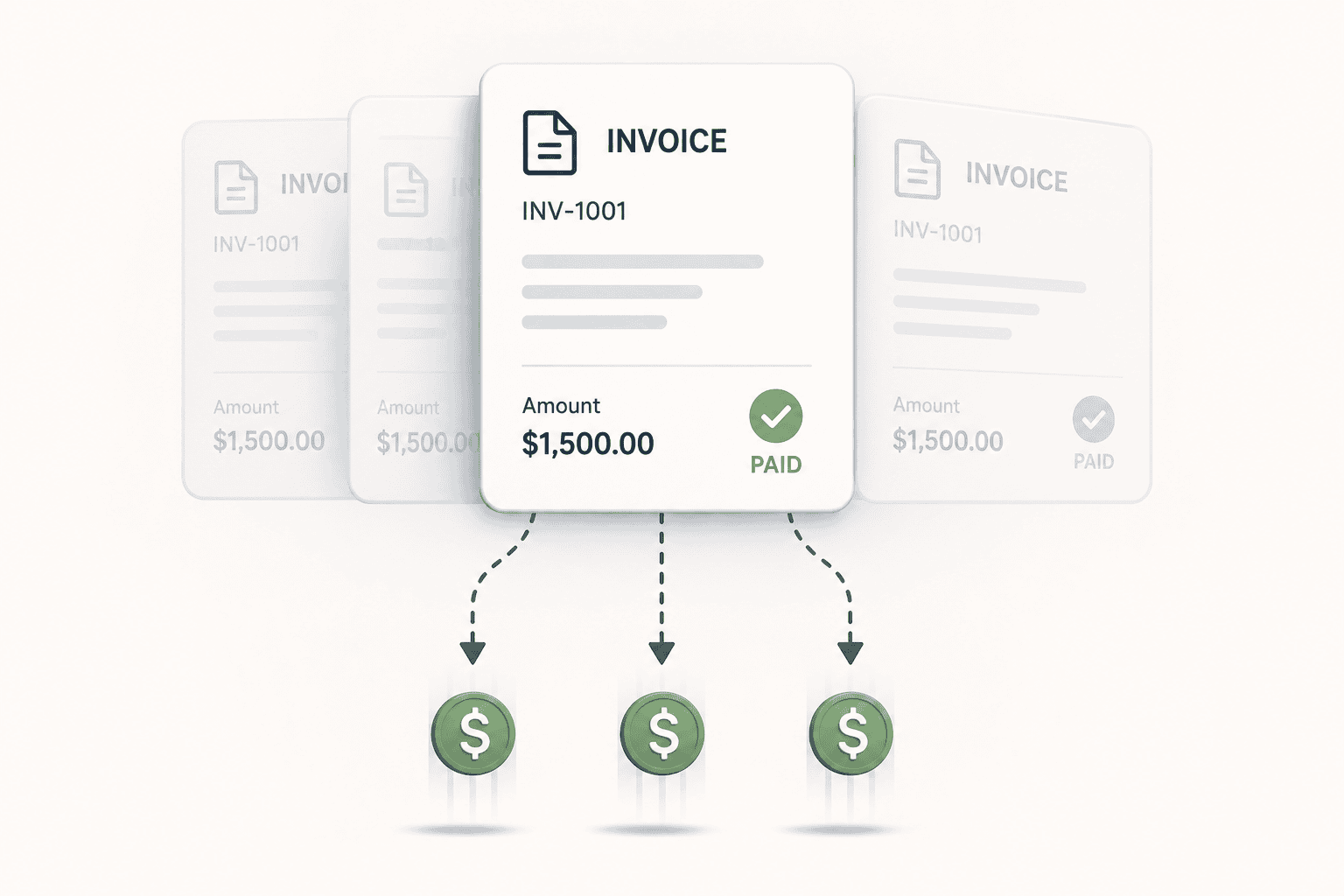
- B2B / accounts payable: A vendor invoice gets paid twice, once through the original submission and once through a resubmitted copy. Sometimes it’s a different invoice number for the same charge, sometimes it’s the same number processed twice.
- B2C / eCommerce: A customer is charged twice for one order, either because of a checkout glitch, a payment gateway retry, or the same sale being recorded across multiple platforms.
The common thread is system design. Duplicate payments aren’t usually about one careless employee. They’re about fragmented workflows, uneven visibility, and controls that don’t talk to each other. Fix the systems and the duplicates mostly stop.
The real causes of duplicate payments
The list below covers the patterns that show up across nearly every business that struggles with duplicate payments. Most teams will recognize at least three of these in their own workflows.
- Invoices arriving through multiple channels. A vendor emails the invoice, mails a paper copy, then resubmits through a portal. Each version enters the system as a new record because nothing connects them.
- Small data inconsistencies. “INV-5656,” “INV5656,” and “Invoice #5656” are the same invoice in three formats. ERP duplicate checks that match on exact strings treat them as three separate documents.
- Duplicate vendor or customer records. “ABC Corp (Vendor #1247)” and “ABC Corporation (Vendor #3891)” are the same supplier. The system can’t auto-match invoices between them, so each receives independent processing.
- Manual data entry errors. Flipped digits, typos, decimal points in the wrong place. Brex’s analysis puts manual processing error rates at 1% to 4% of total invoices, which translates to thousands of mistakes per year for mid-sized businesses.
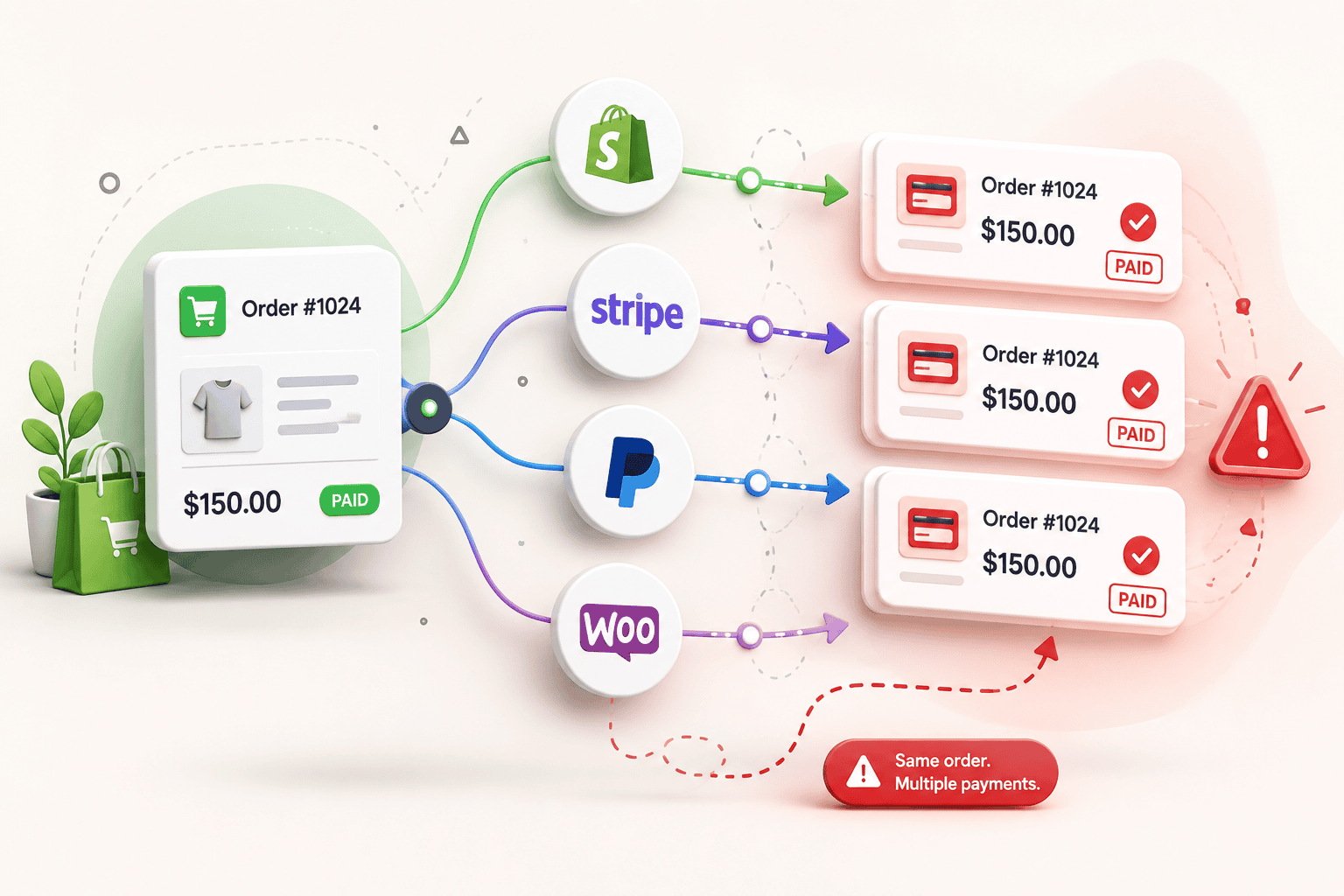
- Multi-platform payment processing. This one is the eCommerce killer. A customer pays via PayPal on Shopify, but Shopify Payments also captures the card. Same order, two charges, two platforms. Or the same sale shows up in both Stripe and WooCommerce, inflating reported revenue by 30% to 60%.
- Double-clicks and network retries at checkout. A customer clicks “Pay” twice on a slow page. Without idempotency keys at the gateway level, both requests process as separate charges.
- Rush payments bypassing controls. Manual “urgent” payments skip the approval workflow designed to catch duplicates. The faster the exception, the higher the duplicate risk.
- System migrations and upgrades. Moving from one ERP or payment processor to another creates an overlap window where both systems process invoices. Duplicates show up six weeks later when reconciliation catches up.
- Vendor resubmissions after payment delays. Vendor doesn’t see the payment within their expected window, sends a follow-up invoice. AP team processes both because nothing flags them as related.
The real cost of duplicate payments
The financial damage is bigger and more measurable than most teams assume.
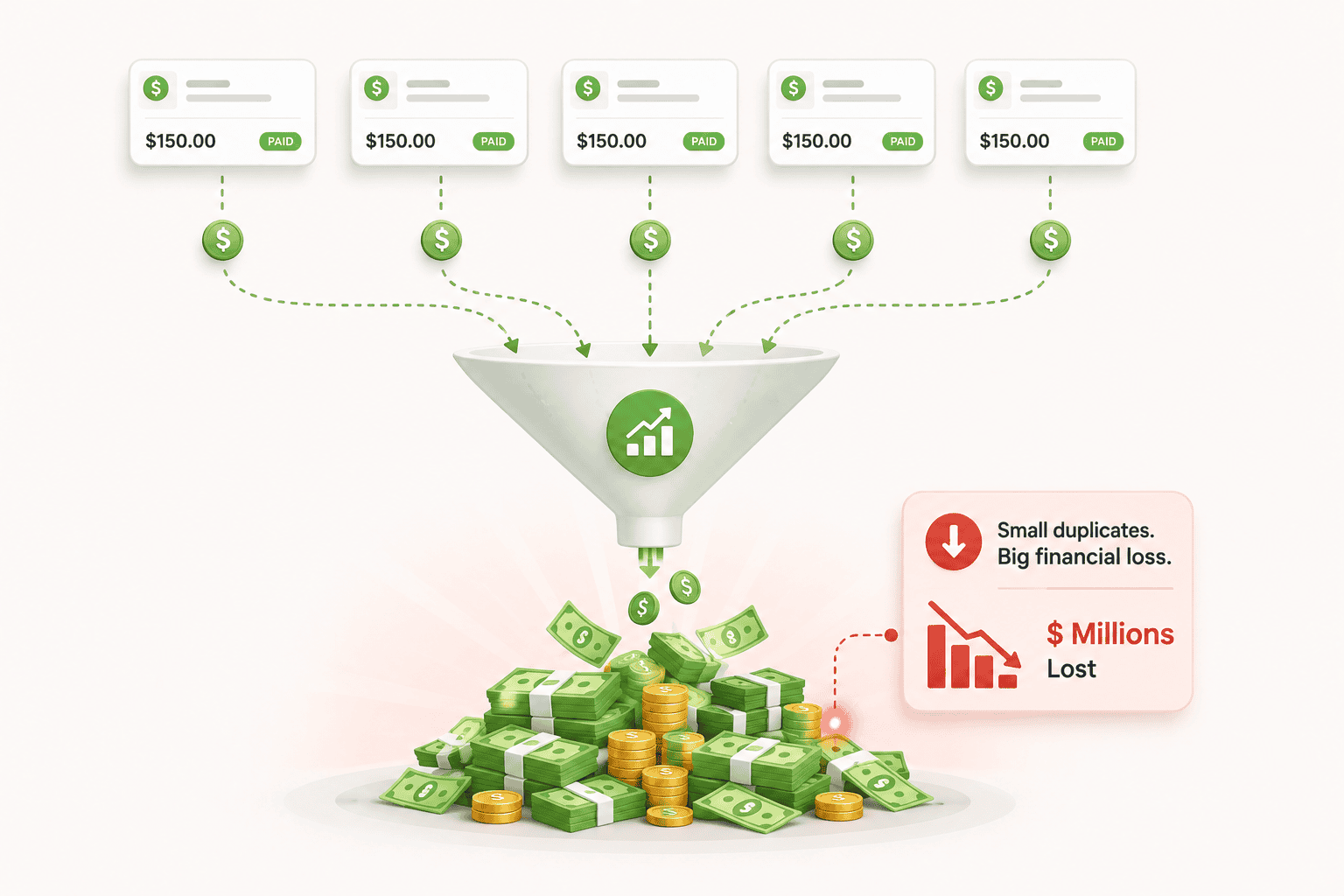
- A March 2026 Xelix study analyzing 481 million invoices found that US and UK businesses lose $53 billion per year to accounts payable financial leakage, with duplicate payments averaging 0.35% of annual spend, or $3.5 million per billion dollars processed.
- The Association for Financial Professionals puts duplicate payments at 0.1% to 0.5% of organizational disbursements. For a business with $150M in annual spend, that’s up to $750K per year.
- The American Productivity & Quality Center found 1% to 2% of all payments turn out to be duplicates across the businesses they surveyed.
- FraudNet’s research shows AP automation catches and prevents 95% of duplicate payments before processing, but only when it’s actually deployed.
The damage isn’t just the cash. The full cost picture includes:
- Chargebacks and refund disputes. Double-charged customers don’t wait politely for a refund. They file chargebacks with their bank, which means lost sales plus dispute fees.
- Damaged trust. B2B vendors and B2C customers both lose confidence after a duplicate payment. eCommerce reviews mentioning “double charged” sink conversion rates on the product page where they appear.
- Audit exposure. Patterns of duplicate payments signal weak internal controls to auditors. That triggers expanded scope reviews and increased scrutiny in future periods.
- Cash flow drag. Money tied up in overpayments isn’t available for operations. For mid-market businesses, even $50K sitting in a vendor’s account for 60 days while the return gets negotiated is a real working capital problem.
- Recovery cost. Stopping a duplicate before payment costs almost nothing. Recovering one after payment costs $160 to $240 in staff time alone, and many never get recovered at all.
5 ways to prevent duplicate payments
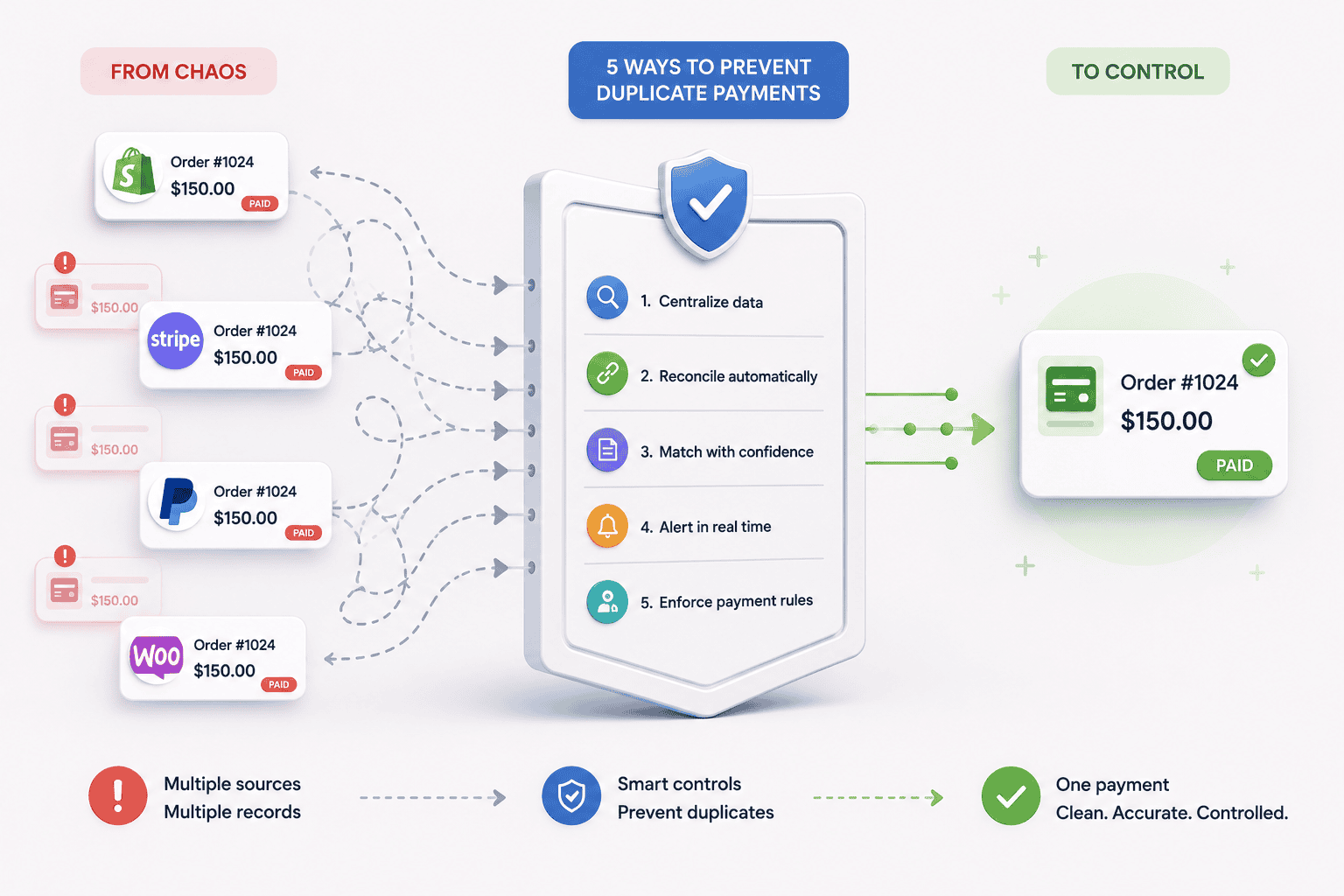
The fixes below address the upstream causes, not the symptoms. Companies that follow this order typically report duplicate rates under 0.05% of total disbursements.
1. Centralize invoice and order intake
The single biggest reduction comes from creating one entry point for every invoice or order. Email, portal, paper, EDI, and supplier-submitted invoices all funnel through one platform before processing.
This eliminates the “same invoice, three channels” problem at the source. A centralized intake system also creates a single audit trail, which makes it trivial to spot duplicates when they do slip through.
For eCommerce, the equivalent is a single source of truth for sales data across every connected store, marketplace, and payment gateway.
2. Clean and deduplicate vendor and customer master records
A dirty vendor file is the root cause of most duplicate payments according to AP recovery audit firms.
The fix is unglamorous but high-impact: audit the master file quarterly, standardize naming conventions, merge duplicate profiles, and lock down who can create new vendor or customer records.
The same applies to customer records in eCommerce. “John Smith (john@email.com)” and “John Smith (jsmith@email.com)” placing identical orders within minutes is a duplicate flag, but only if the records can be linked.
3. Automate three-way matching
Three-way matching compares the invoice, purchase order, and receipt before payment releases. Done manually, it’s slow and error-prone. Done with AP automation, it catches 95% of duplicates before processing.
Modern systems also do fuzzy matching, which spots near-duplicates that exact-match controls miss entirely (“INV-5656” vs “INV5656”). For eCommerce, the parallel is matching transactions across payment gateway, store platform, and order management system before the sale gets counted as new revenue.
4. Use idempotency keys and gateway-level controls
This is the most technical fix and the most important one for online businesses. Stripe’s idempotency keys are unique transaction identifiers that guarantee a payment request can be processed only once.
If a network retry or double-click sends a duplicate request, the system references the existing key and returns the original result instead of creating a second charge.
Most modern gateways (Stripe, Braintree, Razorpay) support idempotency keys natively. The work is making sure the checkout integration actually uses them, which is often missed during initial setup.
5. Use a unified analytics platform to catch what slips through
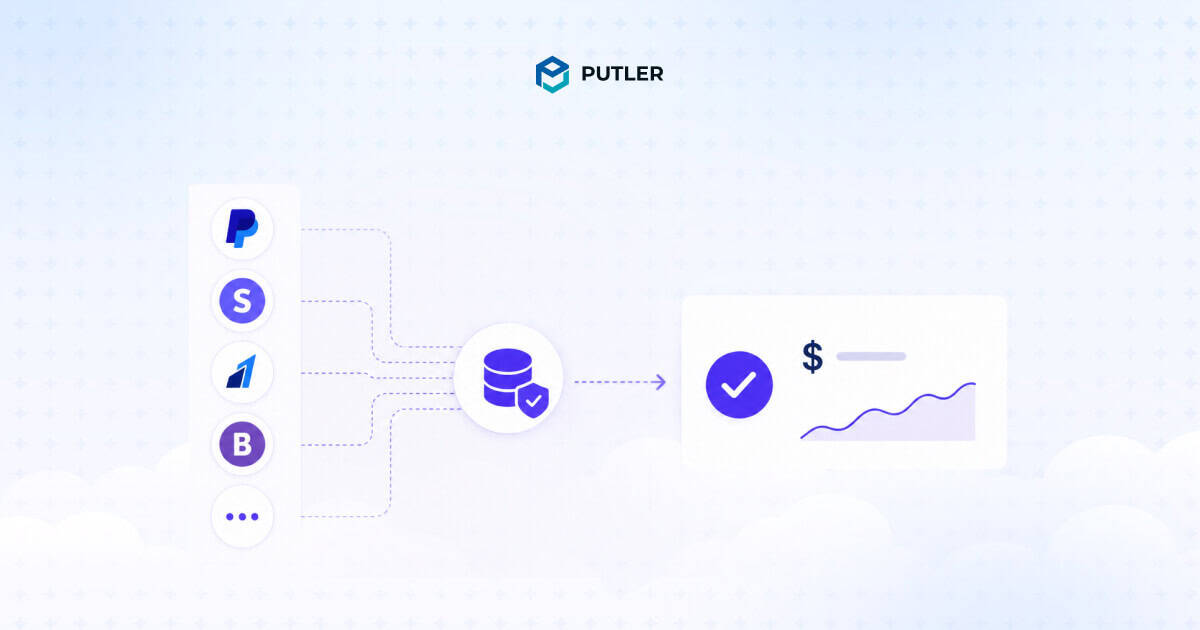
Even with strong upstream prevention, some duplicates survive. The last line of defense is a unified analytics layer that consolidates every payment source into one view and automatically flags duplicate transactions.
Putler does this across 17+ connected sources, including Shopify, WooCommerce, Stripe, PayPal, Braintree, Razorpay, Amazon, Etsy, and eBay. It matches transactions by ID, amount, timestamp, and customer record across platforms, deduplicates automatically, and normalizes 36 currencies into one base figure.
The activity log surfaces every sale, refund, and dispute in real time, so anomalies appear immediately instead of at month-end reconciliation when the trail has gone cold.
For a deeper view of how unified analytics dashboards handle this consolidation, the linked guide walks through the full workflow.
Final thoughts on how to prevent duplicate payments
Duplicate payments are a systems problem with a systems solution. Centralized intake, clean master records, automated matching, gateway-level idempotency, and unified analytics together reduce duplicate rates from 1 to 2% of disbursements down to under 0.05%.
The math on prevention versus recovery isn’t close. Stopping a duplicate before payment costs almost nothing. Recovering one after payment costs hundreds in staff time per case, and many never come back at all.
For eCommerce sellers running on multiple platforms and payment gateways, the consolidation problem is the hardest piece to solve manually. Putler handles the cross-platform deduplication, currency normalization, and real-time anomaly detection automatically.
Start a 14-day free trial, explore the live demo, or book a free consultation to see the unified view in action.