
BigCommerce vs Shopify used to have a simple cost answer: BigCommerce charged no transaction fees, Shopify did. As of June 2026, that answer is gone.
BigCommerce restructured its pricing on June 1, 2026, renamed every plan, lowered its sales caps, and introduced a transaction fee of its own. Most comparison articles still describe the old pricing, which makes them wrong on the single fact merchants care about most.
This article compares BigCommerce and Shopify on current 2026 pricing, transaction fees, features, SEO, scalability, analytics, and migration in both directions. It reflects the restructure that competing articles missed.
BigCommerce vs Shopify: quick comparison
| Factor | Shopify | BigCommerce |
|---|---|---|
| Entry plan | Basic $39/mo ($29 annual) | Core $39/mo ($29 annual) |
| Mid plan | Grow $105/mo ($79 annual) | Growth $105/mo ($79 annual) |
| High plan | Advanced $399/mo ($299 annual) | Scale $399/mo ($299 annual) |
| Enterprise | Plus from $2,300/mo | Performance from $1,499/mo |
| Transaction fee | 0% with Shopify Payments, 0.2% to 2% otherwise | 0% with embedded gateway, 0.6% to 2% otherwise |
| Card rate (entry) | 2.9% + 30¢ | Varies by gateway |
| POS | Native, POS Lite free | Third-party integration only |
| B2B | Advanced features on Plus | Native, lower tiers |
| App ecosystem | 8,000+ apps | ~1,200 apps |
| Best for | DTC, omnichannel retail, fast checkout | B2B, multi-storefront, URL control |
The headline: these two platforms have converged. Base prices now match tier for tier, and both charge a plan-based fee on payments processed outside their preferred gateway. Which one is cheaper depends almost entirely on how you take payments, not on the sticker price.
What is BigCommerce?
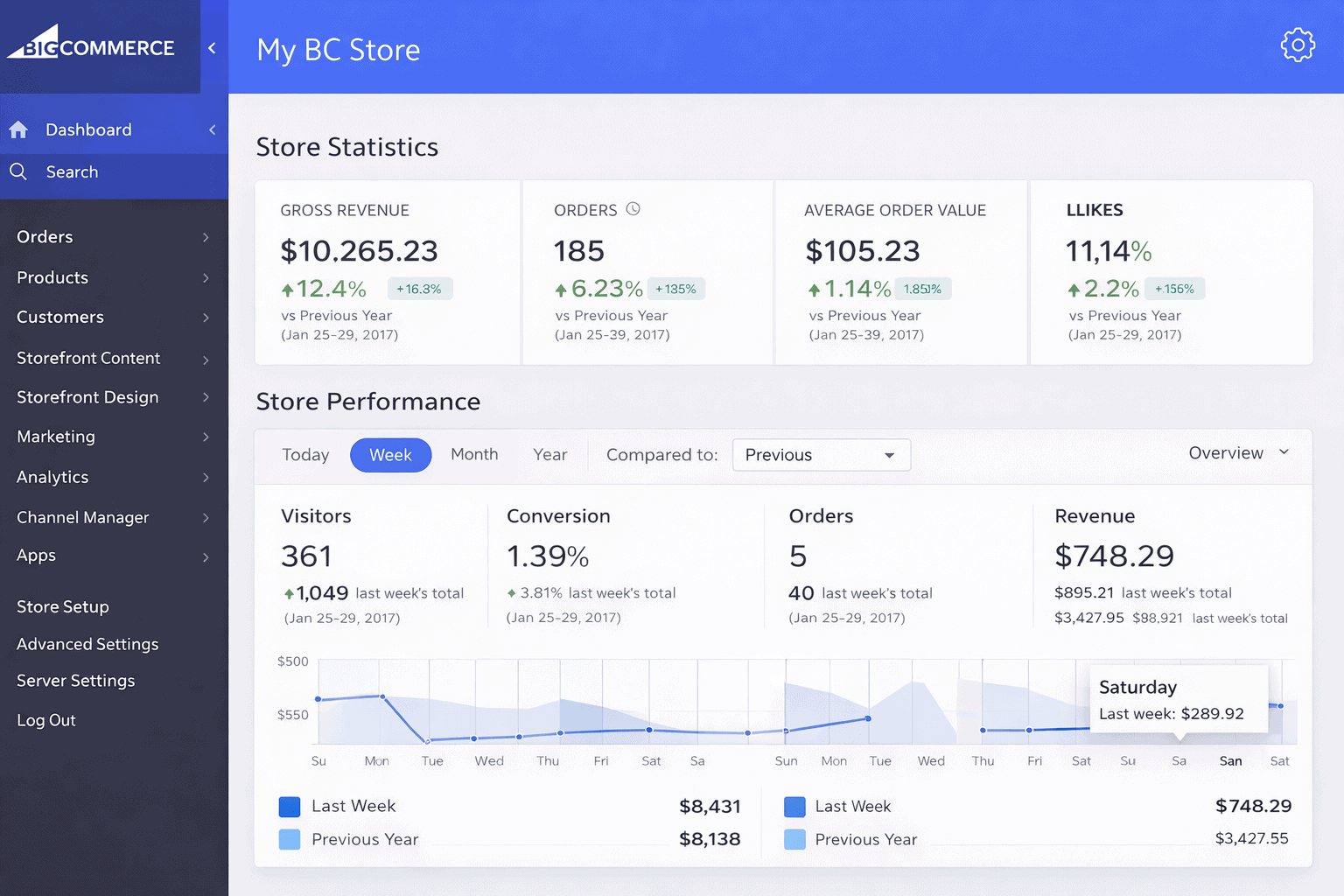
BigCommerce is a hosted eCommerce platform, like Shopify, but with a reputation for building more features natively and leaning less on apps. It has historically been the stronger choice for B2B and multi-storefront selling.
Its parent company rebranded to Commerce.com in 2026, though the BigCommerce platform name is unchanged. Live store counts are hard to pin down, but current estimates put it around 37,000 active stores, down roughly 8% year over year as the company shifts toward mid-market and enterprise accounts.
Notable brands on BigCommerce include Toyota, Skullcandy, Sony, and Ben & Jerry’s.
What BigCommerce includes natively:
- B2B tooling: price lists, customer groups, quotes, and purchase-order payments at lower price tiers than Shopify
- Multi-storefront: run several storefronts from one backend, added per storefront
- Faceted search and product filtering: built in, where Shopify often needs an app
- Full URL control: a real technical-SEO advantage covered later
What is Shopify?
Shopify is the largest hosted eCommerce platform in the world. It powers millions of stores, processed $378 billion in GMV in 2025, and dominates the direct-to-consumer market.
Shopify’s strengths are checkout conversion, the largest app ecosystem in commerce, native point of sale, and a clear lead in AI features. Brands on Shopify include Gymshark, Allbirds, SKIMS, and Supreme.
What Shopify includes:
- The highest-converting checkout in commerce: Shop Pay is widely regarded as the conversion leader
- Native POS: POS Lite free on every plan, sharing one inventory and customer layer with the online store
- Shopify Magic and Sidekick: free AI tools for content and admin tasks
- Agentic commerce: selling through ChatGPT, Gemini, and Copilot, managed from the admin
- Shopify analytics, with real limits covered later
Per Shopify’s Q1 2026 earnings, AI-driven traffic to stores grew 8x year over year, and orders from AI-powered searches grew nearly 13x. Whatever you think of the hype, the channel is real.
BigCommerce vs Shopify pricing in 2026
Pricing is where the June restructure changed everything in the BigCommerce vs Shopify decision, and where most comparisons are now wrong.
BigCommerce pricing after the June 2026 restructure
On June 1, 2026, BigCommerce renamed all plans and changed the economics.
| New name | Old name | Monthly | Annual | Sales cap | Open payment provider fee |
|---|---|---|---|---|---|
| Core | Standard | $39 | $29 | Up to $30K | 2.0% |
| Growth | Plus | $105 | $79 | Up to $100K | 1.0% |
| Scale | Pro | $399 | $299 | $400K, then 0.9% overage | 0.6% |
| Performance | Enterprise | From $1,499 | Contract | $3M | None |
Three changes matter:
- The no-transaction-fee era is over. The new Open Payment Provider Fee applies to any order processed through a gateway not on BigCommerce’s approved embedded list. It’s a BigCommerce fee, billed to you monthly, and it even applies to offline and purchase-order payments.
- Sales caps dropped sharply. The entry cap fell from $50,000 to $30,000 and the mid cap from $180,000 to $100,000. The same revenue that kept you on a cheaper plan last quarter can now force an upgrade.
- Inclusive GMV changed. The threshold calculation now reduces gross order value by 10%, up from 3%, and it counts taxes, shipping, and marketplace orders. The figure won’t match your own reports, which BigCommerce confirms is expected.
Who actually pays the fee: most B2C merchants on Stripe, PayPal, or BigCommerce Payments pay nothing, because those are embedded providers. The merchants hit are those on niche, regional, or industry-specific gateways, often the exact merchants who chose BigCommerce because it supported their processor.
Shopify pricing in 2026
Shopify runs five plans. Note the middle plan, previously called “Shopify,” was renamed Grow in 2026.
| Plan | Monthly | Annual (25% off) | Online card rate | Third-party gateway fee |
|---|---|---|---|---|
| Starter | $5 | N/A | 5% without Shopify Payments | N/A |
| Basic | $39 | $29 | 2.9% + 30¢ | 2.0% |
| Grow | $105 | $79 | 2.7% + 30¢ | 1.0% |
| Advanced | $399 | $299 | 2.5% + 30¢ | 0.6% |
| Plus | From $2,300 | Contract | Negotiated | 0.2% |
Shopify’s third-party gateway surcharge disappears entirely if you use Shopify Payments, now available in 39 countries. For most merchants, that’s a single setting that removes the fee.
Which one is actually cheaper
The uncomfortable answer for both vendors: they’re now priced almost identically.
- Base prices match tier for tier at $39, $105, and $399.
- Transaction fees match too. BigCommerce’s open-provider fee (2%/1%/0.6%) mirrors Shopify’s third-party surcharge (2%/1%/0.6%) almost exactly.
- Both fees vanish on the preferred processor: Shopify Payments for Shopify, an embedded gateway for BigCommerce.
So the cost winner is decided by your payment setup, not the platform. A merchant on a mainstream gateway pays no fee on either. A merchant on a specialty gateway now pays on BigCommerce where they previously didn’t, which tilts cost toward Shopify for that group.
Shopify’s own comparison page claims a 36% total-cost advantage. That figure comes from research Shopify commissioned and publishes itself, so treat it as marketing rather than neutral evidence.
Shopify vs BigCommerce: features
The BigCommerce vs Shopify feature gap is narrow on the basics. The differences show up in four areas.
B2B and wholesale: BigCommerce wins on capability per dollar. Native price lists, customer groups, quotes, and purchase orders come at lower tiers. Shopify made basic B2B features available on all plans in 2026, but advanced B2B stays locked to Plus.
Point of sale: Shopify wins decisively. POS Lite is free on every plan, POS Pro is $89 per month per location, and everything shares one inventory and customer layer with the online store. BigCommerce has no comparable first-party POS and relies on third-party integrations like Square or Lightspeed.
AI: Shopify is clearly ahead. Shopify Magic, Sidekick, semantic search, and agentic commerce are all live in 2026. BigCommerce’s native AI is thinner by comparison.
Multi-storefront and headless: BigCommerce offers native multi-storefront on standard plans, where Shopify reserves expansion stores for Plus. Both support headless commerce, Shopify through Hydrogen and BigCommerce through Catalyst.
On dropshipping, one correction worth making: Shopify shut down Oberlo in 2022. Its official replacement is DSers, with Spocket and AutoDS as strong alternatives. Any guide still recommending Oberlo is out of date.
Shopify or BigCommerce for SEO
Both platforms handle SEO fundamentals: SSL, editable meta tags, sitemaps, 301 redirects, and mobile themes. The difference is URL control.
BigCommerce allows full URL customization, including removing subfolder prefixes. That’s a genuine technical-SEO edge for large-catalog, content-led stores.
Shopify forces /products/ and /collections/ prefixes that can’t be removed, and creates duplicate paths when a product sits in multiple collections. Canonical tags handle the duplication by default, so it’s rarely the ranking problem people claim, but the lack of control is real.
BigCommerce also auto-generates product schema, where Shopify usually needs a theme edit or app.
For most stores, the URL difference matters less than content quality, speed, and backlinks. For a large catalog competing on organic search, BigCommerce’s control is worth having.
Scalability and performance
Both platforms scale to enterprise. They market different strengths.
Shopify markets managed reliability and proven peak-traffic handling. Plus offers around 10x the API throughput of Advanced and handles flash sales at tens of thousands of checkouts per minute.
BigCommerce markets API-first flexibility. Its rate limits run to 60,000 requests per hour on Scale, and Performance removes fixed limits. Large catalogs can hit ceilings on lower tiers.
On raw page speed, ignore any article quoting exact load-time averages like “1.3 seconds versus 2.2 seconds.” Those figures have no credible published source. Both platforms serve from global CDNs and both are fast. Real-world speed depends on your theme, image weight, and app load far more than on the platform.
BigCommerce to Shopify migration
BigCommerce to Shopify is the more common migration direction in 2026, accelerated by the pricing restructure.
What transfers: products, customers, order history, and some content, using tools like Matrixify, Cart2Cart, or a migration partner.
What doesn’t: your theme needs rebuilding, apps need reconfiguring from scratch, and customer passwords can’t move, so buyers reset on first login. BigCommerce CDN-hosted images often need re-hosting on Shopify.
Cost and time: roughly $500 to $3,000 for a small store, more for complex catalogs, with typical timelines of four to six weeks.
The SEO step that matters most: map every indexed BigCommerce URL to its new Shopify equivalent with 301 redirects, preserve title tags and meta descriptions, and resubmit your sitemap. Done wrong, stores report 20% to 60% organic traffic loss. Done right, rankings recover within four to eight weeks. Your old store stays live until DNS cutover, so there’s no downtime.
Shopify to BigCommerce migration
Merchants move from Shopify to BigCommerce for specific reasons: native B2B, multiple storefronts from one backend, ERP integration, URL control, and escaping per-app costs.
The process mirrors the reverse direction. Rebuild the theme, since Shopify’s Liquid themes don’t port to BigCommerce’s Stencil. Reconfigure apps. Passwords don’t transfer. Build a complete 301 redirect map, which BigCommerce’s URL flexibility actually makes easier to match against your old Shopify structure.
One honest caveat worth weighing: BigCommerce’s new sales caps and open-provider fee cut against some of the cost reasons merchants historically cited for moving. Run the numbers on your actual revenue and gateway before committing to the switch.
Where both platforms run out of reporting
Every merchant hits this eventually, and it’s the part of the BigCommerce vs Shopify comparison neither vendor advertises. Neither platform’s native analytics solves it.
Shopify gates reports by plan and caps them hard:
- Reports display a maximum of 1,000 rows in the admin
- Exports cap at 10,000 rows per report
- Session history only goes back to October 2022
- Attribution is last-click only, with no multi-touch option
- Deeper reports like cohorts are locked to Advanced and Plus
BigCommerce’s native analytics is surface-level. Its report suite covers the basics but is weak on lifetime value, cohort retention, and cross-channel attribution, and its exports are static snapshots.
The shared problem: neither platform can pull in ad spend for true ROAS, cost of goods from your accounting tool, or customer lifetime value across channels. And if you run either platform alongside Amazon, Etsy, or a second store, there’s no native consolidated view at all. Month-end becomes a CSV exercise.
Analytics across BigCommerce and Shopify with Putler
Putler connects both platforms and reports on them together.
It’s an eCommerce analytics tool that pulls sales, customer, product, and transaction data from BigCommerce, Shopify, payment gateways, and marketplaces into one dashboard. Multiple stores are supported, and duplicate records across sources merge automatically.
What that changes:
- One revenue number: combined across every store and channel, or filtered to one
- Customer segmentation: RFM analysis identifying your best and lapsing customers across platforms
- Product-level insight: which products carry margin, which sell together, which drive repeat purchases
- No row caps: full data access without Shopify’s 1,000-row admin limit
- Forecasting: revenue and customer projections built on your own history
- Faster exports: CSV in one click
Putler doesn’t replace either platform’s admin. It sits on top and answers the questions neither one can answer alone, which matters most if you run both platforms or you’re mid-migration between them.
BigCommerce or Shopify: which should you choose
Choose Shopify if:
- You sell direct-to-consumer and want the highest-converting checkout
- You sell in person and need native POS
- You want the largest app ecosystem and the strongest AI features
- You’re on a mainstream payment gateway, so no transaction fee applies
- Ease of use and speed to launch matter most
Choose BigCommerce if:
- You sell B2B or wholesale and want native tooling at a lower tier
- You need multiple storefronts without jumping to enterprise pricing
- Full URL and technical-SEO control matters for a large catalog
- You use an embedded gateway, so the open-provider fee doesn’t apply
The deciding question for most merchants isn’t features. It’s payments. On a mainstream processor the platforms cost nearly the same, so pick on fit. On a specialty processor, BigCommerce’s new fee tilts the math toward Shopify.
If you go with Shopify, growing sales on Shopify is the natural next step, and knowing the common issues Shopify stores face helps you prepare.
FAQs
BigCommerce versus Shopify: which is cheaper?
They’re now priced almost identically. Base plans match at $39, $105, and $399, and both charge a similar transaction fee on payments outside their preferred gateway. On a mainstream processor, both cost the same. On a specialty gateway, BigCommerce’s new fee makes Shopify cheaper.
Does BigCommerce still have no transaction fees?
No. As of June 1, 2026, BigCommerce charges an Open Payment Provider Fee of 2% on Core, 1% on Growth, and 0.6% on Scale for orders processed through a non-embedded gateway. Using an embedded provider like Stripe, PayPal, or BigCommerce Payments avoids it.
What was renamed in BigCommerce’s 2026 restructure?
Standard became Core, Plus became Growth, Pro became Scale, and Enterprise became Performance. Sales caps were lowered and the Open Payment Provider Fee was introduced at the same time.
Which is better for SEO?
BigCommerce gives more URL control and auto-generates schema, a real edge for large catalogs. Shopify forces fixed URL prefixes but handles duplicate content with canonical tags. For most stores the difference is smaller than content and speed.
Which is better for B2B?
BigCommerce, on capability per dollar. Native price lists, quotes, and purchase orders come at lower tiers. Shopify’s advanced B2B features are locked to its Plus plan.
Which has better point of sale?
Shopify. POS Lite is free on every plan and shares one inventory and customer layer with the online store. BigCommerce relies on third-party POS integrations.
Can I migrate between the two platforms?
Yes, in both directions. Products, customers, and orders transfer through tools like Cart2Cart or Matrixify. Themes, apps, and passwords do not, and need rebuilding. Map 301 redirects carefully to protect rankings.
Which has better analytics?
Both are limited. Shopify gates reports by plan and caps them at 1,000 rows in the admin. BigCommerce’s native reporting is surface-level. Neither consolidates data across multiple stores or channels, which is where a tool like Putler fills the gap.
BigCommerce vs Shopify: the honest verdict
Neither platform is better outright. Shopify fits direct-to-consumer, omnichannel, and mainstream-gateway sellers. BigCommerce fits B2B, multi-storefront, and embedded-gateway sellers.
The 2026 restructure erased BigCommerce’s oldest selling point, so the decision now rests on how you sell and how you take payments. Both leave you short on reporting, which is the one gap you’ll hit either way.
- Shopify vs WooCommerce: a full comparison of the two most popular eCommerce platforms
- PayPal vs Stripe: which payment gateway fits your store
- Etsy vs eBay: where to sell handmade and resale products
- Authorize.net vs Stripe: comparing two major payment processors
- Shopify analytics: what the native reports show and where they stop