

Running multiple Etsy shops is allowed, and Etsy actively encourages it when sellers cater to different products or niches. The harder part is managing them without letting the extra accounts, logins, and reports eat your week.
This guide covers the current rules for running multiple Etsy shops in 2026, how to open and switch between shops, whether Etsy can connect your accounts, the real pros and cons, and the tools that keep everything in one view. It reflects Etsy’s latest seller policies and the native shop-switching feature most older guides still get wrong.
By the end, you’ll know:
- Whether you can (and should) have more than one Etsy shop
- Etsy’s exact rules for running multiple stores without risking suspension
- How Etsy connects your shops, and how to stay compliant
- Step-by-step instructions to open and switch between Etsy shops
- The pros and cons of running multiple Etsy stores
- The smartest tools to manage multiple Etsy shops from one place
Can you have more than one Etsy shop?
Yes. Etsy allows sellers to open multiple shops, and it doesn’t publish a cap on how many you can run, as long as each one follows Etsy’s guidelines and transparency rules.
Here’s what every additional shop needs:
- A separate Etsy account
- A separate email address
Each new shop also has to adhere to Etsy’s Seller Policy. One person can own two shops, five shops, or more. The constraint is never the number. It’s whether each shop has a distinct purpose and stays compliant.
One limit worth knowing up front: each Etsy account holds exactly one shop and one email address at a time. So “can I have multiple Etsy shops on one account” has a simple answer. No. Every shop means a new account with its own email.
Etsy’s rules for running multiple shops
Most suspensions tied to multiple Etsy shops come down to a handful of rules sellers overlook. Get these right and the rest is just workload.
- Separate account and email: You cannot run two shops from one account or one email. Each shop needs its own login and a unique email address.
- Disclose every shop publicly: Etsy requires transparency. List the names of your other shops in the public profile section of each account so it’s clear you own them.
- Shared payment info is allowed: You can use the same bank account, credit card, and PayPal across all your shops. You must use the same taxpayer ID and address when applicable.
- No duplicate shops or listings: This is the big one. Etsy strictly prohibits creating duplicate shops or listing the same items across shops to manipulate search rankings. Doing it can get every shop you own suspended, not just one.
- Shops can’t be merged or transferred: Etsy can’t move shop information from one account to another, and it can’t combine two shops onto one account. If you want the same product in two shops, you recreate the listing manually.
- One LLC can own multiple shops: A single business entity can hold several Etsy shops in practice. Keep separate financial records for each shop’s transactions and you’re fine.
The honest summary: Etsy is generous about how many shops you run and relaxed about shared finances. It is strict about duplication and transparency. Those two lines are where accounts get flagged.
How Etsy connects your multiple Etsy accounts (and how to stay safe)
Running multiple Etsy shops from one computer (IP address) is completely allowed. The worry sellers actually have is different. They’re afraid Etsy will link their accounts, decide something looks coordinated, and suspend the lot. That fear is worth addressing directly.
Platforms in general associate accounts through a few signals: the device you log in from, your IP address, and the cookies your browser carries between sessions. None of that is unique to Etsy, and none of it is a problem on its own. Owning multiple Etsy shops is within the rules. The trouble starts only when the shops look like an attempt to game the system.
So the goal isn’t to hide that you own several shops. Etsy already requires you to disclose them. The goal is to keep each shop clean and distinct:
- Use a separate email and account per shop: Non-negotiable, and it’s the foundation of staying compliant.
- Disclose every shop in each public profile: Transparency is the opposite of a red flag. Hiding ownership is what looks suspicious.
- Never duplicate listings across shops: Identical items in multiple shops is the single fastest way to get flagged for manipulating search.
- Keep taxpayer ID and address consistent: Mismatched identity details across accounts create confusion you don’t want.
- Use separate browsers or browser profiles: One shop in Chrome, another in Firefox, or a dedicated browser profile per shop keeps sessions tidy and makes day-to-day management easier.
Some guides push antidetect browsers that mask your device fingerprint to make shops look unrelated. Skip that route. It’s built for evading platform detection, and it works against the transparency Etsy explicitly requires. Play inside the rules and multiple Etsy shops are a normal, safe thing to run.
Should you open a second Etsy shop?
Many Etsy sellers assume that opening multiple Etsy shops automatically leads to more sales. In reality, it only works when each shop serves a different purpose.
A second Etsy shop may make sense if:
- You sell products in completely different categories.
- Your target customers are very different.
- You want separate branding for each product line.
- You sell both physical and digital products.
- You operate in different regions or markets.
The physical-versus-digital split deserves a mention of its own. Physical goods need shipping profiles, packaging, and processing times. Digital downloads deliver instantly and need none of that. Buyers who skim listings often confuse the two, so splitting them into separate shops removes a common source of refund requests and one-star surprises.
A second shop may not be necessary if:
- Your products serve the same audience.
- You can organize products using Etsy sections and categories.
- Managing inventory and customer support is already challenging.
There’s a simpler test before you commit. Use Etsy’s Sections feature to organize product categories inside one shop first. If that still leaves your branding or audience muddled, that’s your signal a second shop is worth it.
Will a new shop solve a customer problem, or simply create more work?
For many sellers, improving an existing store produces better results than creating another one.
Common reasons sellers create multiple Etsy shops
Sellers open multiple Etsy shops for strategic reasons, not for the novelty of a second dashboard. The most common ones:
- Separate brands: A shop selling wedding invitations may create a separate brand for pet accessories. Unrelated categories rarely share an audience.
- Different target audiences: Separate stores keep messaging and product positioning focused for different buyers.
- Physical and digital products: One shop for shipped goods, one for instant downloads, so buyers always know what they’re getting.
- Testing new business ideas: A second shop lets sellers experiment with new products without affecting the reputation of an established store.
- International expansion: Some sellers create dedicated shops to serve customers in different countries and regions, including regions with their own rules like GDPR in the EU.
Advantages of running multiple Etsy shops
Running multiple Etsy shops comes with real upside when each shop is focused.
- Increased product visibility: Expanding your product presence across shops helps you reach more customers.
- Sharper niche marketing: Each shop can focus on a specific target audience with more precision.
- Room to test strategies: Run different prices, titles, and sales strategies per shop and compare what works.
- Cleaner branding: Distinct branding per shop helps each store stand out and build its own loyal following.
Disadvantages of running multiple Etsy shops
The downsides of running multiple Etsy shops are mostly about time and risk, not fees.
- Separate accounts and emails: Every new shop means another account and another email address to manage.
- More time and effort: Multiple stores demand more work. You’ll switch between shops regularly to keep everything on track.
- Room for manual errors: Juggling several shops raises the odds of human error in listings, inventory, and orders.
- Higher costs: Listing fees and any paid tools multiply with each shop you add.
- Linked account risk: Etsy reviews your shops together. A violation in one shop can affect all of them, so one weak shop puts the rest at risk.
Dos and don’ts of multiple Etsy shops
Before setting up your multiple Etsy shops, run through these practices. This checklist keeps your shops compliant and manageable.
- Avoid duplicate shops and listings.
- Mention the names of all your shops in each shop’s public profile.
- Follow Etsy’s seller policy to keep your shops transparent.
- Register each new Etsy shop with a different email address.
- Use Etsy’s native “Switch shop” option or separate browsers to manage shops.
- Use the Etsy Seller app to receive orders and messages across shops.
- Keep your taxpayer ID and address consistent across accounts.
- Use the same credit card and bank information to simplify payments.
- Open more shops only when each one has a distinct purpose.
How to open a second Etsy shop (step-by-step)
Once you’ve validated your reasons and checked the rules, opening a second Etsy shop is simple.
- Sign out of your current Etsy account.
- Go to Etsy.com and select “Sign in.”
- Choose “Register” to create a new account.
- Enter a new email address that isn’t linked to another Etsy shop, along with your name and password, then select “Register.”
- Follow the prompts to set up your new shop.
You can repeat these same steps to create every additional shop. Etsy doesn’t let you transfer listings between shops, so any product you want in both stores has to be recreated by hand.
How to switch between multiple Etsy shops
Older guides tell you to log out and log back in every time you change shops. That’s no longer the full picture. Etsy now gives you faster ways to move between accounts.
- Native shop switching: In Shop Manager, use the “Switch shop” option in your account menu to move between shops you’re signed into without a full log-out.
- Separate browsers or profiles: Log in to one shop in Chrome and another in Firefox, Safari, or a separate browser profile, so you can view both at once and compare side by side.
- Etsy Seller app: The app lets you receive notifications, messages, and orders from multiple accounts without constantly signing in and out.
None of these solve the deeper problem though. Switching lets you view one shop at a time. It doesn’t give you a combined picture of how your whole business is performing.
What multi-shop checkout means for sellers
Multi-shop checkout is an Etsy feature that lets a buyer purchase items from several shops in a single payment, as long as those shops use Etsy’s Direct Checkout. It matters to anyone running multiple Etsy shops because it changes how buyers move between your multiple Etsy shops.
Here’s how it plays out:
- One cart, one payment: A shopper buying from three of your shops at once completes a single transaction instead of three separate checkouts.
- Separate receipts per shop: Each shop still sends its own receipt with its own branding, location, and message to the buyer. Buy four items from three shops, get three receipts.
- Direct Checkout required: If a shop doesn’t have Direct Checkout enabled, its items sit in a separate section of the cart and the buyer pays for them separately.
The practical upside: buyers used to abandon items from a second shop after finishing their first payment. A combined cart removes that friction, which quietly helps sellers who run more than one shop.
How to manage multiple Etsy shops efficiently
Managing one Etsy shop is simple enough. Managing multiple Etsy shops becomes a daily juggling act the moment order volume picks up.
Common challenges include:
- Switching between multiple Etsy accounts.
- Checking messages and orders across every shop.
- Managing inventory and product listings.
- Comparing store performance to spot growth opportunities.
- Creating consolidated reports for your business.
Most of the daily pain is operational, not analytical. Before reaching for any analytics tool, these habits keep the day-to-day under control:
- Use the Etsy Seller app for daily triage: It pulls messages and orders from multiple accounts into one app, so you handle customer support without logging in and out.
- Keep a browser profile per shop: A dedicated profile for each store stays logged in and ready, which beats signing out every time you switch.
- Run a tabbed workspace: Sellers with many shops often keep each store in its own pinned tab or workspace app, then move down the list once a day to clear messages.
- Set a fixed daily routine: Pick a time, work through every shop’s messages and orders in the same order, and you’ll never leave a buyer waiting in the shop you forgot about.
Those habits handle the operations. The reporting side is where the switching-and-exporting approach falls apart, and that’s a different problem to solve.
Best tools to manage multiple Etsy shops
There are plenty of tools built to help you manage, promote, and monitor multiple Etsy shops from one place. Here are the ones worth your time, sorted by what they do best.
Best for multistore analytics on Etsy: Putler
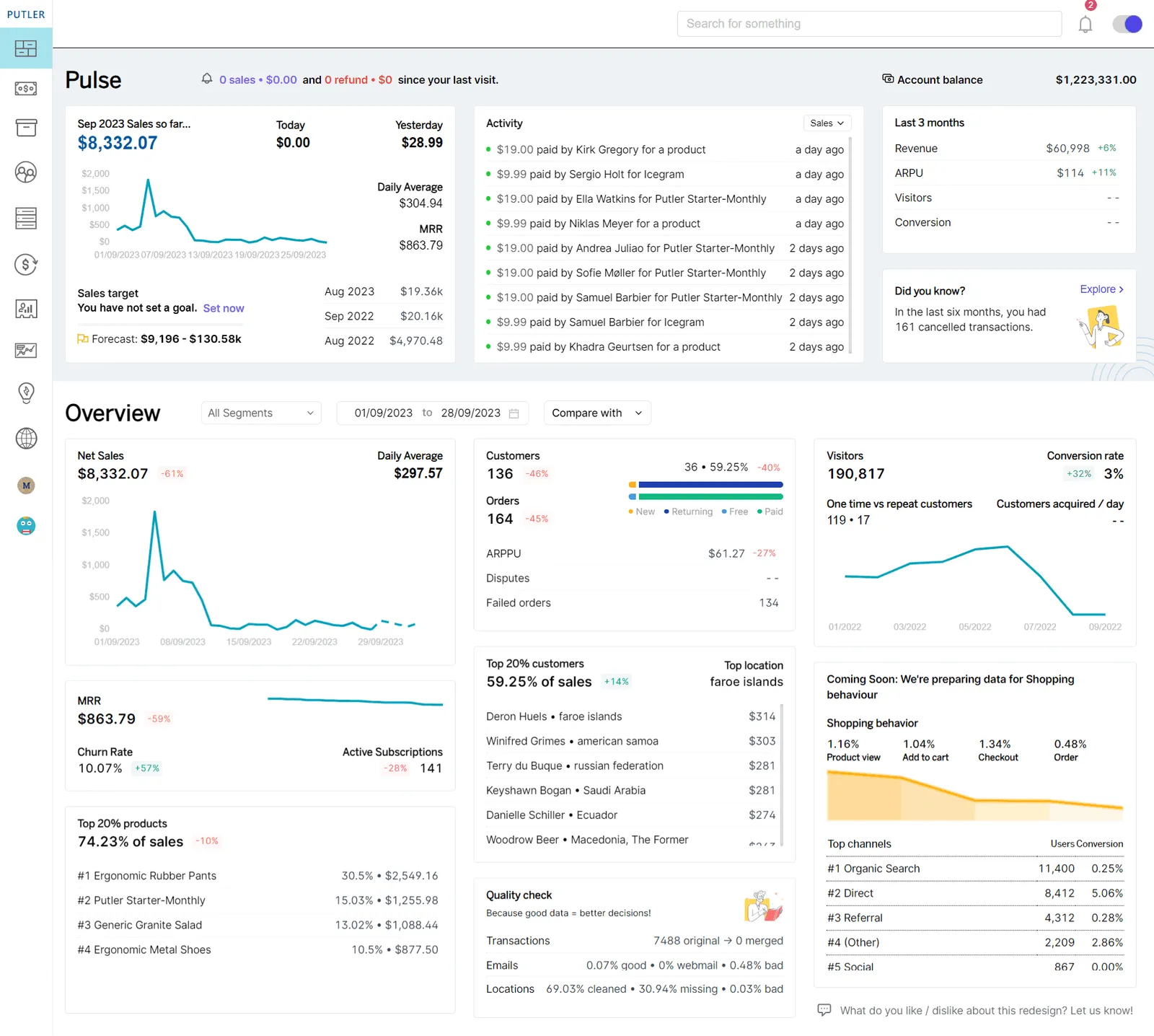
When you run multiple Etsy stores, the biggest challenge is understanding your overall business performance. Switching between accounts, exporting reports, and comparing shops by hand eats hours.
Putler solves this by bringing data from all your multiple Etsy shops into a single dashboard, so you monitor and analyze everything from one place.
Putler is an eCommerce analytics tool that helps Etsy sellers track sales, products, customers, and overall store performance.
The biggest USP: It lets you monitor all your Etsy shops from one centralized place. Switch between stores or view consolidated reports across every shop with a single click.
Putler provides advanced reports on every key metric including sales, products, customers, transactions, customer segments, and subscriptions. Beyond reports, it also delivers actionable insights, forecasts, sales heatmaps, and growth tools that help you make better business decisions.
You can connect unlimited Etsy stores to Putler. It automatically imports, merges, cleans, and enriches your store data, giving you a complete picture of your business without manual effort.
This lets you:
- View combined sales across all Etsy shops.
- Compare the performance of individual stores.
- Identify top-selling products and valuable customers.
- Track trends and seasonal demand patterns.
- Generate reports without manually exporting data.
Whether you manage two or twenty multiple Etsy shops, centralized reporting saves hours every week and helps you make faster, data-driven decisions.
Price: $20/month onwards
Features:
- In-depth reports on products, customers, sales, and transactions
- Advanced eCommerce and SaaS metrics
- Customer segmentation based on RFM (recency, frequency, monetary)
- Quick CSV exports and weekly email updates
- Revenue, customer, and holiday-season sales forecasting
- Actionable insights and sales heatmaps
- Multiple Etsy store consolidation, data cleansing, and reports
- Performance comparisons across several levels
- Monthly goal monitoring and tracking
- Ready-made filters plus custom segmentation
Other tools worth knowing
Two more tools cover jobs Putler doesn’t, and many sellers running multiple Etsy shops use them alongside analytics.
Vela: best for bulk-editing listings. It edits thousands of listings in seconds, so setting up a sale, adding tags, or optimizing photos across shops takes minutes. Free to use. Open Vela.
Backsty: best for automatic backups. It runs automatic backups with manual restore, so you can revert a shop to a previous version if something breaks. From $3.70/month. Open Backsty.
FAQs
Can I have multiple Etsy shops?
Yes, you can have more than one Etsy shop. Each needs its own account and email address, but you can use the same payment info. There’s no published limit on how many you can run.
Can I have 2 Etsy shops on one account?
No. Each Etsy account holds one shop and one email address. A second shop needs a new account with a different email address.
Can I combine or transfer between my Etsy shops?
No. Etsy can’t move shop information from one account to another, and it can’t merge two shops onto one account. If you want the same item in two shops, you recreate the listing manually.
Will Etsy suspend me for having multiple shops?
Not for having multiple shops. Etsy suspends accounts that create duplicate shops or list identical items to game search rankings. Keep each shop distinct and disclosed and you’re fine.
Do I have to disclose my other Etsy shops?
Yes, it’s mandatory. List all your other shop names in each shop’s public profile to comply with Etsy’s transparency rules.
Can I use the same bank account for multiple Etsy shops?
Yes. You can use the same bank account, credit card, and PayPal across your shops. You must use the same taxpayer ID and address when applicable.
Can I run multiple Etsy shops under one LLC?
Yes. A single business entity can hold several Etsy shops. Keep separate financial records for each shop’s transactions.
How do I switch between my Etsy shops?
Use the “Switch shop” option in Shop Manager, log in to different browsers for side-by-side access, or use the Etsy Seller app to handle orders and messages across accounts.
Final thoughts on running multiple Etsy shops
Running multiple Etsy shops is a smart growth move when each of your multiple Etsy shops targets a different audience, product category, or brand identity. The key is to keep each shop focused, stay compliant with Etsy’s policies, and use tools that let you see performance across all your multiple Etsy shops. If you’re scaling beyond one shop, a consolidated view of your multiple Etsy shops makes management far easier.
Kate
Hi,
Thank you for this brilliant idea.
If one shop will be suspended, will this affect the other shops connected with putler ?
Regards,
Ecaterina
Andrea
No, if one of your shops is suspended, it won’t affect the other shops connected in Putler.