


This ChartMogul review focuses on one buying question: can the tool explain your subscription revenue using the data you actually have? ChartMogul is a strong candidate for SaaS teams that need monthly recurring revenue (MRR) movements, retention cohorts, and customer-level subscription history.
The connection deserves as much attention as the charts. ChartMogul can report non-recurring cash flow, for example, but its PayPal connector does not import ordinary one-off payment buttons.
This review is published by Putler, an alternative discussed below. The assessment uses current vendor documentation and public product examples, rather than a claimed hands-on test of either platform.
ChartMogul review at a glance
Choose by reporting job first. A SaaS finance team explaining expansion and churn has different needs from a store owner comparing products and repeat purchases across storefronts.
| Your main question | Where to start | What to check |
|---|---|---|
| Why did subscription revenue change? | ChartMogul | MRR definitions, billing coverage, and movement history |
| Do newer subscribers stay longer? | ChartMogul | Cohort settings, historical imports, and sample sizes |
| Which products and repeat customers drive store revenue? | A commerce-focused tool such as Putler | Store connections, product detail, and customer segmentation |
| Can one report cover a mixed business? | Trial with representative data | One-time sales and subscriptions must both arrive correctly |
What does ChartMogul do?
ChartMogul is a subscription analytics and CRM platform that brings billing and customer data into reports for recurring revenue, churn, retention, and growth. Subscription reporting is the central use case; cash-flow reports and customer records extend the view beyond a single MRR total.
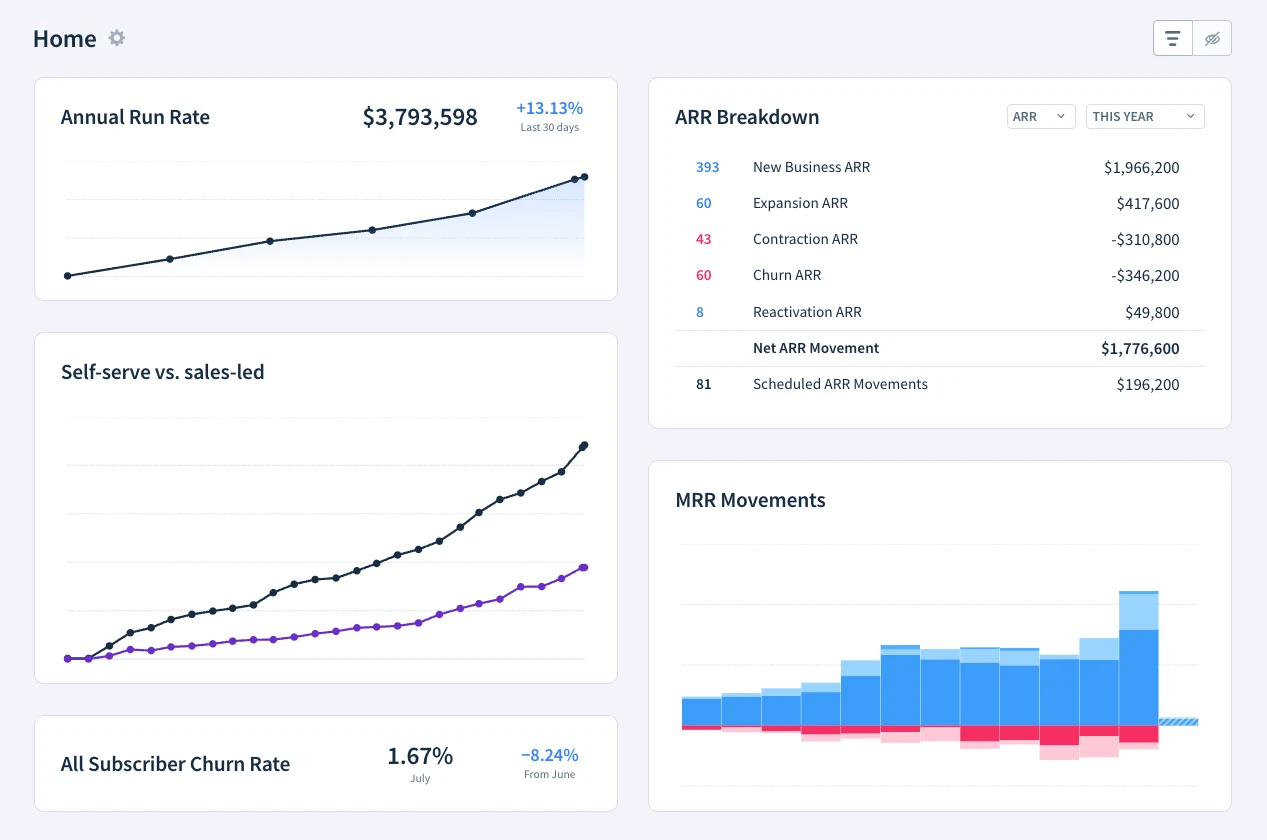
The distinction between recurring revenue and cash received matters. An annual subscription contributes a monthly equivalent to MRR, while the payment arrives on its billing date.
The Non-Recurring Cash Flow report tracks cash received for one-time invoice items. Discounts reduce its total, but taxes, refunds, and transaction fees are not deducted, so it is not a net-proceeds figure.
Before evaluating a tool, agree on the subscription metrics your team needs to defend. A useful review starts with those definitions and the source records behind them.
ChartMogul API and integrations
ChartMogul’s integration directory includes several kinds of connections. Billing sources, CRM imports, destinations, and enrichment apps do different jobs; a long logo list does not tell you which transactions will appear in a report.
| Connection route | Examples | Practical boundary |
|---|---|---|
| Native billing integration | Stripe, Chargebee, Braintree, Recurly, and PayPal | Check the individual connector’s supported data and history |
| SaaSync partner integration | WooCommerce, Shopify Partners, Paddle, Xero, and others | Uses a separate SaaSync account and counts as a billing source |
| Custom or third-party source | API, CSV, Google Sheets, and automation tools | Uses a separate plan allowance from billing sources |
Two names need particular care:
- PayPal: the official connector supports subscription flows, including billing agreements and subscription buttons. It excludes one-off payment buttons, and the documented import delay is around three hours.
- Shopify Partners: this partner-built route serves Shopify app developers’ subscription revenue. Do not treat it as a promise to import a normal Shopify store’s orders.
SaaSync maintains its own connection and account requirements. Its standard listed integrations are included with ChartMogul, while custom work can carry extra costs.
For an unsupported billing setup, use the ChartMogul API documentation to assess the import work. The custom-source guide explains the available routes; manual subscription entry has limits around refunds, proration, voided invoices, and multi-component subscriptions.
Ask for the required import fields before committing engineering time. An available API is a route to building an integration, not proof that your existing records already contain everything the reports need.
ChartMogul features that matter in practice
Consolidated reporting and source filters
You can combine billing data and inspect an individual source. ChartMogul’s data comparison guide specifically recommends the Source filter when comparing its figures with a billing system.
That makes a useful acceptance check: select one source, match the reporting period, and inspect the underlying customers or invoices behind a difference. Separate the import delay from a difference in metric definitions before calling a total wrong.
Currency reporting
ChartMogul converts revenue into a primary reporting currency. Its foreign-currency guidance distinguishes exchange-rate effects from changes in subscriptions, and uses the transaction date for cash-flow conversion.
A higher converted total does not always mean a customer upgraded. Check currency effects separately when explaining growth, and consult the current supported-currency list for your markets.
MRR and segmentation
The MRR report normalizes subscription revenue to a monthly amount. One-time charges do not become MRR simply because the same customer also has a subscription.
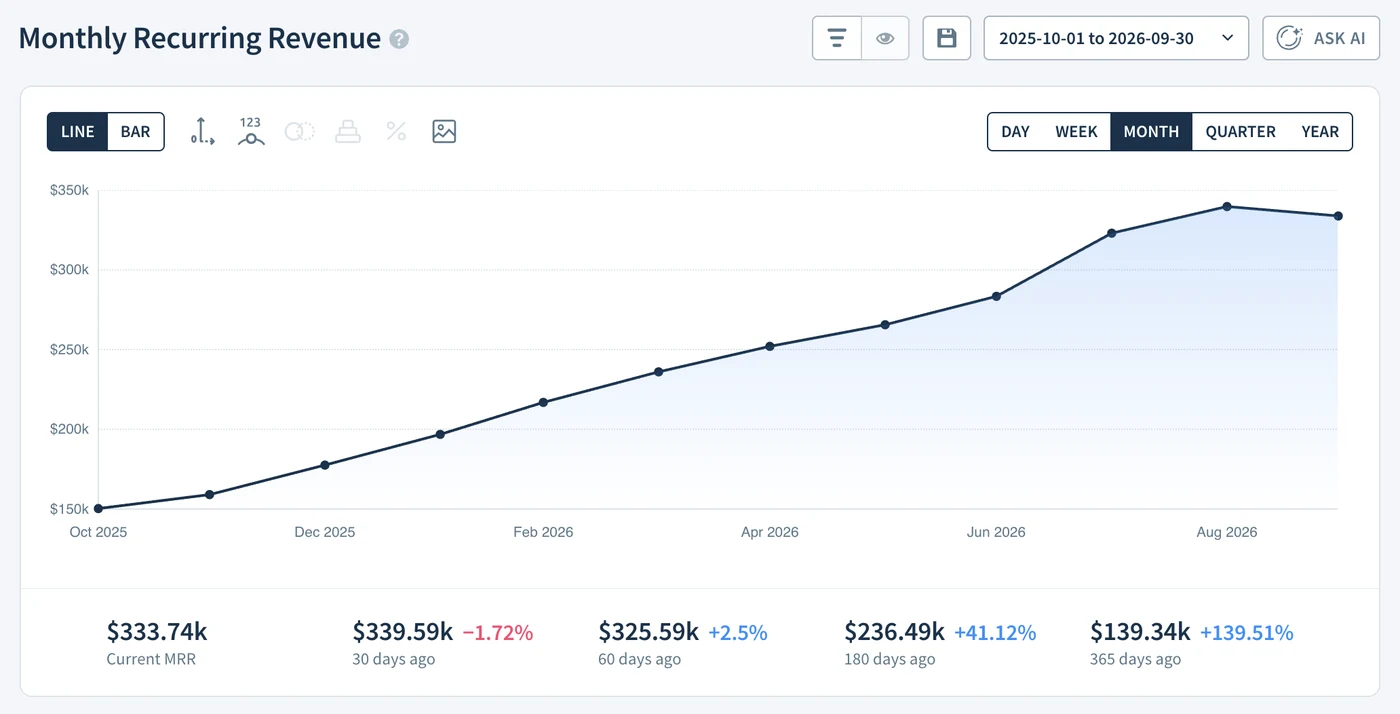
Use segments to narrow the question: compare plans, billing intervals, regions, or customer attributes. A total can show that churn increased; a plan-level comparison helps locate which group needs attention.
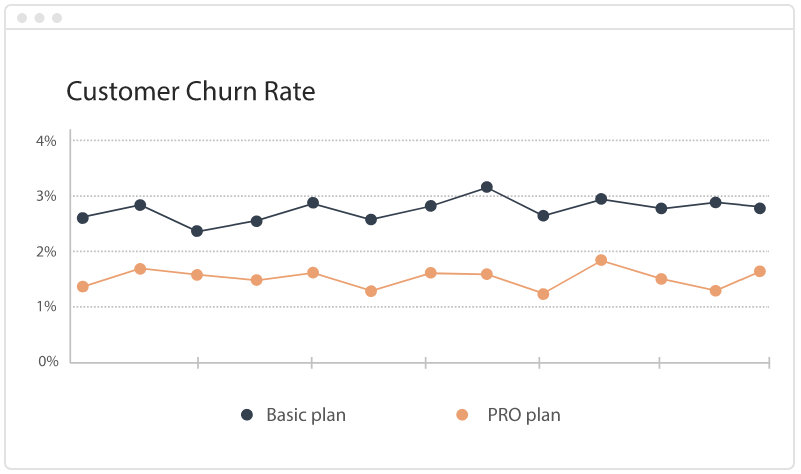
Segmentation only works with usable attributes. Check that the plan names or custom fields you want to compare arrive consistently, especially when two billing systems describe the same product differently.
Geographic maps
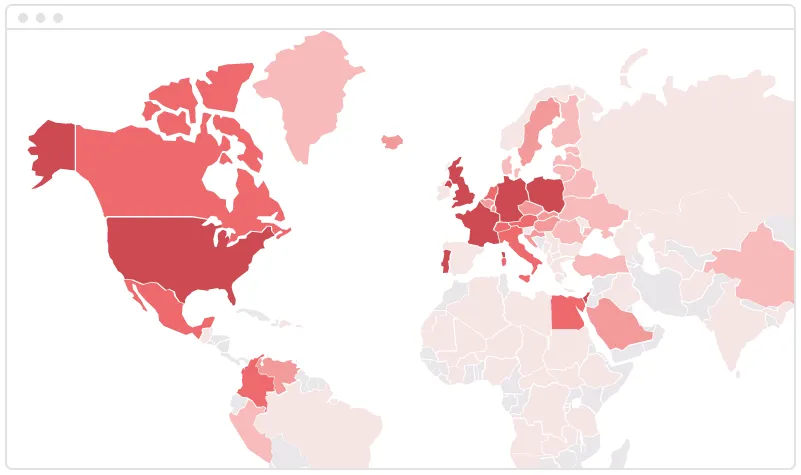
ChartMogul’s Maps feature provides a geographic view of customer and revenue data. Use it to find markets worth investigating, then check the supporting customer records rather than reading a large colored region as proof of demand.
Cohort analysis
Cohorts group customers by when their first subscription began. Comparing each group at the same age helps answer whether newer customers retain better, rather than comparing a mature group with customers who joined last month.
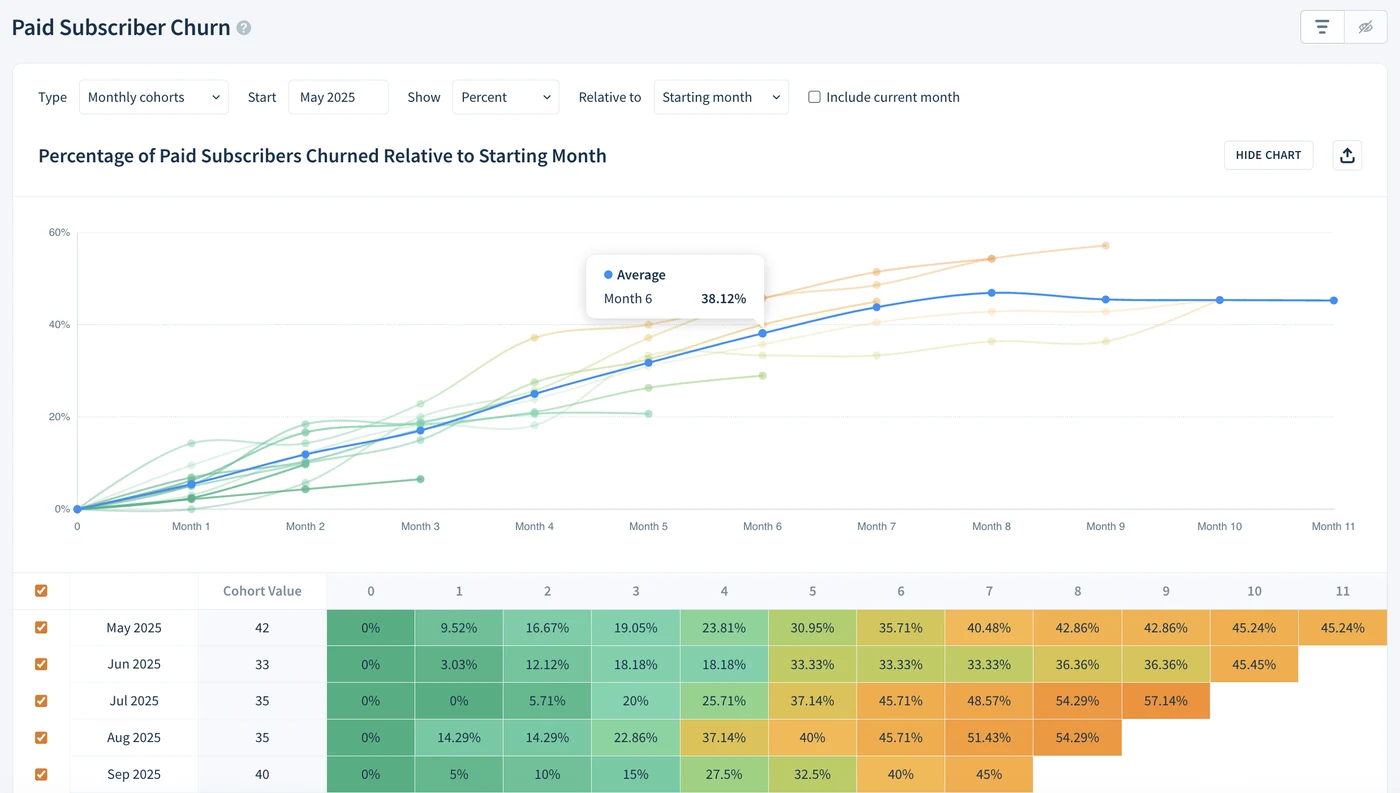
Read the configuration before interpreting a cell: the displayed measure, cohort interval, starting period, and comparison basis all matter. In the example above, a larger percentage means more subscribers have churned; treating it as retention would reverse the conclusion.
Notifications and MRR movements
ChartMogul supports recap emails and MRR-movement notifications, alongside task and mention notifications. Recaps can be daily, weekly, or monthly; source import delays still affect when a revenue event reaches the system.
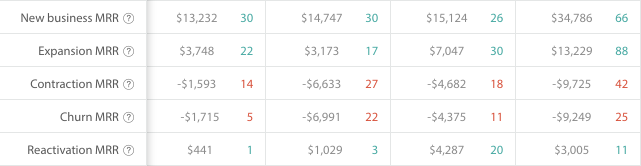
The current MRR movement model has six types:
- New Business: a customer’s first paid subscription.
- Expansion: an existing customer’s MRR increases.
- Contraction: an existing customer’s MRR falls without ending the last subscription.
- Churn: a customer ends the last subscription.
- Reactivation: a churned customer returns to a paid plan.
- Neutral: a subscription changes without changing MRR, such as a move between equally priced plans.
Customer profiles, CRM, and AI
ChartMogul has customer profiles with customer details and subscription history. Its built-in CRM also covers contacts, opportunities, and tasks, so an evaluation that assumes customer-level records are missing is out of date.
The vendor now offers AI-powered analysis, including natural-language questions about business data. Treat generated answers as an aid to investigation: compare an answer with its source report, and confirm the current access terms for your plan.

ChartMogul pricing
Source limits can decide the plan before price does.
ChartMogul pricing is based on tracked annual recurring revenue, with plan differences for sources, team access, and other capabilities. The current pricing page lists Free, Starter, Pro, and Enterprise; the trial lasts 14 days and does not require a credit card.
Checked on 18 October 2026, the calculator showed these USD prices at $450K tracked ARR:
| Plan | Monthly billing | Annual billing |
|---|---|---|
| Starter | $69 per month | $57 per month billed annually |
| Pro | $119 per month | $99 per month billed annually |
This is one calculator example, not a fixed price for every business. Free eligibility extends to $10K MRR ($120K ARR), while Enterprise is listed separately from $19,900 per year.
Source limits can decide the plan before price does. Free and Starter each include one billing source; Pro includes five, and Enterprise includes 15.
Custom and third-party sources use a different allowance: Starter includes two, while the other listed plans show unlimited. Starter also limits team access to three people, so quote the setup your team needs rather than comparing the lowest visible fees alone.
ChartMogul vs. Putler: the reporting job decides
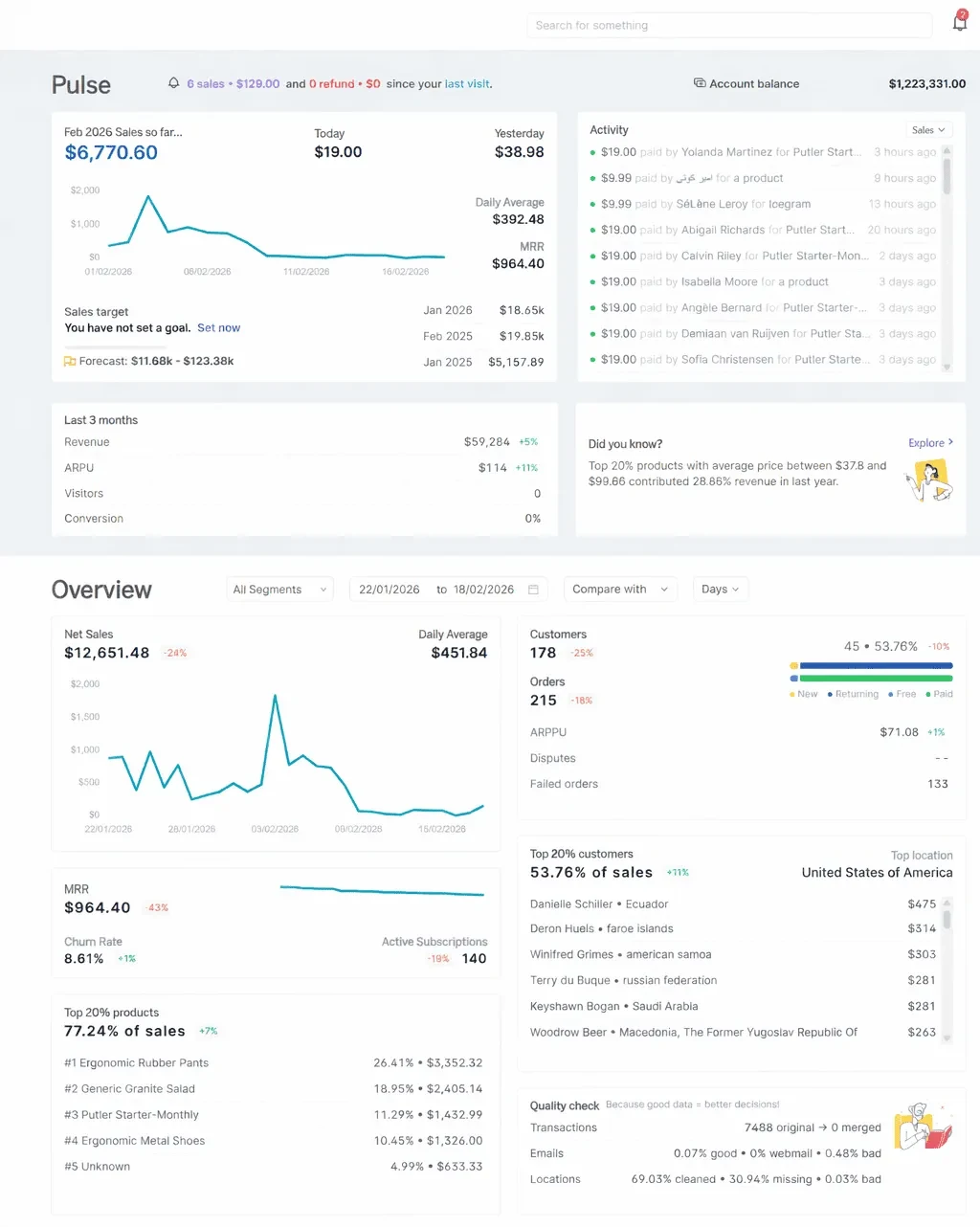
Putler is worth evaluating when the main job is commerce reporting across connected storefronts and payment systems. Product performance, purchase history, and RFM customer groups serve a different daily workflow from a SaaS team investigating subscription movements and retention cohorts.
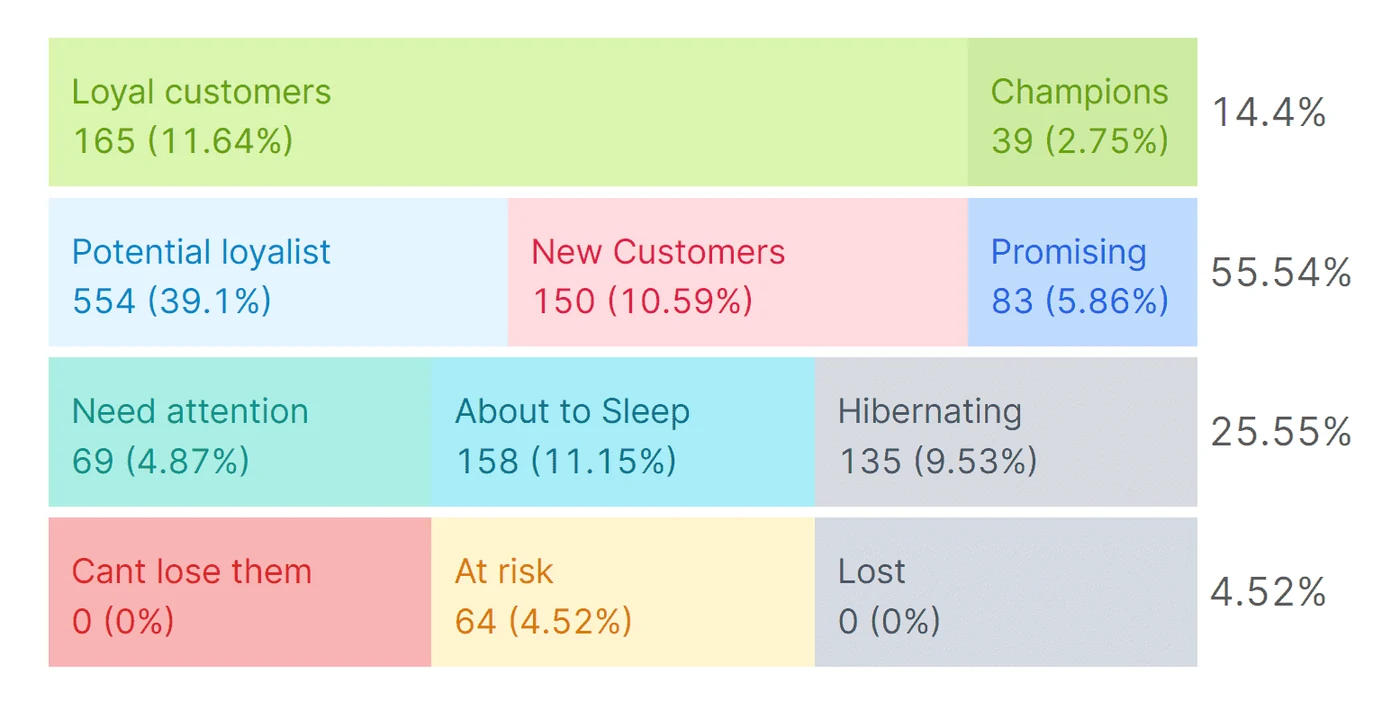
RFM groups customers by recency, frequency, and monetary value: when they last bought, how often they buy, and how much they spend. Those groups help a store owner distinguish loyal customers from buyers who may need a win-back offer.
| Criterion | ChartMogul | Putler |
|---|---|---|
| Main reporting emphasis | Subscription revenue, movements, and cohorts | Commerce sales, products, customers, and subscriptions |
| Customer analysis | Profiles, subscription history, segments, and CRM | Purchase history and RFM customer groups |
| One-time revenue | Non-recurring cash-flow reporting where imported | One-time sales alongside recurring revenue from supported sources |
| Connection check | Native versus partner versus custom route; source limits vary by plan | Verify the specific store or gateway and selected source allowance |
| Price basis | Tracked ARR | Monthly revenue |
The pricing bases differ. Putler currently lists $20/month for revenue up to $10K/month and $50/month for the next band up to $30K/month; compare the current terms with your mix of one-time and recurring sales.
Putler also advertises transaction operations, but confirm refund and subscription-action support for your particular gateway. Reporting access does not guarantee that every payment action is available across every connection.
Where ChartMogul has the clearer fit
Start with ChartMogul when the decision depends on subscription-specific detail: explaining expansion versus reactivation, comparing cohorts, or joining customer conversations with recurring-revenue history. The current documentation supports those jobs without needing to claim that a competing tool lacks all customer reporting.
For more options, use the subscription analytics tools guide. If your question is broader than subscriptions, compare the reporting jobs in the ecommerce analytics tools guide before choosing a shortlist.
What should you check during the trial?
A trial should establish whether the tool can reproduce a few known billing histories and answer the decisions your team makes. Start with representative records, then compare source coverage, metric settings, and report output before spending time arranging a large dashboard.
Use these five checks:
- Trace one monthly and one annual subscription. Compare invoices with monthly-normalized MRR so billing frequency does not create a false mismatch.
- Inspect an upgrade, cancellation, and refund. Check the resulting movement and cash-flow treatment against the documented settings.
- Add a one-time purchase if you sell both. Confirm the connector imports it and the appropriate report includes it.
- Compare one source separately. Match dates and currency to distinguish a genuine missing record from a reporting-definition difference.
- Price the working setup. Include all required sources, team access, billing period, and any custom integration work.
Choose the tool that can explain those records clearly and support the reports you need next month. Keep the checked records as a reference for future billing changes.
FAQ
Is ChartMogul free?
ChartMogul offers a Free plan for businesses up to $10K MRR ($120K ARR), plus a 14-day trial without a credit card. Paid pricing depends on tracked ARR and the chosen plan. Check source allowances and team limits as well as revenue eligibility, because the lowest-cost plan may not support the required setup.
Can ChartMogul combine multiple billing systems?
Yes. ChartMogul can consolidate multiple connected billing sources and filter reporting by source. Current allowances differ by plan: Free and Starter include one billing source, Pro includes five, and Enterprise includes 15. Custom and third-party sources use a separate allowance, so confirm how each required connection is classified before choosing a plan.
Does ChartMogul report one-time revenue from PayPal?
ChartMogul supports non-recurring cash-flow reporting, but that does not mean every connector imports every one-time payment. Its PayPal integration supports subscription flows and excludes ordinary one-off payment buttons. Check the exact import route for the revenue you need; use a supported alternative import method only after confirming the required data can be supplied.
Which ChartMogul alternative should a store owner consider?
A store owner should compare tools against the actual reporting job: products, purchase history, repeat customers, storefront coverage, or subscriptions. Putler is one option for connected commerce reporting and RFM groups. A SaaS team needing deeper subscription movements and cohorts should still evaluate ChartMogul; a vendor name alone does not establish the better fit.