

MRR and ARR measure the same recurring revenue, just on different clocks. Google mrr vs arr or arr vs mrr and you’ll land on roughly the same question: which number should actually drive your decisions?
This article breaks down the difference between MRR and ARR, the formulas (with the math checked), and when each one is the right one to look at.
What is recurring revenue?
Recurring revenue is the income a subscription business can count on from ongoing contracts, not one-off sales. MRR and ARR are the two standard ways to measure it.
What is MRR (Monthly Recurring Revenue)?
Monthly Recurring Revenue is the total revenue generated from monthly subscriptions within a specific month. New sign-ups, cancellations, upgrades, and downgrades all move it.
MRR gets used for financial reporting, forecasting, and evaluating marketing and sales performance. It’s also a working tool for pricing decisions.
What is ARR (Annual Recurring Revenue)?
Annual Recurring Revenue is the total revenue expected from recurring subscriptions over 12 months. It’s a forward-looking number based on the subscriptions already in place.
ARR trends show a business’s growth trajectory and financial stability over time. It’s typically read alongside customer lifetime value (CLTV) and churn rate to judge overall business health.
Stripe covers the accounting mechanics of ARR in more detail here.
MRR vs ARR: key differences
MRR vs ARR comes down to one axis first: time frame. Everything else below follows from that.
| Dimension | MRR | ARR |
|---|---|---|
| Time frame | One month of subscription revenue | Twelve months of subscription revenue |
| Sensitivity | Reacts immediately to sign-ups, cancellations, upgrades, and downgrades | Smooths out month-to-month fluctuations |
| Best for | Monthly health checks, churn tracking, sales and marketing performance | Financial planning, investor reporting, long-term forecasting |
| Formula | Existing-customer revenue + new-customer revenue, normalized to a month | MRR × 12, or the sum of all annual contract values |
| Primary audience | Marketing, sales, and product teams | Investors, finance teams, the board |
Picking between MRR vs ARR is part of a bigger question: how to assess a SaaS business’s performance as a whole. Neither metric answers that alone.
Why MRR and ARR matter for SaaS businesses
Accurately gauging and predicting revenue keeps a subscription business solvent. MRR and ARR are the two numbers that make that possible.
Revenue predictability
MRR and ARR show the revenue a business can count on every month or year. Budgeting and resource planning both depend on that baseline.
Customer retention and expansion
Tracking subscription revenue, monthly or annually, shows how well a business is retaining customers and where upselling is working. Patterns in customer behavior show up here first: who’s sticking around, and who’s likely on the way out. ARR in particular reveals customer retention and expansion trends over longer periods.
Business performance evaluation
These two metrics work like a report card. They show how a business is doing at attracting and keeping customers, and how growth compares to targets and competitors.
How to calculate MRR and ARR
Both formulas start from the same idea: add up recurring revenue from existing customers, then add revenue from new customers. The rest is normalization. MRR keeps it monthly, ARR expands it to a year.
Calculating MRR
MRR sums the monthly subscription revenue from every active customer during a single month, excluding one-time or non-recurring fees.
MRR = Monthly recurring revenue from existing customers + Monthly recurring revenue from new customers
Example: 100 existing customers paying $50 a month, plus 50 new customers on $100 a month.
MRR = ($50 × 100) + ($100 × 50) = $5,000 + $5,000 = $10,000
Calculating ARR
ARR adds up the total value of every annual subscription contract, excluding one-time fees.
ARR = Annual recurring revenue from existing customers + Annual recurring revenue from new customers
Example: 50 existing customers paying $1,000 a year, plus 20 new customers on $800 a year.
ARR = ($1,000 × 50) + ($800 × 20) = $50,000 + $16,000 = $66,000
Here’s a good read on ARR and MRR calculation.
What moves MRR and ARR after the first calculation
Neither number stays static once new customers start signing up and existing ones start changing plans. The movement breaks into four parts:
- New MRR: revenue added from first-time customers.
- Expansion MRR: revenue added from existing customers upgrading or buying more.
- Contraction MRR: revenue lost from existing customers downgrading.
- Churned MRR: revenue lost from customers who cancel.
Net new MRR for the month is New plus Expansion, minus Contraction, minus Churned. Multiply that trend by 12 and it explains most of the swings between one ARR snapshot and the next.
Common mistakes when calculating MRR and ARR
The formulas are simple. Getting the inputs right is where most SaaS teams go wrong.
- Counting one-time fees: setup fees, onboarding charges, and one-off add-ons are not recurring. Including them inflates both MRR and ARR.
- Not normalizing non-monthly billing: a customer on a quarterly or weekly plan needs to be converted to a monthly-equivalent figure before it goes into MRR. Skipping this step under- or overstates the total.
- Mixing currencies without converting: a business collecting revenue in dollars, euros, and pounds has to convert everything to one base currency first. Adding raw numbers across currencies produces a total that means nothing.
- Confusing ARR with actual annual revenue: ARR is a projection based on current recurring contracts, not the total revenue a business booked last year. One-time sales, refunds, and non-subscription revenue don’t belong in it.
Strategies to grow recurring subscription revenue
Growing MRR and ARR comes down to two levers: keep the customers already paying, and get more revenue out of them over time.
Customer retention techniques
Personalized service and responsive support keep existing customers from looking elsewhere. Targeted re-engagement campaigns and loyalty programs work as proactive retention layers, catching accounts before they churn rather than after.
Upselling and cross-selling opportunities
Existing customers on lower-tier plans are natural upgrade candidates. Complementary products or add-on features round out the same account. Customer insights data, usage patterns, feature adoption, plan history, is what makes these offers land instead of getting ignored, and it feeds directly into sustainable growth.
How to track MRR and ARR with Putler
Calculating MRR and ARR by hand gets harder as the number of data sources, currencies, and billing intervals grows. Putler pulls that calculation out of spreadsheets and runs it automatically.
Tracking recurring revenue with Putler works in four steps.
- Connect data sources.

Begin by integrating your data sources, shopping carts and payment gateways like Stripe, WooCommerce, EDD, Braintree, and Authorize.Net, with Putler. This setup lets Putler pull and aggregate transaction data from every connected source.
- Sync data in real time. Transaction data updates automatically, so MRR and ARR reflect current numbers without manual re-pulls or delays.
- Read the subscription dashboard.

MRR, ARR, churn rate, and customer lifetime value all sit on one screen, already normalized across currencies and billing intervals.
- Set up reports and alerts. Custom reports and automated alerts flag changes in recurring revenue as they happen, instead of surfacing them at month-end.

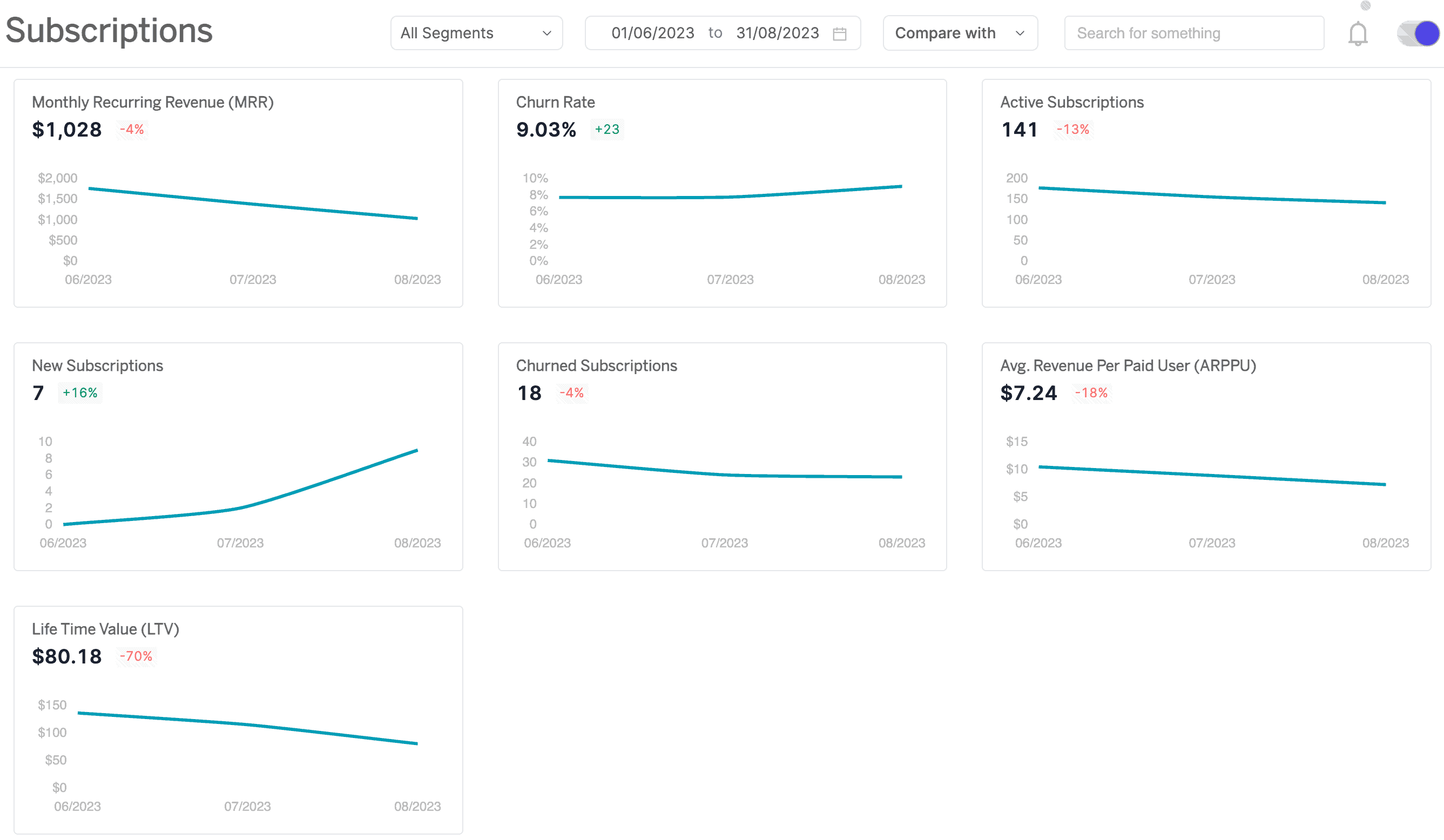
By using Putler’s intuitive platform, MRR and ARR turn from a manual spreadsheet exercise into numbers that update on their own, freeing up time for the decisions that actually grow the business.
MRR vs ARR: which one should you use?
The choice between MRR and ARR usually comes down to how fast a business needs to react versus how far ahead it needs to plan.
FAQs
Quick answers to the MRR vs ARR questions that come up most.
Is ARR just MRR × 12?
As a quick estimate, yes: multiplying MRR by 12 gives a run-rate ARR. For a business with mostly annual contracts, calculating ARR directly from contract values is more accurate than annualizing MRR.
ARR vs MRR: which number should investors see first?
Investors typically want ARR for valuation and growth-trajectory conversations, with MRR available as supporting detail on momentum and churn.
Do MRR and ARR include one-time fees?
No. Setup fees, onboarding charges, and other one-off charges are excluded from both. Including them overstates recurring revenue.
How often should MRR and ARR be recalculated?
MRR gets recalculated monthly, in step with billing cycles. ARR gets recalculated whenever MRR changes materially, or on a standard monthly or quarterly reporting cadence.
Which metric is more accurate for a business with mixed monthly and annual plans?
Neither on its own. Non-monthly plans need to be normalized to a monthly-equivalent figure before they’re added to MRR, and that normalized MRR is what should feed into ARR.
MRR vs ARR: the bottom line
MRR and ARR measure the same recurring revenue on different timelines. Use MRR to catch problems early and track short-term momentum. Use ARR to plan, forecast, and report to investors. Most SaaS businesses need both, calculated from the same underlying data rather than two separate spreadsheets.
- What is MRR? – The ultimate guide for calculating Monthly Recurring Revenue for your SaaS Business
- What is ARR (Annual Recurring Revenue) – How to Calculate and Optimize?
- Subscription metrics analytics: How to calculate MRR, churn rate, ARPPU and more
- SaaS Reporting: Importance of SaaS Reports and the 6 Key Metrics You Must Measure for Success
- SaaS Metrics Dashboard for Subscriptions and eCommerce