

Databox is a solid KPI dashboard tool for marketing teams, but it isn’t built for ecommerce. The best Databox alternative for most multi-platform sellers is Putler, which consolidates and deduplicates revenue across Shopify, Amazon, Etsy, PayPal, and Stripe in one dashboard. For Shopify brands focused on ad attribution, Triple Whale or Polar Analytics are stronger fits, and Metorik is the better pick for WooCommerce stores.
Databox pulls KPIs from 130+ integrations into clean dashboards, which works for marketing teams but falls short for ecommerce sellers tracking revenue across Shopify, Amazon, Etsy, PayPal, and Stripe at once. It starts at $159/month on annual billing ($199 monthly) with just 3 data sources, and extra connections cost $5.60 each. This article covers five Databox alternatives, what each does well, where it falls short, and who it suits best.
Why ecommerce sellers look for Databox alternatives
Many sellers start with Databox because it offers clean dashboards and easy KPI tracking. But as stores expand across multiple channels, the limitations start appearing:
- Revenue gets duplicated across payment gateways
- Marketplace sales stay disconnected
- Customer data remains fragmented
- Product profitability becomes difficult to track
- Multi-currency reporting breaks down
- Data source pricing gets expensive quickly
The problem is not dashboard visualization. The problem is getting one accurate view of your business. That’s why many ecommerce brands eventually move to tools built specifically for cross-platform revenue analytics.
What is Databox, and why do ecommerce sellers look for alternatives?
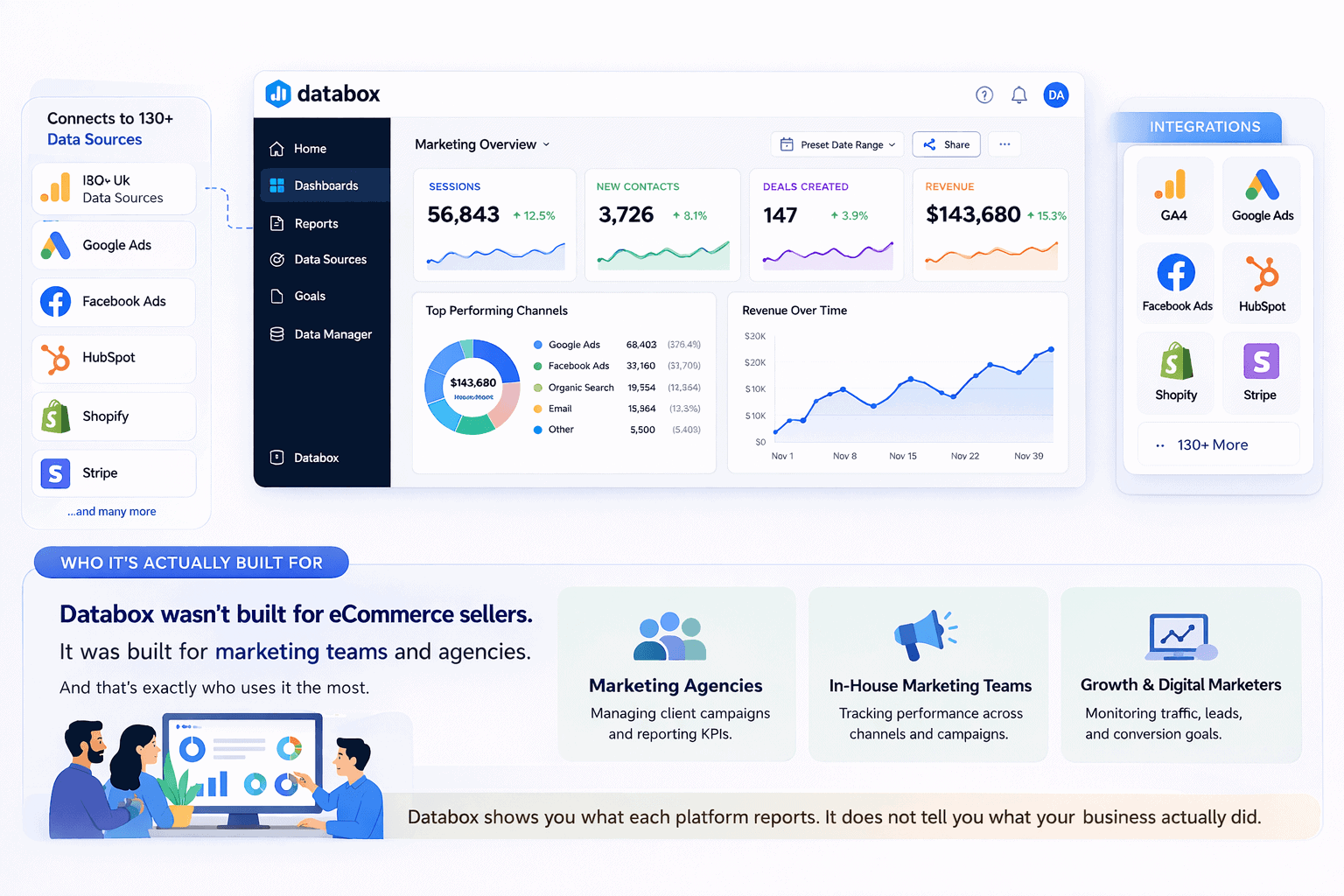
Databox is a cloud-based business intelligence platform that connects to 130+ data sources and turns the data into visual dashboards, automated reports, and goal-tracking views. It does a few things well.
Pre-built templates: 200+ ready-made dashboards covering marketing, sales, and finance KPIs.
Goal tracking: Set targets for any metric and monitor progress in real time.
Automated reporting: Scheduled snapshots, TV display mode, mobile app, and Slack integration.
AI Analyst: Natural-language queries on Growth and higher plans.
Broad integrations: GA4, HubSpot, Facebook Ads, Google Ads, Shopify, Stripe, and more.
Used by 20,000+ teams globally, Databox is popular among marketing agencies and in-house marketing teams who need KPI visibility without building a data warehouse. That’s exactly the problem. Its top user segments are inbound marketing, content marketing, and digital marketing professionals, and its templates are built around traffic, leads, and campaign performance.
Ecommerce sellers are an afterthought. The platform can pull in Shopify or WooCommerce data, but it visualizes it as-is. No transformation. No cross-platform reconciliation. No ecommerce-specific computation.
Why Databox may not be the best fit for ecommerce analytics
It’s a dashboard tool, not a revenue analytics platform
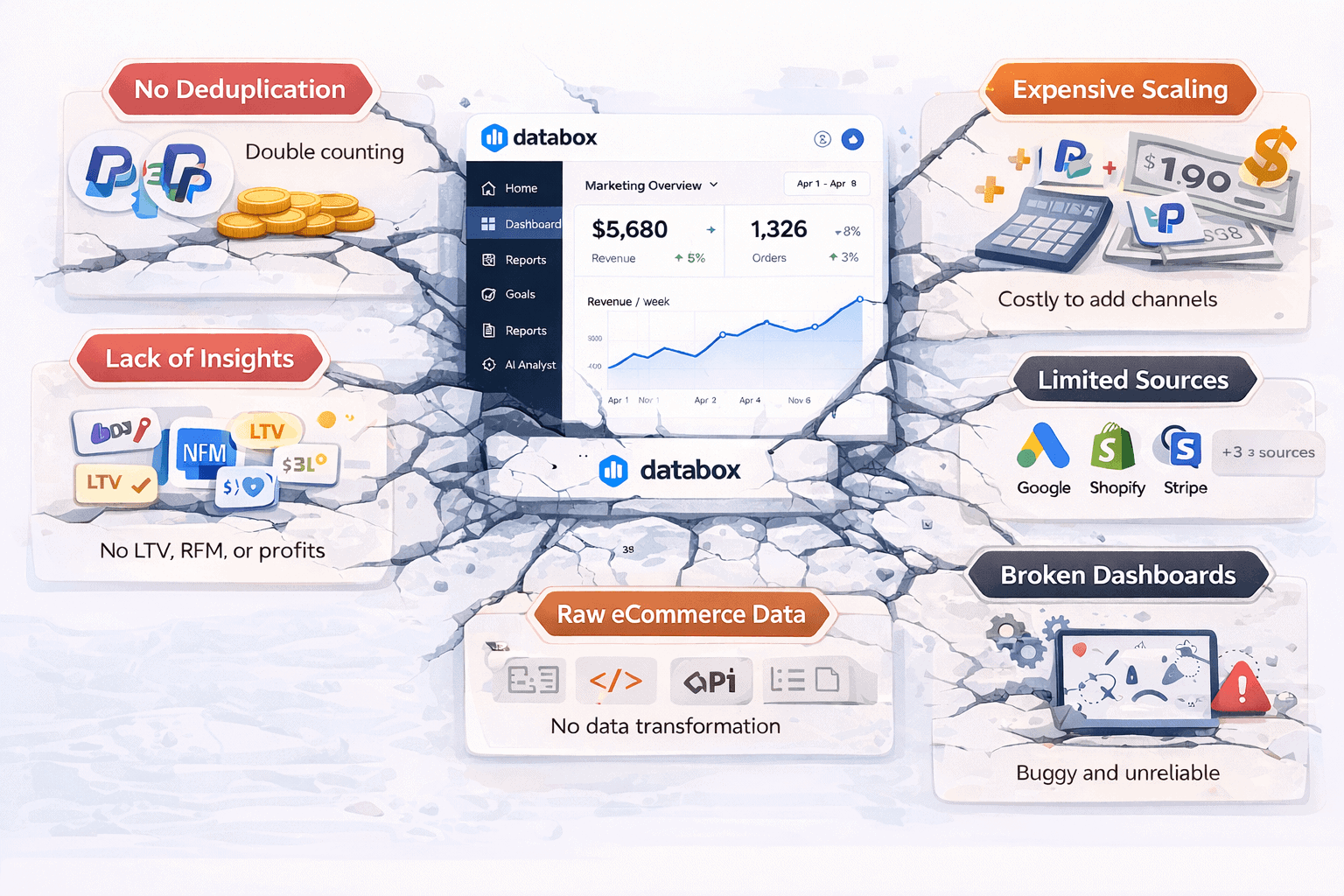
Databox visualizes data. It does not analyze it. Every metric it shows is pulled directly from each platform’s API and displayed as-is. There’s no transformation layer, no cross-source computation, and no way to blend data from multiple platforms into a unified view on standard plans.
The Growth plan ($399/month) adds a datasets feature for basic data prep. But even that is a generic table-based tool, not purpose-built ecommerce analytics. Dedicated ecommerce dashboard platforms often automate workflows that require manual setup inside Databox.
No ecommerce-specific metrics
Open Databox’s Shopify dashboard and you’ll see sessions, orders, and revenue. That’s roughly where it stops. There’s no customer lifetime value calculated across channels. No RFM segmentation to identify your champions versus your at-risk buyers. No product profitability tracking. No refund trend analysis. No cohort analysis showing how customers acquired in January 2024 compare to those acquired in January 2025.
For WooCommerce users, it gets worse. Databox’s own documentation confirms it cannot fetch individual refunded orders due to an API limitation. Multi-currency stores hit another wall: revenue metrics are always returned in the store’s default currency with no conversion support.
No deduplication across payment gateways
This is the one that quietly costs ecommerce sellers the most. Connect Shopify and PayPal to Databox. A customer buys through your store and pays via PayPal. That one transaction now appears in two places. Databox treats each integration as completely separate. It has no awareness that the same sale has been recorded twice.
Stack Shopify, Stripe, PayPal, and WooCommerce together, and duplicate transactions can inflate reported revenue significantly. Platform-reported revenue already overstates actual figures due to attribution overlap, and Databox compounds this by adding double-counting on top.
Data source limits get expensive fast
The Pro plan ($159/month on annual billing, $199 monthly) includes just 3 data sources. Every additional source costs $5.60/month on annual billing or $7/month on monthly billing.
A typical multi-channel seller connecting Shopify, Amazon, GA4, Facebook Ads, Google Ads, Stripe, PayPal, Klaviyo, and QuickBooks needs 9 sources. That’s 6 extra connections on top of the Pro plan, bringing the real cost to roughly $193/month minimum. On Growth, the same setup runs over $430/month.
Databox also restructured its plans in 2026, moving its focus upmarket toward paid tiers. The entry point that once made Databox easy for small sellers to test has narrowed, and the cheapest paid plan now starts at $159/month.
Support and reliability issues
User reviews across Capterra, G2, and Trustpilot tell a consistent story. One Capterra reviewer described running a two-year pilot with five clients where dashboards were constantly broken, ultimately abandoning the platform. Another flagged a dashboard “full of wrong KPIs” with support taking a month to respond. Databox also enforces a non-refundable billing policy, which multiple users flagged as the final dealbreaker after experiencing unresolved issues.
How we evaluated these Databox alternatives
We evaluated each platform based on:
- Ecommerce platform coverage
- Revenue accuracy and deduplication
- Marketplace integrations
- Customer analytics
- Attribution and reporting
- Pricing transparency
- Ease of setup
- Scalability for growing stores
- User reviews from G2, Capterra, Reddit, and ecommerce communities
The goal was simple: identify which tools actually help sellers understand revenue across multiple channels without adding reporting complexity.
Quick comparison: best Databox alternatives
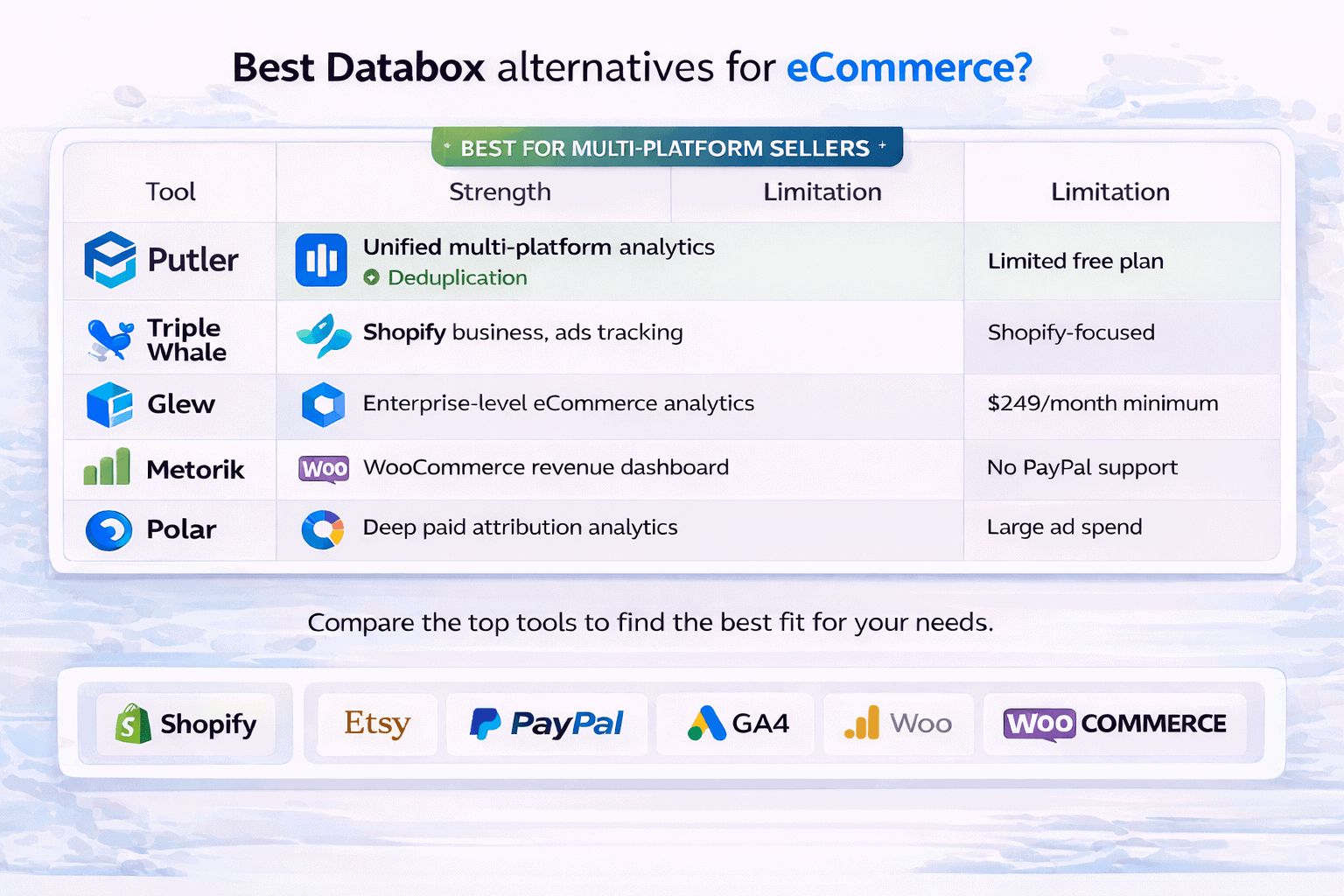
| Tool | Best for | Platforms | Starting price |
|---|---|---|---|
| Putler | Multi-platform ecommerce and SaaS sellers | Shopify, WooCommerce, Etsy, Amazon, eBay, PayPal, Stripe + 17 sources | $20/month |
| Triple Whale | Shopify brands running paid ads | Shopify only | Free, paid from $149/month |
| Glew | Mid-market omnichannel retailers | Shopify, WooCommerce, BigCommerce, Magento | Custom (≈$79+/month) |
| Metorik | WooCommerce and Shopify stores | WooCommerce, Shopify | $25/month |
| Polar Analytics | High-growth Shopify DTC brands | Shopify (+ Amazon connector) | ≈$400/month |
5 best Databox alternatives for ecommerce businesses in 2026
1. Putler: best for multi-platform ecommerce and SaaS sellers
Putler is a multichannel ecommerce analytics platform that connects 17+ data sources and consolidates everything into one unified dashboard. It covers 153 KPIs across 7 dedicated dashboards and handles both ecommerce and SaaS revenue in the same view.
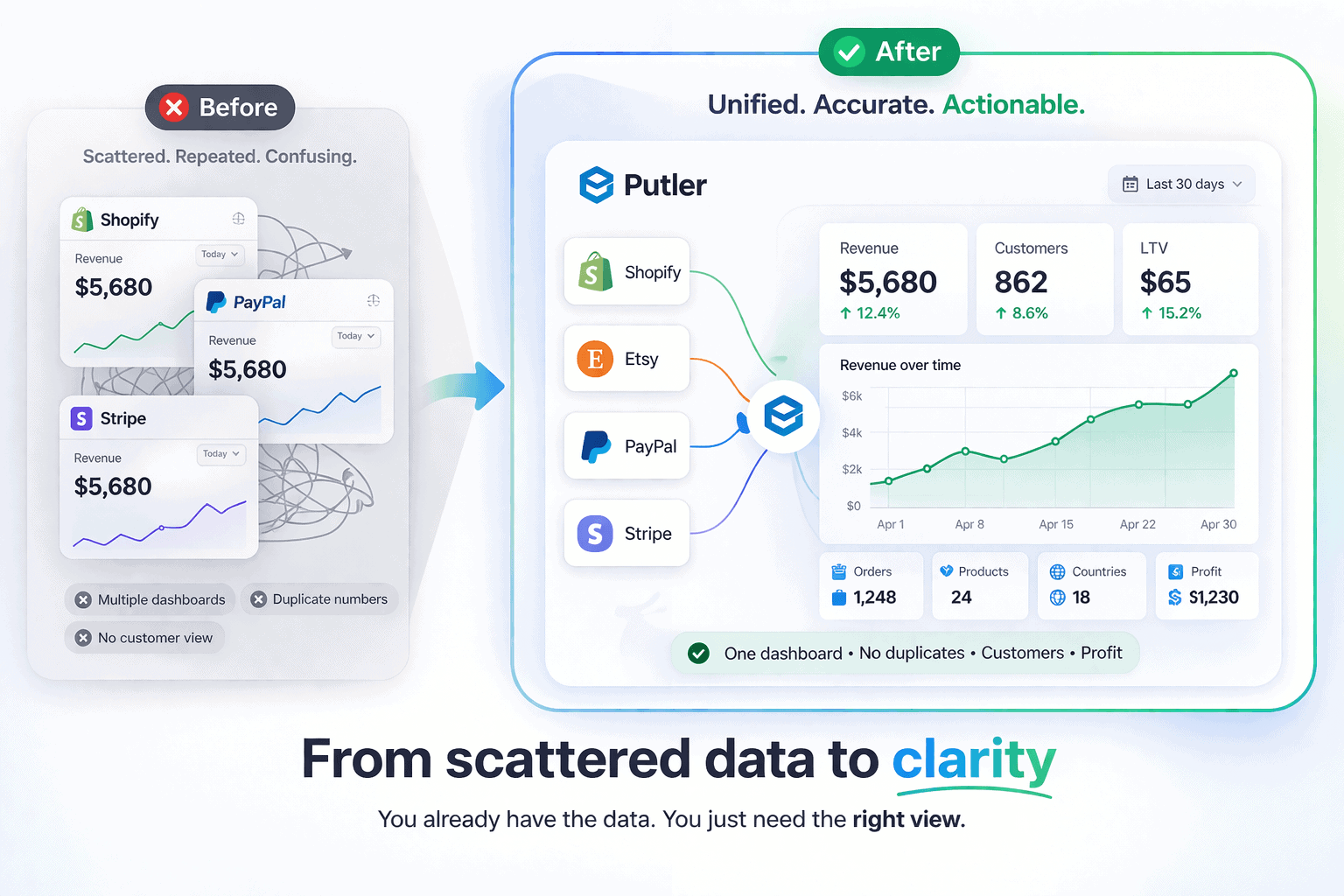
What makes Putler stand out is its ability to consolidate revenue, customer, and product data across marketplaces, payment gateways, and ecommerce platforms without technical setup. It’s the only ecommerce analytics tool that connects Shopify, WooCommerce, Etsy, Amazon, eBay, PayPal, and Stripe simultaneously. And it starts at $20/month.
Platforms it connects to:
- Payment gateways: PayPal, Stripe, Braintree, Razorpay, Authorize.Net, 2Checkout
- Ecommerce platforms and marketplaces: Shopify, WooCommerce, BigCommerce, Easy Digital Downloads, Etsy, Amazon, eBay, Gumroad
- Analytics and marketing: Google Analytics, Google Search Console, Mailchimp
Key features:
Data consolidation and deduplication: When the same transaction appears in both WooCommerce and Stripe, Putler merges it automatically. It fixes 100+ data problems including duplicate records, currency mismatches, and timezone misalignment, with no configuration required.
RFM segmentation with 11 groups: Putler automatically sorts every customer into one of 11 groups, from Champions to At Risk to Lost, each with built-in action recommendations. Export any segment to Mailchimp or CSV in three clicks.
Unified customer profiles: Every customer gets a single profile built from transaction data across all platforms, with full purchase history, LTV, and refund records in one place.
Product analysis: The product leaderboard applies 80/20 Pareto analysis to show which products drive most of your revenue, plus per-product refund rates and products-bought-together insights.
Sales heatmap: Revenue plotted across days and hours in a color-coded grid, so you can time campaigns and promotions around your actual buying windows.
Transaction management: Search any customer, product, or order instantly, and issue full or partial refunds without giving your team access to PayPal or Stripe.
SaaS metrics: Full subscription analytics including MRR, ARR, and churn rate, handling one-time and recurring revenue in the same dashboard.
Pricing:
| Monthly Revenue | Monthly Price |
|---|---|
| Up to $10K | $20/month |
| $10K–$30K | $50/month |
| $30K–$50K | $100/month |
| $50K–$100K | $150/month |
| $100K–$200K | $250/month |
| $200K–$500K | $350–$500/month |
| $500K–$1M | $750/month |
14-day free trial. No credit card required. First month $1.
What users say:
“I spend a lot of time getting an overview with Excel, but when I got Putler, I have an overview for Amazon, eBay, Etsy, Shopify. I don’t need to do Excel anymore.” — G2 reviewer
“Customer segmentation with RFM analysis turned out to be a game changer. Once I started using RFM segmented lists, my campaign costs were down by 78% and revenues jumped by 32%.” — Kayla McQueen, Putler customer
Pros:
- Broadest multi-platform coverage at this price point
- Automatic deduplication solves the double-counting problem out of the box
- Works for ecommerce and SaaS revenue simultaneously
- No SQL, no engineering, no setup complexity
- Revenue-based pricing that scales down when your revenue drops
Cons:
- No native Facebook Ads or Google Ads integration
- No dedicated mobile app
Best for: Small to mid-sized sellers operating across multiple platforms and payment processors who need consolidated, deduplicated revenue analytics without enterprise pricing.
2. Triple Whale: best for Shopify DTC brands running paid ads
Triple Whale is an AI-powered analytics and attribution platform built specifically for Shopify DTC brands, and the go-to tool for Shopify founders managing significant paid-media budgets. Its core strength is attribution accuracy: the Triple Pixel tracks first-party conversion data independently of Meta and Google, giving a more reliable picture of which ads actually drove sales.
Platforms: Shopify only. Does not support WooCommerce, BigCommerce, Etsy, eBay, or any marketplace.
Key features: Triple Pixel first-party attribution, customizable dashboards and SQL editor, multi-touch attribution, creative analytics, customer segments, cohort analysis, LTV tracking, and the Moby AI agent for analysis and automation.
Pricing:
| Plan | Starting Price (under $250K GMV) |
|---|---|
| Free (Founders Dash) | $0/month |
| Starter / Foundation | $149/month |
| Advanced / Automate | $219/month |
| Enterprise | Custom ($20M+ GMV) |
Pricing scales with annual GMV, so the same plan costs more as your revenue grows. A $1M+ GMV brand commonly pays $429/month and up.
Pros:
- Best-in-class attribution for Shopify paid media
- Free Founders Dash for basic monitoring
- Moby AI delivers genuine operational insights
- Unlimited users on all plans
- Strong creative analytics
Cons:
- Shopify only, which eliminates every other platform
- GMV pricing escalates as you grow, and add-ons raise the real cost
- No product profitability or COGS tracking
Best for: Shopify-only DTC brands spending meaningfully on Meta and Google who need accurate attribution and creative performance data.
3. Glew: best for mid-market multi-channel retailers
Glew is an end-to-end commerce data platform that handles data ingestion, warehousing, and reporting. It connects 170+ integrations and delivers insights through pre-built dashboards and Looker-powered custom reporting on higher tiers. The platform serves mid-sized to enterprise retailers managing multiple brands, channels, and data sources.
Platforms: Shopify, WooCommerce, BigCommerce, Magento, plus Amazon, eBay, and Walmart connectors. No Etsy integration.
Key features: 150+ pre-built KPIs, 30+ customer segments, product profitability tracking, LTV analysis, subscription analytics, automated Klaviyo and Listrak segment syncing, multi-store and multi-brand aggregation, and Looker-powered custom reporting on higher tiers.
Pricing: Not publicly listed in full. Third-party trackers show a range from roughly $79/month to $649/month depending on volume and features, with annual prepayment typically required and a sales call needed for an exact quote.
Pros:
- Widest integration library (170+) in this comparison
- Strong product and inventory analytics
- Looker-powered BI for custom reporting
- Multi-brand aggregation for enterprise retailers
Cons:
- No Etsy integration
- Slow loading and performance issues consistently flagged in reviews
- Annual prepayment with difficult cancellation
- Opaque pricing requires a sales call
Best for: Mid-market retailers at $1M+ revenue selling across Shopify, WooCommerce, and BigCommerce who need enterprise-grade analytics and can commit to annual contracts.
4. Metorik: best for WooCommerce and Shopify stores
Metorik is a cloud-based analytics and email marketing platform built for WooCommerce (primary) and Shopify stores. A former WooCommerce core engineer created it. It serves 8,000+ merchants and replaces the limited native reporting of both platforms with a polished, data-rich experience.
Platforms: WooCommerce and Shopify only. No Amazon, eBay, Etsy, or any marketplace.
Key features: 100+ KPIs, 500+ filter criteria for advanced segmentation, cohort analysis, cost and profit reporting with COGS at product level, subscription reporting for WooCommerce Subscriptions, built-in email marketing with abandoned cart recovery, and multi-store support for same-platform stores.
Pricing:
| Monthly Orders | Approx. Price |
|---|---|
| Up to 100 | $25/month |
| Up to 500 | $50/month |
| Up to 2,500 | $100/month |
| Up to 10,000 | $250/month |
30-day free trial. No credit card required.
Pros:
- Exceptional UX far ahead of native WooCommerce reporting
- Deep segmentation with 500+ filter options
- All features included at every pricing tier
- Outstanding founder-led customer support
- Email marketing built in
Cons:
- WooCommerce and Shopify only, no marketplace connectivity
- Pricing scales with order volume
- No attribution modeling or AI features
Best for: WooCommerce or Shopify stores that need a serious analytics upgrade and don’t sell on external marketplaces.
5. Polar Analytics: best for Shopify brands with heavy ad spend
Polar Analytics is an all-in-one analytics and BI platform built for Shopify DTC brands with a strong focus on marketing attribution. The company is based in Paris and serves 4,000+ brands. Its core differentiator is attribution accuracy, shipping a proprietary first-party pixel, server-side tracking, and incrementality testing in a single package.
Platforms: Shopify is the required core platform. Amazon can be pulled in as a connector. No WooCommerce, Etsy, or eBay support.
Key features: Polar Pixel with cross-device tracking, multiple attribution models, a CAPI enhancer that sends conversion events back to Meta and Google, incrementality testing, AI-powered Ask Polar for natural-language queries, dedicated Snowflake database access, Klaviyo integration, and cross-brand benchmarks.
Pricing:
| GMV Bracket | Approx. Monthly Price |
|---|---|
| Entry (under ~$5M GMV) | ≈$400/month |
| Mid ($5M–$7M) | ≈$1,020/month |
| Higher ($10M–$15M) | ≈$1,660/month |
Pricing is GMV-based and quoted on a demo call.
Pros:
- Advanced attribution technology with a full data stack
- AI analyst with strong natural-language query capability
- Strong Klaviyo integration
- Dedicated customer success manager on all plans
- Incrementality testing rarely available at this price point
Cons:
- High cost barrier, around $400/month minimum
- Shopify only, no WooCommerce, Etsy, or eBay
- Opaque pricing requires booking a demo
- Overkill for stores without significant ad spend
Best for: Well-funded Shopify DTC brands at $3M+ GMV with heavy paid advertising who need precise attribution and AI-powered insights.
How to choose the best Databox alternative for your business
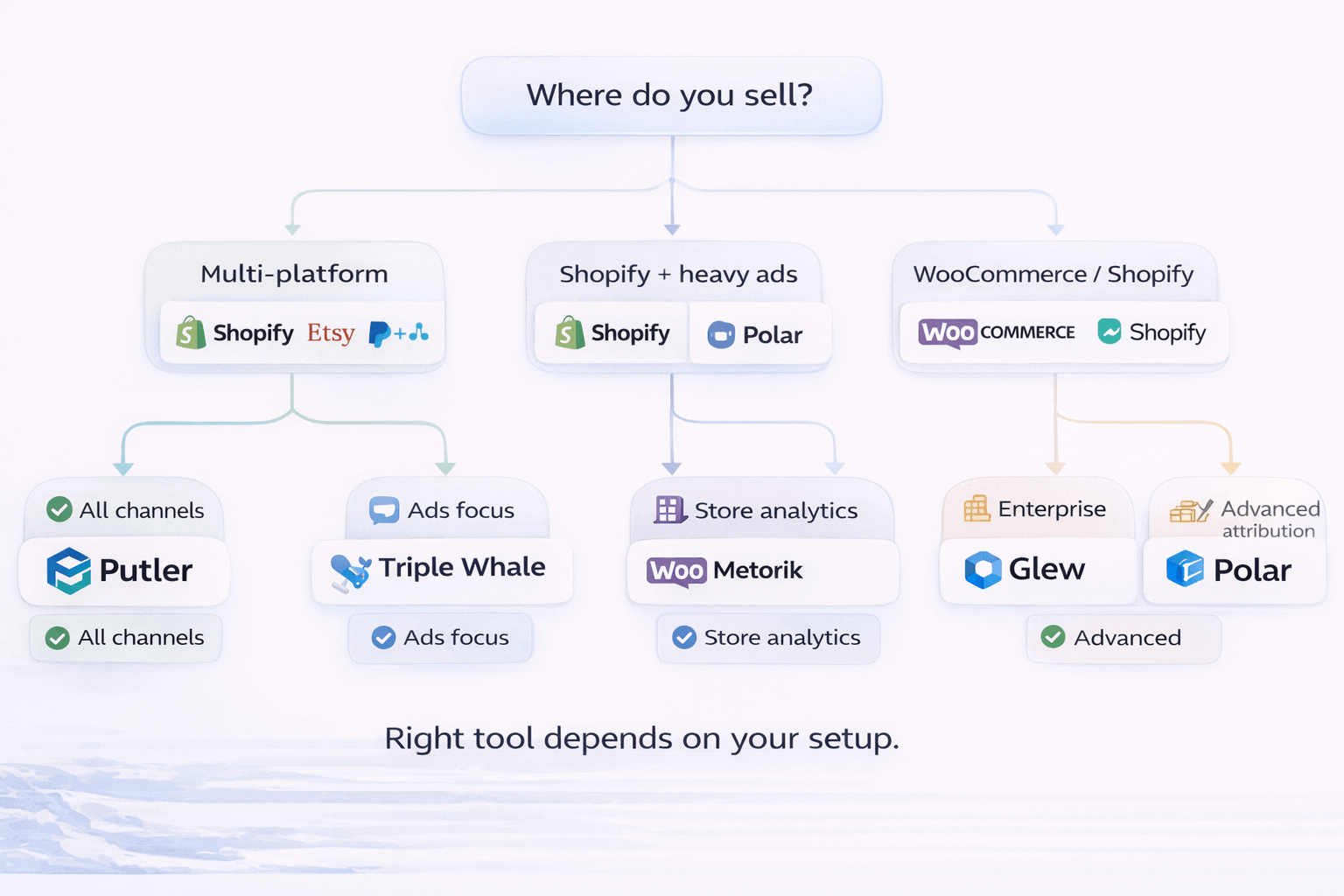
The right tool depends on four things: which platforms you actually sell on, your revenue stage, your technical comfort level, and the specific problem you most need to solve.
Start with your platform mix. A tool that can’t connect to your selling platforms isn’t an analytics tool for you. It’s just another silo.
| If you sell on… | Best Databox alternative |
|---|---|
| Multiple platforms including Etsy, eBay, PayPal, Stripe | Putler |
| Shopify only with heavy paid ads | Triple Whale |
| Shopify, WooCommerce, BigCommerce at scale | Glew |
| WooCommerce or Shopify with no marketplaces | Metorik |
| Shopify only with $3M+ GMV and significant ad spend | Polar Analytics |
Match the tool to your revenue stage.
| Revenue stage | Recommended tool | Starting cost |
|---|---|---|
| Under $50K/month | Putler | $20–$100/month |
| $50K–$200K/month | Putler or Metorik | $100–$300/month |
| $200K–$1M/month | Glew or Putler | $199–$500/month |
| $1M+/month | Glew or Polar Analytics | $600+/month |
Identify your primary problem.
| Primary problem | Best fit |
|---|---|
| Revenue double-counting across gateways and platforms | Putler |
| Marketing attribution for paid ads on Shopify | Triple Whale or Polar Analytics |
| Deep WooCommerce reporting with email automation | Metorik |
| Multi-brand omnichannel data consolidation | Glew |
| Advanced incrementality testing and AI attribution | Polar Analytics |
Find the right Databox alternative for your ecommerce store
Databox works well for what it was built for. Marketing agencies tracking campaign KPIs across HubSpot, Google Ads, and GA4 will find it useful.
The five Databox alternatives in this list were built with ecommerce in mind. Each solves a specific problem better than Databox does. Most ecommerce businesses already have the data they need.
The real challenge is bringing fragmented revenue, customer, and product data into one reliable view. The right analytics platform helps you stop guessing and start understanding what’s actually driving growth.
FAQ
What is the best Databox alternative?
For multi-platform ecommerce sellers, Putler is the best Databox alternative because it consolidates and deduplicates revenue across Shopify, Amazon, Etsy, PayPal, and Stripe in one dashboard, starting at $20/month. Shopify-only brands focused on ad attribution may prefer Triple Whale or Polar Analytics, and WooCommerce stores often choose Metorik.
Is Databox good for ecommerce?
Databox works well for KPI dashboards and marketing reporting, but many ecommerce sellers outgrow it once they need cross-platform revenue analytics, deduplication, or marketplace reporting. It displays each platform’s data as-is, with no reconciliation across sources.
Which Databox alternative is best for Shopify?
For Shopify-only brands focused on attribution, Triple Whale and Polar Analytics are strong options. For broader ecommerce analytics across multiple platforms, Putler is more flexible because it also connects marketplaces and payment gateways.
Is there a free or cheap Databox alternative?
Triple Whale offers a free Founders Dash plan, and Putler starts at $20/month with a 14-day free trial and no credit card required. Metorik begins at $25/month with a 30-day free trial. These are more affordable entry points than Databox’s $159/month starting plan.
What is the best analytics tool for Etsy and Amazon sellers?
Most analytics tools focus heavily on Shopify and don’t support marketplaces. Putler is one of the few that connects Etsy, Amazon, and eBay alongside PayPal, Stripe, and WooCommerce, with automatic deduplication so the same sale isn’t counted twice across channels.
Can Databox combine Shopify and PayPal revenue accurately?
Databox can display data from both platforms, but it treats each as separate and does not deduplicate, so sellers may need to manually reconcile duplicate transactions across payment gateways and storefronts. Putler handles this automatically.
- eCommerce Data Consolidation: How Putler Connects and Cleans Data from 17+ Sources
- Glew Review: Features, Pricing and Alternatives
- Metrilo Review: Features, Pricing and Alternatives
- Best Plausible Alternatives for Your Website Analytics
- Plausible Analytics: A Complete Review
- Matomo Analytics: A Complete Review